


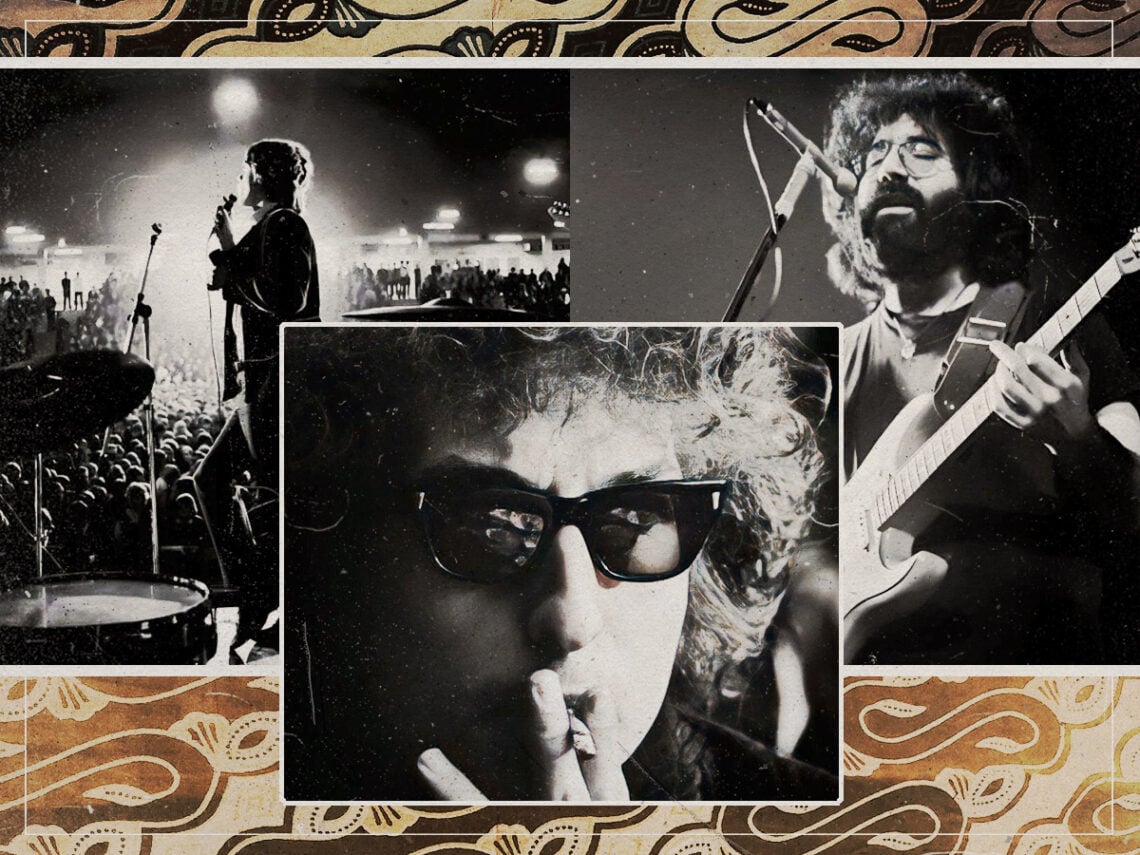
Bob Dylan compares the live shows of the Grateful Dead and The Rolling Stones

In 1987, Bob Dylan went on tour with the Grateful Dead. In its own weird way, it made perfect sense. Not only were the Dead among his favourite bands, and Jerry Garcia was a close buddy, but both acts seemed to tap into a notion of American freedom. They built their artistry on this core tenet of clinging to a Dream, whether lamenting its loss or striving to somehow protect it, there is an inherent sense of meaning to their work.
This made Dylan a proverbial Deadhead. “He was that great, much more than a superb musician, with an uncanny ear and dexterity,” Dylan wrote in his obituary for Garcia in Rolling Stone. “He’s the very spirit personified of whatever is Muddy River country at its core and screams up into the spheres. He really had no equal.”
And Dylan really meant that ”no equal” remark in every way. In the past, Dylan might’ve referred to The Rolling Stones as the greatest rock band, but that’s only because he doesn’t consider the Grateful Dead in the same category. The folk troubadour made that perfectly clear in his new book, The Philosophy of Modern Song, in which he wrote: “The Grateful Dead are not your usual rock and roll band. They’re essentially a dance band.“
As it happens, the precursor to the Dead, Mother McCree’s Uptown Jug Champions, were quite literally a dance band. The jug style of music that they showcased went back to travelling shows of the South, where barn dances were a culmination of the night, embracing an open stage ethos. The band never lost sight of this as they entered a traditional rock ‘n’ roll setting. With the help of Owsley Stanley’s wall of sound, they successfully transmuted the jug celebration to stadiums all over the world, creating more of a community of followers than any other band.
For Dylan, this is heavily linked to the essence of their music. He continues: ”They have more in common with Artie Shaw and Bebop than they do with The Byrds or The Stones. Whirling dervish dancers are as much a part of their music as anything else. There is a big difference in the types of women that you see from the stage when you are with The Stones compared to the Dead.”
Explaining: ”With The Stones, it’s like being at a porno convention. With the Dead, it’s more like the women you see by the river in the movie O Brother, Where Art Thou?”.
This rather more dream-like affair is exactly what Garcia always looked to create: a little world of 1960s utopia with its roots reaching to the dream of freedom that first birthed America. While The Stones provide a visceral thrill, their music is more rigidly rock ‘n’ roll, lacking the amorphous flow of The Grateful Dead. While Keith Richards saw this as getting to the point and called his counterparts “boring shit”, Dylan could never play live with The Stones. His appearance alongside the band in France ended with the ‘Blowin’ in the Wind’ singer walking off stage mid-song and flipping Richards the finger after he refused to improvise when Dylan delayed his delivery.
That’s the antithesis of the Dead’s footloose shows and, according to Dylan, the women who populate them. ”Free floating, snaky and slithering like in a typical daydream,” Dylan describes them. ”Thousands of them. With most bands the audience participates like in a spectator sport. They just stand there and watch. They keep a distance. With the Dead, the audience is part of the band-they might as well be on the stage.”
It’s for this reason that the great man describes them as one of the greatest live bands of all time. Having shared the stage with them countless times, not to mention all the other greats he has performed alongside, that is quite the glowing testimony.

Never Miss A Tale
The Far Out Bob Dylan Newsletter
All the latest stories about Bob Dylan from the independent voice of culture.
Straight to your inbox.