


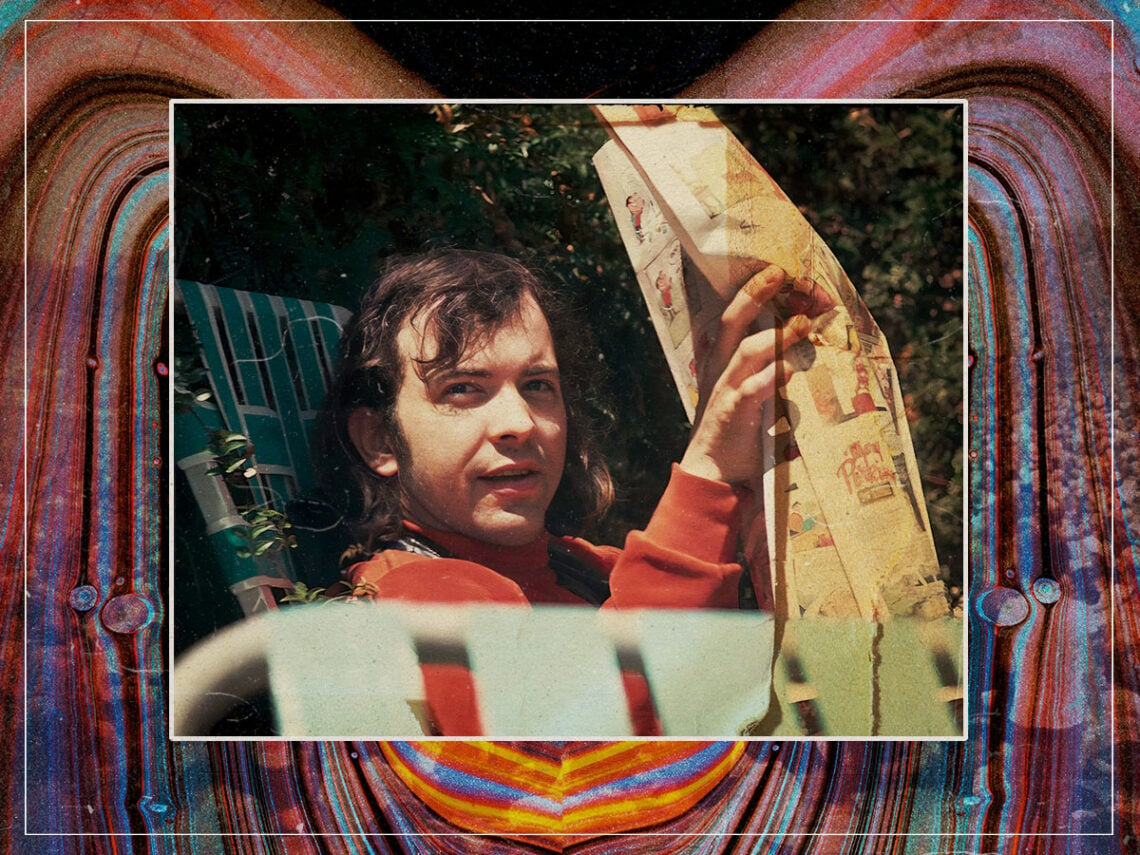
Augustus Owsley Stanley III: How the LSD king invented the modern stadium show

It’s probable that without the man responsible for an estimated five million heady trips, there would be no Sphere currently blighting the skyline of Las Vegas.
Kings and Queens have always been shapers of society; King Tut shaped the Egyptian tourist industry, King Henry VIII worked wonders for the turtleneck trade, and The Acid King, Augustus Owsley Stanley III, defined the counterculture movement. Anyone from a long line of Augustus-es is bound to have some bearing on society, but in the tumbling dominos of culture, the third fellow in this long line of Kentuckian politicos presented a pivotal moment of diegesis that changed the course of pop culture.
He was the West’s wayward rock ‘n’ Walter White, but perhaps his greatest experiment was with sound. Beyond the tie-dye hue he cast upon a nation, spreading from the Bay Area to beyond, he also greatly impacted the modern concert. The notion first came to him while standing in a field being graced by the music of the Grateful Dead and embracing the party put on by a coterie of mad hippies in a psychedelic bus called The Merry Pranksters.
These tripping folks would pull up at various spots around the country and have picnics. Therein, Kool-Aid containing acid was served up, and the spun-out folks in attendance would take in a band bashing out rock ‘n’ roll. Their journey was a vehicle for the counterculture movement, and the main band absorbed in the gatherings was the Grateful Dead. Stanley III met the Dead at one of these picnics and told them he knew just as much about sound engineering as he did about acid—he was immediately inducted into their ranks.
Given the nature of these picnics, Owsley wanted the sound of the band to engulf and drown the audience. So, he got to work on racking up a mega stack of PA systems, all aligned for maximum fidelity and no-holds-barred embalming. At the same time, the band that first pushed him towards the explosion, The Beatles, who he heard exactly one week after dropping his first mind-altering tab in 1964, were playing to the biggest roaring crowds the world had ever seen. And they were failing.
Recently, the multiple Grammy-award-winning producer Steve Lillywhite touched upon these failing shows, postulating that Queen were “more relevant today than The Beatles are.” His argument was that “The Beatles never made anything you could play in a stadium.”
“So Queen, when you talk about the greatest bands ever – I would never say anyone is greater than The Beatles – but there’s an argument right now that Queen, because of their ability to transcend stadiums, there’s an argument that they are more relevant today than The Beatles are,” he told Warren Huart’s Produce Like A Pro podcast.
However, the point he missed is the path that Owsley paved for others to follow that The Beatles sadly missed out on. Fans of the Fab Four would argue that from mid-1964 onward, the band almost exclusively played either stadiums or large auditoriums in an era whereby the sound quality of large-scale amplification made this a rarity. This huge leap allowed others to follow in their footsteps and changed the nature of music thereafter. In essence, The Beatles floundered in screaming stadia so that Queen could blast the proverbial roof off of Wembley, and this was all thanks to Owsley.
In David Byrne’s book, How Music Works, the Talking Heads man makes the pertinent point that there is a symbiotic relationship between venues, technology and music, each adapting to a change in impetus from one prong of the triumvirate. If a band gets big enough to attract a stadium-size audience, but they have to stop because they literally can’t hear themselves over the crowd, then soon enough, PA system technology will improve, and that, in turn, will lead to a change in musicology as bands experiment with bigger sounds.
As Byrne wrote: “In a sense, the space, the platform, and the software ‘makes’ the art, the music, or whatever. After something succeeds, more venues of a similar size and shape are built to accommodate more production of the same. After a while, the form of the work that predominates in these spaces is taken for granted— of course, we mainly hear symphonies in symphony halls.”
This has been true since time immemorial. The grandest buildings in any ancient city are often cathedrals. These hallowed spaces were also literally hollowed because this meant that when a choir began pelting out their hymns, the echoing boom would induce godly awe. However, in open spaces where music was largely played outdoors, such as West Africa, you’ll find that the sounds were much more percussive because this was what carried over the terrain.
This was the problem that Owsley confronted when he was faced with presenting the godly awe of the Grateful Dead over great open expanses. He finally cracked this in 1973 by creating ‘The Wall of Sound’. It was the largest concert sound system ever. And it meant that acts could now be as expansive as they liked if they were willing to follow his unique arrangement of around 600 interrogated speakers and vacuum tube amplifiers.
His spun-out mind had dreamt up an invention that shifted one of the prongs in Byrne’s triumvirate, and now we are reeling from the results as concert venues grow ever grander almost to accommodate his wall of sound as much as anything else. Oh, and of course, the commercial potentials, which Owsley never really cared for himself.
