


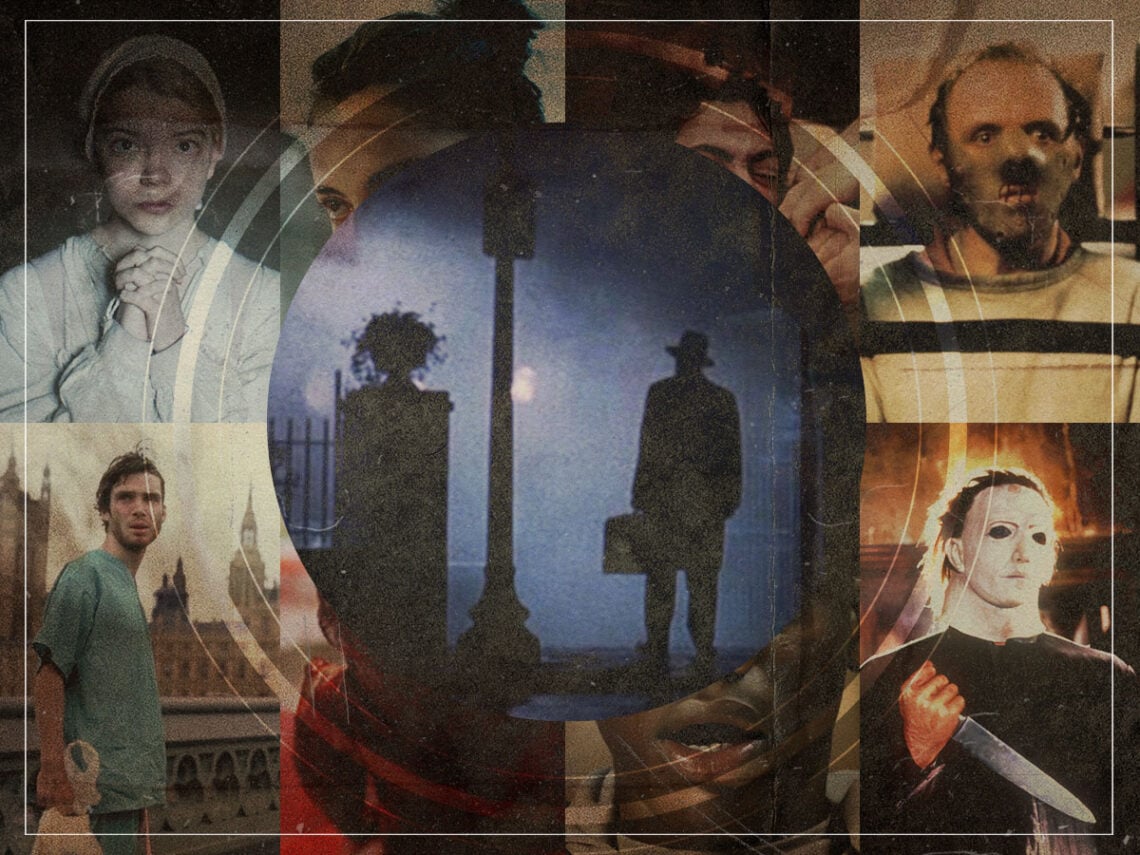
A complete collection of the best horror movies ever made

Finding the right horror movie to watch when looking for a fright is always an arduous task. That’s not because the cupboards of that particular genre are bare but because they overflow so intently that they are almost guaranteed to leave a bloody mess on the floor. If you’ve lost your mind while trying to break the algorithmic chokehold your favourite streaming service has on you, then this collection of the greatest horror movies ever made may well be of interest.
It should be a reminder to us all that horror has existed way before the genre sub-categories started appearing on our screens. The notion of scaring one another for the sake of entertainment is an idea that can be traced back to our earliest moments as a society. Exploring the inner workings of our fragile, fleshy minds to the inexplicable fears of the wider universe, horror is a genre ingrained within the subconscious of the human psyche.
Unlike many of our most based emotions, though, horror and the idea of being scared have transcended the grey matter inside our skulls and moved into the spectral space of Hollywood. Ever since finding a home in the glorious hills of Tinseltown, the genre has grown and morphed into an unstoppable monster.
It means that as the appetite for blood-spilling fun continues to grow inside our deepest desires like an unwanted demon, the Hollywood machine is more than happy to pump into a brand-new collection of terrifying movies every single year. While this might be a joy for those partially entranced by the glowing eyes of the genre, it can make picking a terrifying movie to watch a little tricky. Thankfully, if you’re looking for Japanese horror, 1980s slashers or science’s favourite horror flicks, there’s something for everyone here.
The best horror movies of all time:
The 50 best horror movies ever made
Picking the greatest horror movies ever made is always a difficult task. Trying to summarise an entire genre into just 50 titles is nigh-on impossible. But it is also the kind of task that horror lovers the world over enjoy commencing. Charting 50 pictures from across the world of cinema, from contemporary cinema to its very dawn in the 1920s, discussing early filmmaking pioneers like FW Murnau to modern greats like Jennifer Kent, this list is an exploration of the finest screams ever committed to the silver screen.
Imagine you were strapped to a torture device with the worst villain imaginable looming over you, ready to enjoy your slow demise. If you only had 50 movies worth of attention left in you and a penchant for horror, then this is the only list you would need.
- Black Sunday (Mario Bava, 1960)
- The Witch (Robert Eggers, 2015)
- Repulsion (Roman Polanski, 1965)
- The Devils (Ken Russell, 1971)
- Hereditary (Ari Aster, 2018)
- Let the Right One In (Tomas Alfredson, 2008)
- Raw (Julia Ducournau, 2016)
- Come and See (Elem Klimov, 1985)
- Dawn of the Dead (George A. Romero, 1978)
- Les Diaboliques (Henri-Georges Clouzot, 1955)
- Salò, or the 120 Days of Sodom (Pier Paolo Pasolini, 1975)
- Evil Dead II (Sam Raimi, 1987)
- Kwaidan (Masaki Kobayashi, 1964)
- Martyrs (Pascal Laugier, 2008)
- Pulse (Kiyoshi Kurosawa, 2001)
- The Silence of the Lambs (Jonathan Demme, 1991)
- The Descent (Neil Marshall, 2005)
- REC (Jaume Balagueró and Paco Plaza, 2007)
- Videodrome (David Cronenberg, 1983)
- Hellraiser (Clive Barker, 1987)
- The Omen (Richard Donner, 1976)
- A Nightmare on Elm Street (Wes Craven, 1984)
- The Fly (David Cronenberg, 1986)
- Peeping Tom (Michael Powell, 1960)
- 28 Days Later (Danny Boyle, 2002)
- An American Werewolf in London (John Landis, 1981)
- Invasion of the Body Snatchers (Phillip Kaufman, 1978)
- The Cabinet of Dr. Caligari (Robert Wiene, 1920)
- Scream (Wes Craven, 1996)
- Nosferatu (F. W. Murnau, 1922)
- Ringu (Hideo Nakata, 1998)
- Get Out (Jordan Peele, 2017)
- The Innocents (Jack Clayton, 1961)
- Possession (Andrzej Żuławski, 1981)
- The Thing (John Carpenter, 1982)
- Carrie (Brian De Palma, 1976)
- Audition (Takashi Miike, 1999)
- Alien (Ridley Scott, 1979)
- Jaws (Steven Spielberg, 1975)
- Eyes Without a Face (Georges Franju, 1960)
- Don’t Look Now (Nicolas Roeg, 1973)
- Suspiria (Dario Argento, 1977)
- Night of the Living Dead (George Romero, 1968)
- The Exorcist (William Friedkin, 1973)
- Rosemary’s Baby (Roman Polanski, 1968)
- The Shining (Stanley Kubrick, 1980)
- Halloween (John Carpenter, 1978)
- The Wicker Man (Robin Hardy, 1973)
- Psycho (Alfred Hitchcock, 1960)
- The Texas Chainsaw Massacre (Tobe Hooper, 1974)
The scariest movies ever made, according to science
For the most part, modern filmmakers claim that they have demystified the genre to a science, which is evident from the formulaic regurgitations that surface every year while masquerading as horror. However, a group of researchers actually sat down to figure out which of these modern films actually terrifies the audience.
Broadband Choices set up a ‘Science of Scare‘ project, which shortlisted films from recommendations on public forums on the internet and the general public in order to study their effects on viewers. The movies selected are not only what they believe to be the scariest but also the titles they have scientifically proven to have the most terrifying effect on their chosen subjects. It’s a list of movies guaranteed to send you behind the couch and squealing for it all to stop.
- Host (Rob Savage, 2020)
- Sinister (Scott Derrickson, 2012)
- Insidious (James Wan, 2010)
- The Conjuring (James Wan, 2013)
- Hereditary (Ari Aster, 2018)
- Terrified (Demián Rugna, 2017)
- It Follows (David Robert Mitchell, 2014)
- A Quiet Place II (John Krasinski, 2020)
- Paranormal Activity (Oren Peli, 2007)
- The Conjuring II (James Wan, 2016)
10 obscure horror movies you have to see before you die
Sometimes, the classics of genre loom so large that the shadow they cast over the smaller, independent movies leaves them entirely in the dark. As a genre with clearly defined borders and endless narrative possibilities, horror has long-attracted filmmakers looking to make the most of low-budget movie efforts, making for a significantly congested genre.
While many of these films merely try to capitalise on the disturbing appetites of young teenagers eager for horror, no matter the lack of quality, many others celebrate the genre with ingenious ways of finding terror in the most unique places. If you are looking for ten obscure horror movies you absolutely need to see, then we have you covered.
- Grave Encounters (Colin Minihan, Stuart Ortiz, The Vicious Brothers, 2011)
- Audition (Takashi Miike, 2001)
- Pulse (Kiyoshi Kurosawa, 2001)
- Lake Mungo (Joel Anderson, 2008)
- Noroi: The Curse (Kōji Shiraishi, 2005)
- Deathdream (Bob Clark, 1974)
- Under the Shadow (Babak Anvari, 2016)
- The Borderlands (Elliot Goldner, 2013)
- Alice, Sweet Alice (Alfred Sole, 1976)
- Possession (Andrzej Żuławski, 1981)
The most essential slasher movies ever made
What exactly sparked the obsession with brutal slasher horror villains in the 1980s? It’s hard to tell, but since its inception, the idea of a blade-wielding psychopath has entranced horror lovers. It has since become a repeatable and enjoyable setting for some of the scariest—most realistic—horror.
The emergence of this horror subgenre brought a new set of rules for the genre to follow. Convention took hold, and production companies latched onto the newfound craze, churning out movie after movie. It may feel like overkill, but the subgenre has become as comforting as a cold blade by your throat.
- Psycho (Alfred Hitchcock, 1960)
- Black Christmas (Bob Clark, 1974)
- Halloween (John Carpenter, 1978)
- A Nightmare on Elm Street (Wes Craven, 1984)
- Scream (Wes Craven, 1996)
- Hush (Mike Flanagan, 2016)
The 10 best science-fiction horror movies
It’s easy to see how science fiction and horror go hand in hand. Forgetting the fact that soft, slithering tentacles attached to a grotesque human-eating monster is the kind of horror candy that lovers of the genre chow down on every morning. But, as humans, we are inherently scared of the future and what it might hold, meaning a sense of dread is usually already present in the work of sci-fi filmmakers.
Without the need to adhere to the laws of physics, science-fiction horror movies can explore truly dark concepts, exploring daunting existential questions that we can’t help but ponder. It turns out that it is very difficult to remove humanity from a monster movie, and these movies do a great job of marrying two genres destined to always make us question society at large.
- Frankenstein (James Whale, 1931)
- Annihilation (Alex Garland, 2018)
- Re-Animator (Stuart Gordon, 1985)
- Videodrome (David Cronenberg, 1983)
- 28 Days Later (Danny Boyle, 2002)
- Invasion of the Body Snatchers (Philip Kaufman, 1978)
- Under the Skin (Jonathan Glazer, 2013)
- The Fly (David Cronenberg, 1986)
- The Thing (John Carpenter, 1982)
- Alien (Ridley Scott, 1979)
10 horror movies that will make you laugh
“Like comedy, horror has an ability to provoke thought and further the conversation on real social issues in a very powerful way,” said Jordan Peele of the unique intersection of fear and laughter. Combining the two genres isn’t only a great relief for those in the middle of a horror movie marathon, but the fusion is one of the most enjoyable genre-hybrids you are likely to come across.
Horror comedies have been a consistent genre hybrid throughout the history of cinema, from Mel Brooks’ Young Frankenstein to This is the End, starring Evan Goldberg and Seth Rogen. They break down the boundary that the bloodthirsty genre often puts up against general audiences. To satisfy both sides of your emotional requirements, fulfil yourself with these ten classic horror comedies.
- Behind the Mask: The Rise of Leslie Vernon (Scott Glosserman, 2006)
- Cabin in the Woods (Drew Goddard, 2012)
- What We Do In The Shadows (Jemaine Clement, Taika Waititi, 2014)
- Little Shop of Horrors (Frank Oz, 1986)
- In Fabric (Peter Strickland, 2018)
- Hausu (Nobuhiko Obayashi, 1977)
- Braindead (Peter Jackson, 1992)
- Evil Dead 2 (Sam Raimi, 1987)
- Shaun of the Dead (Edgar Wright, 2004)
- An American Werewolf in London (John Landis, 1981)
The most glamorous horror movies ever made
Horror doesn’t have to be hokey. The very nature of escapist cinema lends itself perfectly to the notion of Hollywood glamour, and while they may seem like separate entries on the cinematic colour wheel, beauty and horror nestle together perfectly.
Glamorous horrors especially have carved out their own cult fanbase. Mixing horror storytelling with a total dedication to stunning visuals, sometimes beauty can be the scariest thing of all. Leaning into the sins of lust, pride and gluttony, enchanting horror films cash in on excess with vast landscapes, striking colours, evil elegancy and beautiful brutality. Seasoned pro or scaredy-cat, these ten flicks are guaranteed to have you making sure you look just right before being slain.
- Carrie (Brian De Palma, 1976)
- Suspiria (Dario Argento, 1977)
- Midsommar (Ari Aster, 2019)
- Raw (Julia Ducournau, 2016)
- The Love Witch (Anna Biller, 2016)
- Bram Stoker’s Dracula (Francis Ford Coppola, 1992)
- The Hunger (Tony Scott, 1983)
- The Craft (Andrew Fleming, 1996)
- The Wicker Man (Robin Hardy, 1973)
- The Neon Demon (Nicolas Winding Refn, 2016)
The best French horror movies ever made
It may not be the first place you go to when thinking of classic horror movies, but French cinema has rarely been indebted to anything but its own style, and this makes for a truly surreal and uncomfortable set of horrors to watch.
French horror, like many European ventures into the genre, is riddled with visceral terror, digging deep into ingrained psychological fears to expose a fleshy, vulnerable core. Seeking inspiration from a range of eclectic sources, from the violence of the Grand Guignol to the experimental wonder of Salvador Dalí and Pier Paolo Pasolini, French horror cinema has helped to establish several sub-genres we now appreciate as cornerstones of horror. It makes for one of the most uniquely placed sub-genres in our list.
- Calvaire (Fabrice Du Welz, 1929)
- The Tenant (Roman Polanski, 1976)
- Amer (Hélène Cattet, Bruno Forzani, 2009)
- Inside (Alexandre Bustillo, Julien Maury, 2007)
- Climax (Gaspar Noé, 2018)
- Martyrs (Pascal Laugier, 2008)
- Les Diaboliques (Henri-Georges Clouzot, 1955)
- Raw (Julia Ducournau, 2016)
- Possession (Andrzej Żuławski, 1981)
- Eyes Without a Face (Georges Franju, 1960)
The best Spanish horror movies ever made
Modern Spanish horror films have attracted larger audiences worldwide in recent years. However, Spanish horror’s origins extend further into the last century, with some criminally neglected masterpieces embedded in its legacy. Although it hasn’t received the same amount of attention as its European counterparts, Spanish horror has contributed to the genre’s evolution in innumerable ways.
Featuring charming cinematic surrealism and original interpretations of the horror genre, the country’s horror cinema provides a perfect introduction to the unique sensibilities of Spanish artists. Which, if you’re from the sun-soaked country or simply an admirer of it, means that the collection of its best horror movies not only highlights a little of their creativity but the very essence of the culture too.
- The Awful Dr. Orloff (Jesús Franco, 1962)
- Tombs of the Blind Dead (Amando de Ossorio, 1972)
- The Cannibal Man (Eloy de la Iglesia, 1972)
- Who Can Kill a Child? (Narciso Ibáñez Serrador, 1976)
- Pieces (Juan Piquer Simón, 1982)
- The Day of the Beast (Álex de la Iglesia, 1995)
- Thesis (Alejandro Amenábar, 1996)
- The Devil’s Backbone (Guillermo del Toro, 2001)
- REC (Jaume Balagueró and Paco Plaza, 2007)
- The Skin I Live In (Pedro Almodóvar, 2011)
The best Japanese horror movies ever made
Over the course of the last century, Japanese horror films have gone through various phases of evolution, but all of them have been equally remarkable. Due to the horrors evoked by the aftermath of the Second World War, many artists in Japan responded to the crisis by facilitating the manifestation of their fears through the cinematic medium, which resulted in several masterfully sociopolitically charged horror investigations.
From ghost stories to the monster genre, Japanese horror films have been a constant source of inspiration for almost all contemporary works. Here, we have a collection of the very best the country has ever produced. They range from the weirdest to the most wonderful, decapitating every genre in between.
- Gojira (Ishirô Honda, 1954)
- Jigoku (Nobuo Nakagawa, 1960)
- Kwaidan (Masaki Kobayashi, 1964)
- Onibaba (Kaneto Shindô, 1964)
- The Face of Another (Hiroshi Teshigahara, 1966)
- Belladonna of Sadness (Eiichi Yamamoto, 1973)
- House (Nobuhiko Ôbayashi, 1977)
- 964 Pinocchio (Shozin Fukui, 1991)
- Cure (Kiyoshi Kurosawa, 1997)
- Audition (Takashi Miike, 1999)
The best horror movies from the 1960s
When horror fans discuss the best decade for the genre, the 1970s and 1980s are frequently mentioned due to their fostering of classics like The Texas Chainsaw Massacre, Halloween and Friday the 13th. However, these movies wouldn’t have been possible without the influence of horror films from the 1960s.
During the early days of cinema, horror began to flourish, but when Hollywood censorship prevented filmmakers from depicting explicit violence or anything remotely, the genre’s progression slowed down. As a result, many of the greatest horror movies made during this transitional period, when censorship was in the process of being eased but still active, were independent or foreign-made. This means our list is uniquely creative and expertly crafted with passion.
- Psycho (Alfred Hitchcock, 1960)
- Peeping Tom (Michael Powell, 1960)
- Rosemary’s Baby (Roman Polanski, 1968)
- Eyes Without A Face (Georges Franju, 1960)
- Carnival of Souls (Herk Harvey, 1962)
- Night of the Living Dead (George A. Romero, 1968)
- Onibaba (Kaneto Shindō, 1964)
- Kwaidan (Masaki Kobayashi, 1964)
- Spider Baby (Jack Hill, 1967)
- Black Sunday (Mario Bava, 1960)
The best horror movies from the 1970s
In the 1970s, the horror movie category kicked into gear, with several films being released that revolutionised and popularised the genre. Somewhat departing from the gothic roots of horror established in previous decades, filmmakers of the 1970s began to douse their horror works with more psychological and social considerations.
In addition, 1970s horror directors slowly began to abandon the studio sets and sterile production methods that had made a production company like Hammer Films a household name. Instead, they shot on location, lending new horror movies an air of grit and authenticity. This meant that the fear they instilled in an audience became more real and palpable.
- The Abominable Dr. Phibes (Robert Fuest, 1971)
- The Omen (Richard Donner, 1976)
- The Exorcist (William Friedkin, 1973)
- Alien (Ridley Scott, 1979)
- The Texas Chainsaw Massacre (Tobe Hooper, 1974)
- Halloween (John Carpenter, 1978)
- The Wicker Man (Robin Hardy, 1973)
- Suspiria (Dario Argento, 1977)
- Salo, or the 120 Days of Sodom (Pier Paolo Pasolini, 1975)
- Black Christmas (Bob Clark, 1974)
The best horror movies from the 1980s
It’s hard not to see the start of the horror fascination in the blood-spilling frenzy of the 1980s. Though the previous decade may have sown the seeds of what we now know of the genre, it was the 1980s that it really came to fruition. ‘Seize the video nasties’ and ‘we must protect our children now!’ were just two of the headlines that fueled video nasties’ moral panic throughout the 1980s. Blaming contemporary horror films for abhorrent real-life crimes became the port of call for many years, as films such as Child’s Play, A Nightmare on Elm Street and Friday the 13th were widely vilified.
Ignited by the likes of John Carpenter’s Halloween and Tobe Hooper’s Texas Chainsaw Massacre, released in the previous decade, the 1980s became a slasher horror paradise, where blood, guts, gore and cliches splattered the walls of the cinema auditorium. Here, we have ten of the best from the decade.
- Hellraiser (Clive Barker, 1987)
- A Nightmare on Elm Street (Wes Craven, 1984)
- Evil Dead II (Sam Raimi, 1987)
- The Changeling (Peter Medak, 1980)
- The Fly (David Cronenberg, 1986)
- An American Werewolf in London (John Landis, 1981)
- Videodrome (David Cronenberg, 1983)
- The Thing (John Carpenter, 1982)
- Possession (Andrzej Żuławski, 1981)
- The Shining (Stanley Kubrick, 1980)
The best horror movies from the 1990s
It’s hard to argue with a true horror head about which decade had the greatest scary movies. The truth is, there are so many classics in each one that it becomes very difficult to pick and choose. But, looking at this list, it’s tough not to see some of the greats and think that the 1990s may have just pipped it.
Predictably, just like the erratic styles and sensibilities of the 1990s, horror filmmaking during the decade reflected a similar eccentricity, rewriting the rules of ‘80s horror whilst looking onwards at the terrors of the 21st century. This led to a landscape of ‘90s horror that was hard to truly pin down, caught in flux between the slasher traditions of old and a strive to modernise the genre.
Phantoms of a slasher tradition that had since long gone, these icons of horror no longer felt welcome in the genre, becoming burdens to the genre they once helped to thrive. Instead, ‘90s horror preferred revolution, be it turning a mirror on its own dirty slasher deeds. It makes for a truly inspired list to delve into.
- Candyman (Bernard Rose, 1992)
- Misery (Rob Reiner, 1990)
- Jacob’s Ladder (Adrian Lyne, 1990)
- Henry: Portrait of a Serial Killer (John McNaughton, 1986)
- Cure (Kiyoshi Kurosawa, 1997)
- Braindead (Peter Jackson, 1992)
- The Blair Witch Project (Daniel Myrick and Eduardo Sánchez, 1990)
- Silence of the Lambs (Jonathan Demme, 1991)
- Scream (Wes Craven, 1996)
- Ringu (Hideo Nakata, 1998)
The best horror movies of the 21st century
Horror movies, so naturally placed in the past, got a face lift with the turn of the century. The subjects became less fantastical and became more and more cemented in the terrifying nature of modernity itself. Though found footage now became the format du jour, another more obvious change in how cinema was created meant reality could meet fantasy in the most gruesome of ways.
New technologies saw a horror ascension, giving many outside the studio system the chance to create and explore the genre without the need for large budgets and effects. Despite this, the bizarre cinematic zeitgeist of the new millennium was for gore in extremity. James Wan’s Saw franchise rolled out seven films across the decade, while the short-lived Hostel, inspired by new wave French extremity, was also proving popular.
Horror, as a genre, had to wade through quagmires of found-footage junk in the early 2000s and supernatural Insidious lookalikes of post-2010, it has continued to innovate and inspire behind the scenes. Horror movies of late seem to be an amalgamation of different tones and styles, with each new great shining new light on horror’s darkest corners.
- The Borderlands (Elliot Goldner, 2013)
- Slither (James Gunn, 2006)
- Dark Water (Hideo Nakata, 2002)
- Midsommar (Ari Aster, 2019)
- Martyrs (Pascal Laugier, 2008)
- Climax (Gaspar Noé, 2018)
- Kill List (Ben Wheatley, 2011)
- Raw (Julia Ducournau, 2016)
- Under the Shadow (Babak Anvari, 2016)
- A Girl Walks Home Alone at Night (Ana Lily Amirpour, 2014)
- Pulse (Kairo) (Kiyoshi Kurosawa, 2001)
- The Babadook (Jennifer Kent, 2014)
- The Witch (Robert Eggers, 2015)
- The Descent (Neil Marshall, 2005)
- Get Out (Jordan Peele, 2017)
- Hereditary (Ari Aster, 2018)
- 28 Days Later (Danny Boyle, 2002)
- Let the Right One In (Tomas Alfredson, 2008)
- Audition (Takashi Miike, 2001)
- Rec (Jaume Balagueró, Paco Plaza, 2007)
