


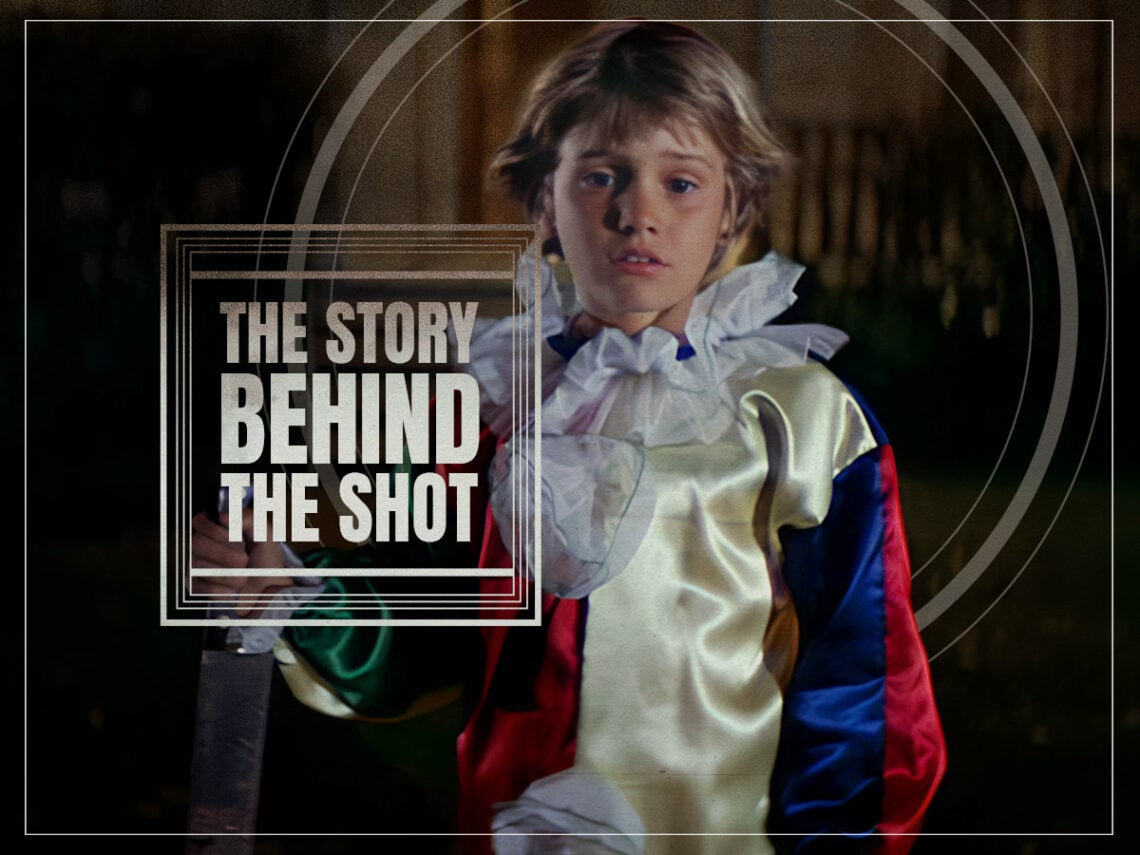
The Story Behind The Shot: the terrifying opening tracking shot of John Carpenter’s ‘Halloween’

From the second the opening credits of John Carpenter’s Halloween start, the audience is immediately unsettled. As his iconic score begins to make its way under the skin of every viewer, the camera slowly zooms in on a pumpkin set against a black background, the candle inside it making the crudely carved eyes and mouth glow eerily. After two agonising minutes, a title card flashes on-screen: Haddonfield, Illinois. Halloween night, 1963. The audience is then plunged straight into one of the most iconic sequences in horror history – the terrifying opening tracking shot, which puts the viewer into the POV of a masked killer.
The story behind this seminal piece of filmmaking is just as interesting as the end result. Halloween was an extremely low-budget film, even by the standards of 1970s horror. Carpenter had $325,000 to work with, the equivalent of roughly $1.5million today. To put that into context, Blumhouse – which prides itself on making highly profitable horror movies on tight budgets – tends to keep its costs below $5m for most of its films. This would have put Carpenter’s Halloween on the low end of already low-budget filmmaking today.
Carpenter had a vested interest in Halloween, though. His young directing career began in 1974 with Dark Star, a sci-fi comedy he had expanded from a student film to feature-length. He then made the moody action thriller Assault on Precinct 13, which was released in 1976. It brought him to the attention of Halloween producer Irwin Yablans and financier Moustapha Akkad, who wanted to make a picture about an insane killer who stalked babysitters. Carpenter agreed to do it, but under the proviso that he would have full creative control. To facilitate this, he agreed to a basement-level salary of $10,000 for writing, directing, and scoring the film – but he also negotiated 10% of the film’s profits to offset his low salary.
This meant Carpenter had skin in the game and much to gain if Halloween was a success, creatively and financially. He knew the film would be his calling card in the industry and was therefore determined to make it look like it cost a hell of a lot more than $325,000 to make. One way of achieving this was to mount an opening sequence that would have been ambitious even for a much larger-scale production.
This opening shot—an unbroken four-minute take from the point of view of a mysterious killer—starts outside a house, enters through the back door, moves through several rooms, goes up and down the stairs, and finally exits into the front garden—was a logistical nightmare for the cast and crew.

Carpenter believed it was integral to establishing that Halloween was aiming higher than usual horror fare, though, so he insisted that they crack it. Because he knew it would be the most complicated and time-consuming sequence, he scheduled it for the final day of the 20-day shoot. In the meantime, he and his cinematographer Dean Cundey did some experiments with a fairly new piece of camera equipment known as the Panaglide.
For this sequence to work, Carpenter knew the camera would need to move through the house as smoothly as possible, almost like it was gliding. He knew the budget for Halloween wouldn’t extend to a dolly track, so the shot would need to be captured by a cameraman wearing a stabilising rig as he walked through the house. The Steadicam was used on most productions that wanted a similar effect, but that piece of equipment was also too rich for Halloween’s blood.
When Carpenter and Cundey discovered a system known as Panaglide, though, they knew it was what they were looking for. Manufactured by Panavision, it cost $70,000 to purchase one camera – a huge chunk of the budget – but Carpenter knew it would be worth its weight in gold. At that time, Panaglide was so new that only three productions before Halloween had used it – the first being Terrence Malick’s Days of Heaven.
On the final night of the shoot, camera operator Ray Stella hoisted the heavy camera rig onto his person and entered the house. While he moved through the space, crew members scurried around, moving lights in and out of position as they tried to make sure the right parts of the house were visible on camera. You see, the house had been dilapidated before the shoot, and the production design team had only partially decorated it to look like a functional home. Second assistant director Krishna Rao revealed that crew members jumped out windows and hung off balconies in their desperate attempts to remain unseen by the wandering eye of the Panaglide.
Ultimately, the sequence took 16 hours to achieve, and three camera operators had to pitch in. Why? Because the equipment was so heavy that no one could be strapped into it for longer than a minute at a time. When the sun finally rose in the morning, cinema history was in the can, and the exhausted crew could finally rest. First assistant director Rick Wallace joked in a 2021 interview, “I’m convinced that if it were still night, we’d still be shooting.”
The shot was insanely complicated to achieve, and it nearly killed everyone involved, but it achieved exactly what Carpenter wanted. It made Halloween look like a much more expensive, classy affair, and that undoubtedly helped it on its way to becoming one of the most successful independent films ever made. By immersing his audience in the perspective of the murderous killer, it also became a horror pioneer – the use of the “killer POV” shot would become almost synonymous with the genre in later years.
