


The Cover Uncovered: The story of Joy Division’s ‘Closer’ art work

It’s near impossible to separate the tragic lore that surrounds Joy Division’s second and final album, Closer.
As ever with rock and roll casualties, an unhelpful romanticising of mental health issues and ‘too good for this world’ caricaturing can plague the human beings caught between their own unglamorous deaths and the mythos their dedicated fanbases have dreamed up.
Ian Curtis is no exception. Taking his own life two months before its release, Joy Division’s sophomore album is all too often shrouded in a funereal epitaph that closes the band’s story, as well as a final curtain on Curtis’ short life.
The fact is, Closer is full of eerie foreshadowing. Coupled with its very title, possibly alluding to a sense of finale, the mournful post-punk soundtrack wandered throughout bottles a deep, inner turmoil. Desolate synthscapes, ruminative gothic attack, and skeletal austerity drape its arcane veil over Curtis’ lyrical introspections, a thematic canvas of existential gnaw and isolated brood far beyond his tender years of 23.
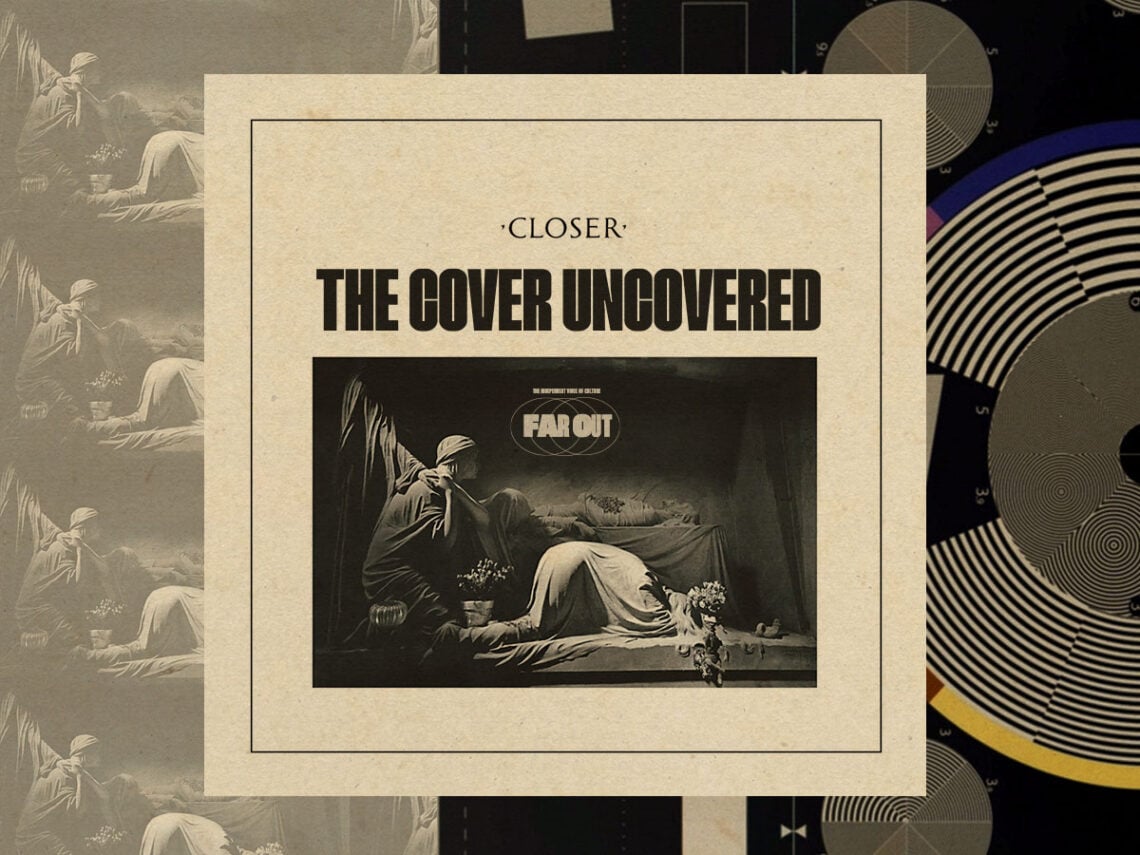
Such mortal gravitas is further illustrated by Closer’s cryptic artwork. Captured with a recondite aura, a grieving onlooker has fallen to their knees at the site of a recently deceased’s lying in state on a catafalque, an arm reached over and placed on her shoulder in comfort. Plunged in stark and monochromatic lighting, it’s easy to initially perceive the cover as a theatrical set-up of actors playing the part of an unknown funeral service from centuries past.
The shot is, in fact, a photograph taken two years earlier by French-American Bernard Pierre Wolff. One of the biggest cemeteries in Europe, the grieving depiction is a snap of the Appiani noble family’s tomb, sculpted by Demetrio Paernio in 1910. Situated in lot A37 of Italy’s Monumental Cemetery of Staglieno in Genoa, the exquisite memorial is just one of many highly artistic monuments that dot the graveyard hillside in Staglieno.
The picture had already been sourced and assembled by Factory in-house arts designer Peter Saville and Martyn Atkins, spotted in an issue of Zoom and added with a simple white border and engraved lettering, not too different from the titling of a stonemason. Panic was had, however, when Curtis’ death so late in the distribution process meant either upending the entire release schedule or keeping the artwork as is. The band chose the latter.

Released on July 18th, 1980, in the wake of Curtis’ death, Closer’s disquieting bookend to Joy Division and their troubled frontman all seemed to anchor with the haunting image, a picture of loss and lamentation that emerges with fiercer thematic presence as the record plays out, ‘The Lamentation of Christ’ in full, sorrowful clarity as Closer’s final cut, ‘Decades’, hisses and trembles into its last few echoes.
Wolff’s work would stand as a recurring theme for Joy Division, using his photo of a grieving angel on the Ribaudo family tomb in the same Genoa cemetery to adorn the 12” issue of their defining ‘Love Will Tear Us Apart’ single as the remaining members were forming their New Order band successor.
