


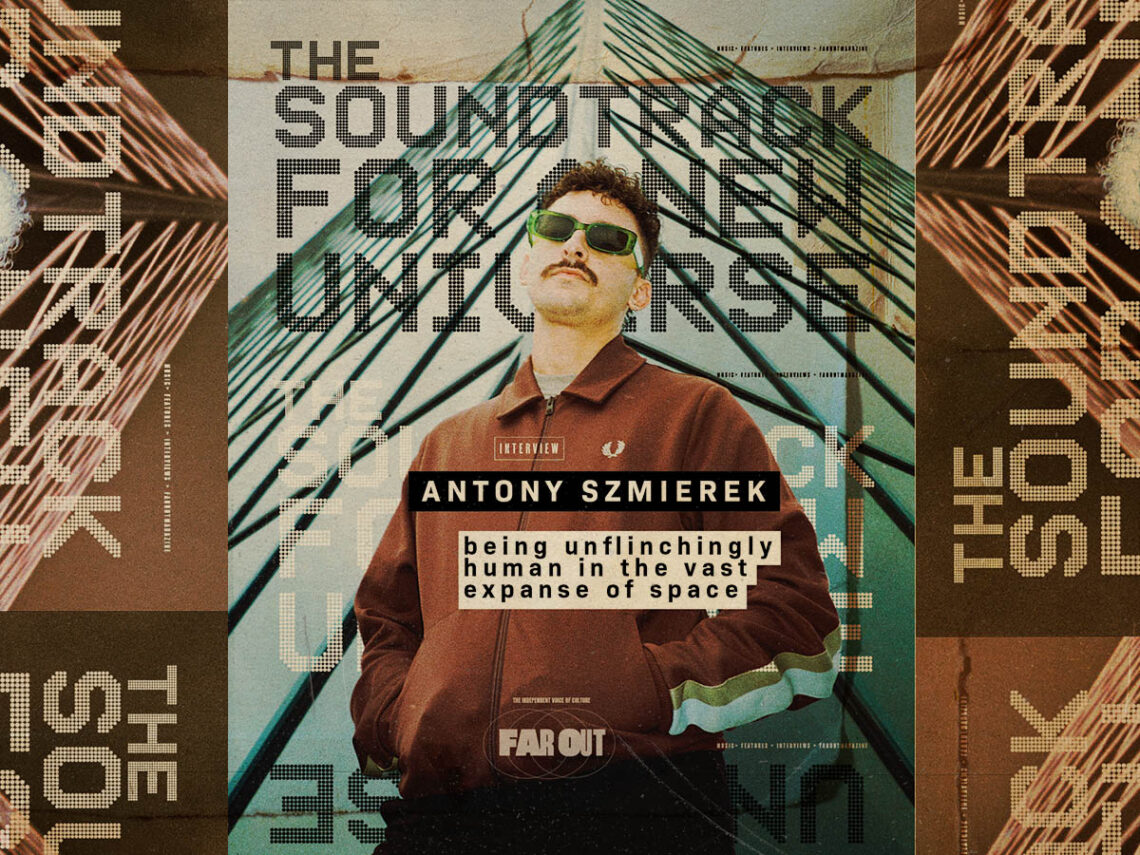
The soundtrack for a new universe: Antony Szmierek being unflinchingly human in the vast expanse of space

At what point in music history did performing apathy become cool? As we jostle for space in crowded arenas, fighting for a glimpse of our favourite musicians—hoping to lock eyes during the chorus of our own personal anthem—they often stare back through tinted sunglasses, exuding indifference rather than gratitude. And for a long time, that only added to the allure. I actually wanted my favourite musicians to be dickheads; it made their work feel more complex, right? At least, that’s what I thought—until I met Antony Szmierek.
His much-talked-about-school teacher-to-musician arc is as defiant to conventional norms as the kid who flipped him off behind his back while he was writing on the whiteboard. While sincerity should always be at the heart of every piece of music, Szmierek wears it in his everyday life, soaking the emotions of a changing nation into a sponge and squeezing them back into his personality.
And now, a week on from the release of his debut album Service Station At The End Of The Universe, the dickhead memo seems to have been lost in the post of growing fan mail, and the next big star of alternative dance music is a wide-eyed and grinning artist, looking to share the gratitude with his fans.
“They thankfully happen once or twice a day when you have a moment where you go right, okay I’d be in period five now or whatever” he tells me when I ask if the pinch-me moments have reached their expiry date.
“I’m sort of a career overthinker now. That’s kind of what my new job is. But yeah, all the time. We’re in rehearsals at the minute. Obviously, they’ve got the cans (headphones) on, and I’ll step out of it and listen to the band, and I’ll be like, how did it get this far?” he says.

In an industry just desperate to harvest troubling feelings of insecurity and promote imposter syndrome, Szmierek avoids the pitfalls by collaborating with like-minded artists. “Because we’re all hobbyists really, they’re all bedroom musicians, and it’s like none of us went to music college or uni to train or anything” he explained.
Adding, “Some of the members of the band still do have proper jobs. Tom’s got his laptop out in rehearsals because he’s doing IT management. He’s like getting into a Zoom call just as he’s playing the outro to ‘Crashing Up’.”
But don’t get it twisted. While it may sound like a sort of artistic rags-to-riches story where Antony Szmierek and his merry men cobble together an album, the reality is anything but. Weaving a complex web of tender vulnerability and social commentary, Service Station At The End Of The Universe is a glittering journey of both the nostalgic and neoteric that pushes you to share the confrontation of personal realities with Szmierek as your tour guide.
“I do kind of feel some element of wanting this to go well and showing this is available for everybody.”
Antony Szmierek
“Even if people don’t listen to it now, or they don’t listen to it for a while, and they go back to it in 10 years from now, you should be able to put it on and feel like you’re in a place,” he says. “That’s why you’re sort of like following the narrator in that you’re walking through, you’re looking at things, you’re seeing things, you fall over. It’s almost like a first-person view, so I quite like that you’re in this place. And I always imagined it as there’s these sort of magical doors in the ‘service station’.”
With Szmierek as narrator, the record ebbs and flows from the euphoric to inquisitive and the deeply compassionate. But perhaps the record’s most interesting trope isn’t its outright reliance on the lyrical nuance of Szmierek to carry it through. Instead, it’s his performance as an emotional tour guide that builds on the aforementioned and creates a sonic composition that weaves its own tale by bobbing between acid-house beats, arpeggiated synths and cutting guitar lines.
It’s a formula that shines brightest on tracks, ‘Crumbs’, ‘Crashing Up’, and ‘Angie’s Wedding’. But as someone who deeply understands narrative arcs, the former track was always going to have extra reverence, given its place as the record’s closer.
Translating the British motorway experience so vividly I could almost feel the cold of the window pressing against my forehead, Szmierek opens up the door of imagination with laser focus and brings a sense of crystallised articulation to the off-piste thoughts we all explore on long journeys of boredom.
Questioning existentialism can often verge on the corny or insincere. Once you’ve established that we are all just people subjected to the passage of time, descriptions of the meaning within those parameters can dangerously err on the side of rambling uni students during the dawn chorus of an afters. But on ‘Angie’s Wedding’ Szmierek’s ponderings are rooted in the every-day or perhaps more importantly, the emotionally accessible.

“That was my favourite song on the record when I wrote it, and it is probably still my favourite song,” he tells me. “Because it is very emblematic of British culture where it’s us reaching for things that are greater than us. It’s quite shit here. But we’re always reaching for these things that are bigger than us and better than us”.
“Even getting married is such a grand swing for me,” he says in relation to the genesis of the song. “It’s this public declaration of love, and it very rarely works out, and I just think all of that’s very British. It’s like the doers and the dreamers, it says in the song, and it’s just we do stuff that we know is not going to work out or that’s slightly over the top or is bound to fail. But we still do it for some reason. We’re always grasping at something over here. I quite like that about us.”
The earnestness with which Szmeirek writes allows him to observe the everyday: the lads on Love Island, the travelling girl on the yoga mat next to him or the soon-to-be-married Angie, allows him to comment without condescension. The doers and the dreamers he speaks of in ‘Angie’s Wedding’ are a collection of people among which he stands firmly.
Explaining, “I’ve got no delusions of grandeur where I’m like, this is this huge record or whatever. I think you’ve got to be in it to win it, and it could be, which is great. I think not coming from Brit School or not coming from Royal Northern College of Music or Leeds Conservatoire or whatever and being an actual normal person who’s had a normal job for a long time maybe doesn’t have a responsibility, but I do kind of feel some element of wanting this to go well and showing this is available for everybody.”
Ironically, the humanity of Szmierek’s work taps into something that extends far beyond the walls of a classroom: “I think it’s just sincere and honest; it’s not me trying to be anything. I think quite luckily you never know how these things are going to turn out, but it’s like this honest reflection of who I am and how I feel.”
This sentiment is proudly worn on his third single from the album campaign, ‘Yoga Teacher’. In a track that averts his observational gaze inwards, it encourages universality through masterful descriptions of the mundane before delving further into the depths of introspection, asking questions about masculinity, fatherhood, and class.
On ‘Restless Leg Syndrome’, he battles through comedown blues with razor-sharp clarity and unflinching vulnerability in a painful portrayal of the very real sense of late-night loneliness that creeps in when the laughter stops. “That’s me being the hardest on myself possible, really,” he says earnestly when I ask him about the song. He continued to explain the words “just sort of came out of nowhere and were quite upsetting weirdly, even though I’ve told them to myself before, it was quite upsetting to hear them.”
If Angie’s wedding did ever happen, it’s quite easy to picture Szmierek standing in the corner, quietly gaining an audience, holding court with charisma and sincerity. Joyful and vulnerable in equal measures, club stamps on his wrist and lipstick marks on his cheek, he sandwiches tales of self-deprecation with charming observations of the wedding party that help knit together an otherwise awkward collection of strangers.
The sort of person whose uncontrived ability to sharpen all corners of his own humanity, be it humour, joy or honesty, would then make the subsequent proposition of a late-night voyage to a service station in space sound like the right idea. Because if Antony Szmierek was taking you there, you’ll most likely feel as human as you ever have.
