


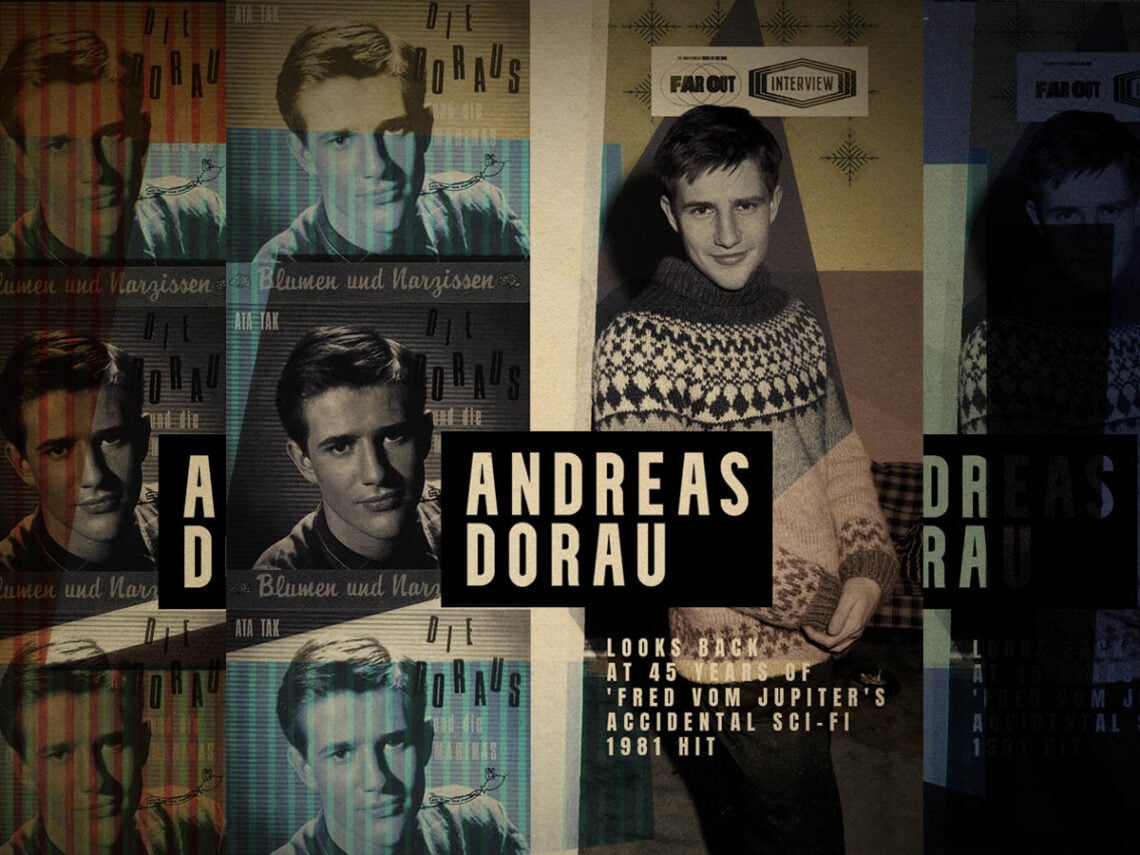
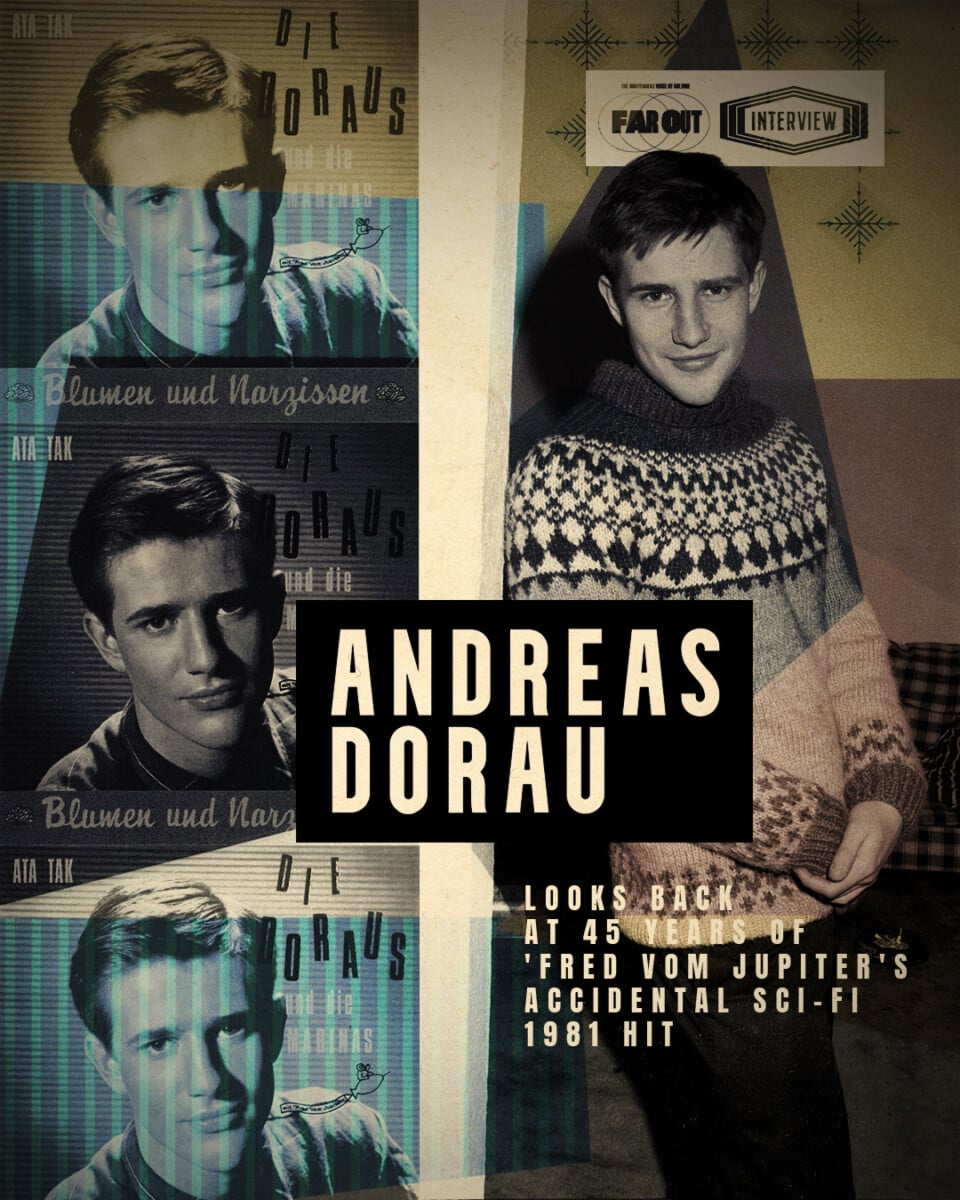
“They just let me do my thing”: Andreas Dorau looks back at 45 years of ‘Fred vom Jupiter’s accidental sci-fi 1981 hit

It was only supposed to be a throwaway school project, but a 15-year-old Andreas Dorau wound up crafting a hit single that would nearly break the German top 20 and catapult him to a minor teen pop sensation back in 1981.
It was an unlikely trajectory. The precocious Hamburg kid was enamoured with Kraftwerk and the country’s experimental Krautrock heritage over the dreaded Schlager easy-listening dross clogging the mainstream charts, a keen devourer of glam rock and Sparks’ sharp lyrical wit, as well as the cutting edge in electronic music from the UK’s The Normal, Cabaret Voltaire, and Chrome over in the San Francisco underground. Heady stuff for a kid in school.
Such a young taste for music’s fringes set a course Doraus would follow his whole career, chiefly to avoid ‘boy loves girl’ trite and dwell in Germany’s unique sense of national mirth. “I like making music which has humour inside, but which is not actually funny,” Doraus tells Far Out, a statement that makes further sense the more you sit with it, as well as perusing any of his droll music videos across the 1990s. “English humour is very different than German humour. I don’t like funny things.”
He didn’t like his peers’ taste for football and typical boyhood pursuits either. Sharing little in common with his fellow male pupils at Hamburg-Jenfeld’s Otto-Hahn-Schule, Dorau grew to be something of a restless daydreamer in class, eyeing up the music department as the one sanctuary away from the dreary 1970s Gesamtschule environment he was otherwise bored rigid in.
“I never talked to my school colleagues about my music because I didn’t like them,” Doraus reflects frankly. “I did my thing. But I had something, some kind of fantasy world where I could go through and forget the school.”
Creative but unruly, Doraus had cycled through 11 guitar teachers before reaching Holger Hiller of later Palais Schaumburg fame, who put it to him that, if he wasn’t going to actually practice the guitar, perhaps he’d like to record his own music instead. Presented with a four-track recorder, these classroom sessions would yield the eerily liturgical ‘Der Lachende Papst’ to be released later on the city’s experimental ZickZack label, then the school’s Projektunterricht assignment would sow the seeds for Dorau’s accidental stumble into the 1980s pop charts.
He had initially written the lyrics for his sugary slice of sci-fi synthpop before schoolmates Natalia Munoz Valderrama, Nicole Kahl, and Birgit Masur, three years below, who served as lead singers, insisted upon a rewrite. Doraus preferred their contributions, depicting a sprightly cosmic tale of a “very attractive and also very muscular” Jovian alien who’s stopped by Earth to refuel his spaceship, taken with all the beautiful Earthling women, and forced to flee back to Jupiter due to the jealousy of the world’s men, breaking the hearts of girls around the globe but vowing to return.
“Fred from Jupiter / Fred from Jupiter / the dream of all women, you make me weak.
Fred from Jupiter / Fred from Jupiter / stay here forever, don’t go away.”



Doraus was pleased enough with ‘Fred vom Jupiter’, eager to shop the song to his beloved Ata Tak, the label operated by Düsseldorf electronic avant-gardists Der Plan. The problem was that Herr Kreffter, the music teacher, forbade Doraus from taking off with school property, forcing a weekend rerecord with a friend at another school’s girl friends, Claudia Flohr, Michelle Milewski, Dagmar Petersen, Isabelle Spelly and Kristine Süßmilch, fulfilling vocal duties and Doraus casting himself as Fred behind layers of voice effects.
Der Plan were into it, to Doraus’ surprise. Having made a fan visit to the Ata Tak office, his school assignment was all he had at hand to present to the band founders, Moritz Reichelt and Frank Fenstermacher, unsure of the reception due to the number’s poppy flair. “The only song I had was ‘Fred vom Jupiter’, which I didn’t plan to release,” Doraus recalls.
“So I just wanted to play them something I made, and Moritz was excited and Frank as well, and they asked me to release it.”
It made sense, ZickZack having a slice of his more challenging edge, while Ata Tak could get their hands on his unwitting pop side, “But I wanted to make sure that I didn’t go more in that direction.”
Under the Die Doraus und Die Marinas moniker, “The Marinas” being his supposed backing singers, ‘Fred vom Jupiter’ would be released early 1981, backed with the ‘Auch Die Heimat Ist Nicht Mehr Schön’ B-side – a far more downbeat instrumental translating as “Even the homeland is no longer beautiful,” illustrating Fred’s wish to be back with the Earth girls – that would peak at number 21 of the German charts and afforded a further boost with its Telefunken second issue and distribution over in the UK courtesy of Mute Records. It’s sprightly synth rhythms, bedroom production, and semi-naive vocal lines propelled Doraus’ school project as one of the key hits of the Neue Deutsche Welle era, straddling both the underground and the pop mainstream.
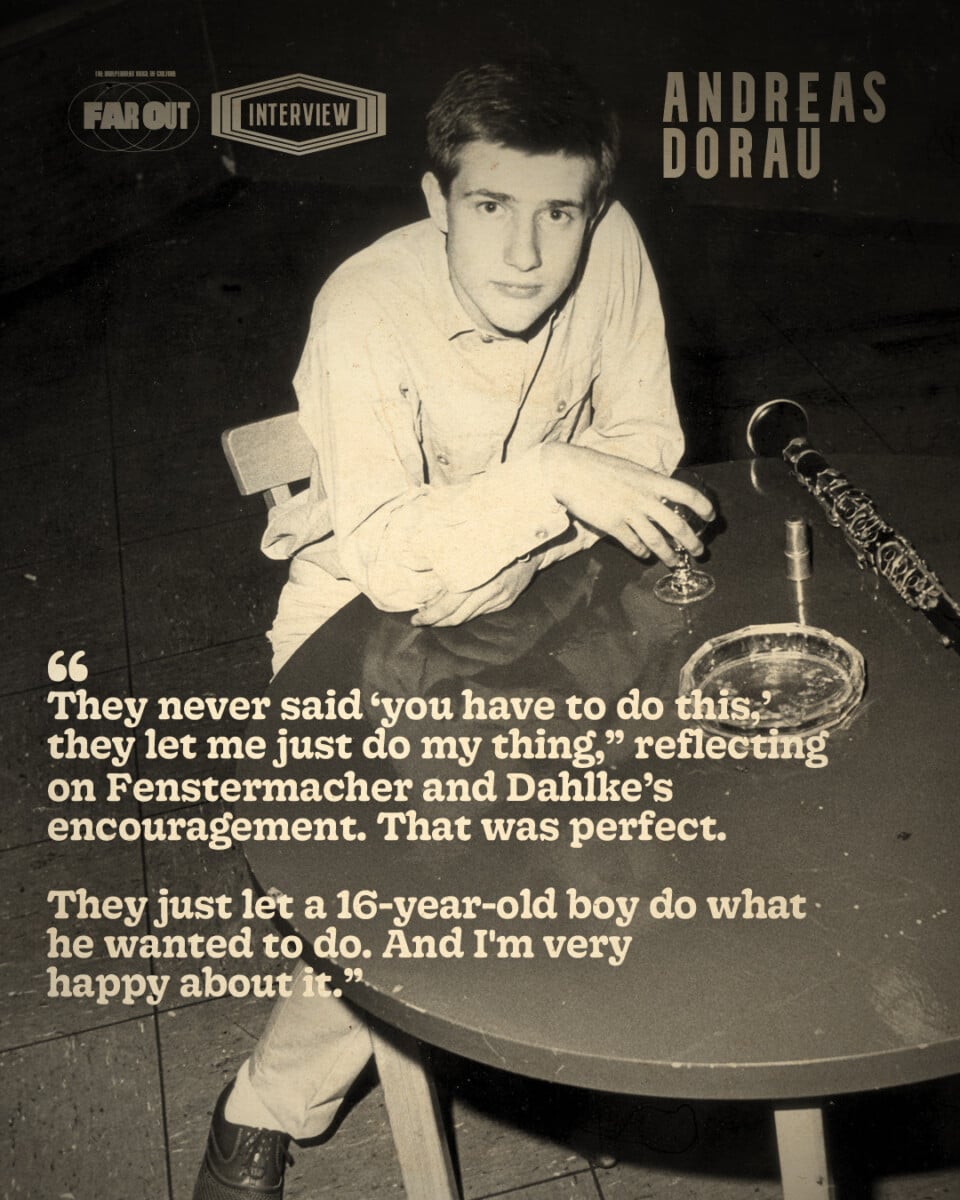
His debut LP would follow the same year, Blumen Und Narzissen, produced by Fenstermacher and Pyrolator’s Kurt Dahlke, who largely left Doraus to his devices at the Studio Lambertz-Brahm to flesh out demos written at his family home on a monophonic keyboard and worked out with his friends during the school holidays, delivering a set of songs still glittered with his big hit’s charm but expanded into more intrepid territory, from ‘Nordsee’s introspective croon to ‘Lokomotivführer’s mutant disco stomp.
“They never said ‘you have to do this,’ they let me just do my thing,” reflecting on Fenstermacher and Dahlke’s encouragement. “That was perfect. They just let a 16-year-old boy do what he wanted to do. And I’m very happy about it.”
The pop landscape was rapidly changing. Before long, the Neue Deutsche Welle that birthed the likes of DAF or Der Plan gave way to Nena’s ‘99 Luftballons’ and Trio’s ‘Da Da Da’, an association Doraus was keen to avoid. Dropped in this new commercial turn, the Die Doraus und Die Marinas Geben Offenherzige Antworten auf Brennende Fragen sophomore in 1983 would see the last time Doraus used his teen moniker, and offer another inventive pop gem, much better than the newfound stars he was dodging, as well as his own misgivings.
“I felt very uncomfortable at that time. I don’t like the record. I have a personal problem with it.”
A distaste with his accidental pop stature resulted in a brief suspension of his music career to study film and art in Munich, then easing back into a solo career in the 1990s and beyond, releasing Wien last year on Tapete Records. With 12-odd albums under his belt and an equal presence in the world of visual media, Doraus looks back on his brush with chart fame with a characteristic acquiesce, ‘Fred vom Jupiter’s opening of musical doors 45 years ago this year largely owes to Der Plan’s arm-twisting on that fateful Ata Tak visit.
“We are great fans, and I was a fan of them,” Doraus declares without fuss. “So if another person would have asked me, ‘Would you like to release it?’ I would say no because it’s the honour that they asked me to release it, so I did.”
