


Anatomy of a Scene: The exhilarating ending of ‘Beau Travail’

Some films feel as though you are in a trance, mesmerised by a mood or quality that you’re not yet able to understand, but you know that you’re witnessing something special, something truly unique. And if you’ve watched Claire Denis’ 1999 film Beau Travail, then there’s a chance that you understand the feeling I’m describing.
Beau Travail is a film made in its stillness. The subtext beneath the strength and stoicism of the soldiers in the barren desert creates a dazzling portrait of masculinity and man’s duality. The story follows a Foreign Legion officer called Galoup, who narrates the film and recalls his time training recruits at a base camp in the Gulf of Djibouti. However, the arrival of a new recruit begins to disturb his sense of self and facade of order and control, threatening the very core of his being.
Denis uses very little dialogue and, instead, uses the visual language and expressiveness of the natural landscape to convey the trappings of modern masculinity, portraying the male body as both a cage and a source of power, something that is both docile and dangerous. Each frame is meticulously planned to either highlight or obscure certain details that exaggerate the extremes of the soldier’s pent-up aggression and pursuit of intimacy. One minute, you’ll be watching men fight and tussle in the dirt, blood and sand becoming mixed together with their uniforms, and the next, you’ll witness a man cradle another man’s head as he shaves his hair, holding back laughter because his fingers feel ticklish on his skin.
The framing of these men as simultaneously fragile and menacing shows a tenderness that the soldiers are being distanced from and brutality that they are being pushed towards, forced to be defined by their physical strength and to abandon their humanity. Nothing encapsulates this more than the final scene, which shows Galoup dancing alone to Corona’s Rhythm of the Night.
Just before the final scene, we see Galoup lying alone in a hotel room, who has recently been disgraced from the army base for his altercation with Sentain. Part of the genius of Denis’ work is that we don’t know exactly why he hated Sentain. Given the nature of the film’s themes, it could either be that he is jealous of his youth and physical strength, that he is ageing and envies the power that Sentain possesses, or it could be that after years alone in the desert with no affection or true intimacy, that he is sexually attracted to the young recruit, and resents him for stirring up these uncomfortable feelings.
However, one thing is clear: in the penultimate scene, Galoup is preparing to end his life. He feigns the routine of the life that once controlled him: making his bed, folding the corners of the sheets and making sure that everything is ordered. Once he’s made his preparations, he lies down on the bed, a gun in his hand, the camera lingering on a pulsing vein on his arm as we watch him in what we believe is his final moment.
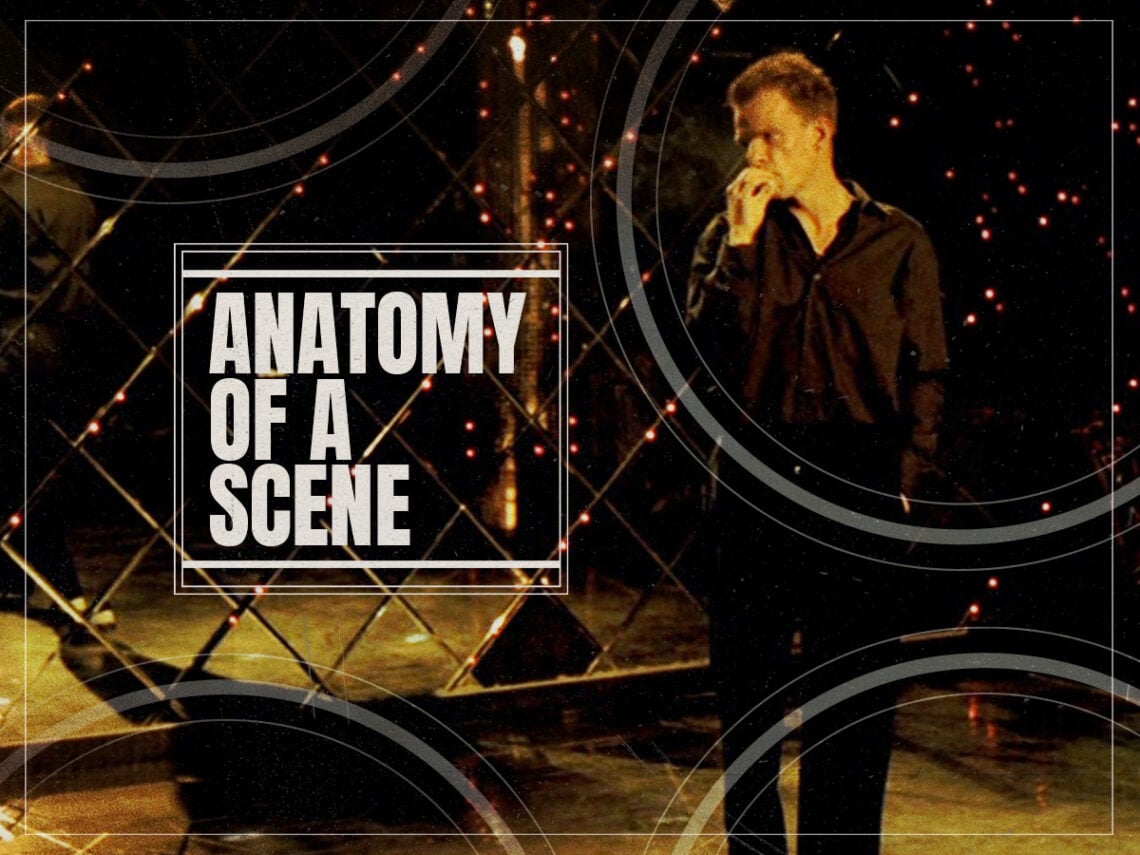
But just as we think the film is coming to a close, Denis cuts to a nightclub scene. Galoup stands at the edge of the room, bathed in pink light and surrounded by mirrors, utterly alone. After a life defined by rigid control and the facade of stoic masculinity, one final act of release becomes inevitable—the ultimate catharsis. And so, he begins to dance. At first, his movements are slow and hesitant, tinged with self-consciousness. But then, he leaps—spinning through the air, arms swirling above his head, shedding the stiffness that once kept him bound.
The surrounding mirrors, reflecting only his own image, heighten this intimate connection with himself. In this moment, he fully embodies the phrase “dance as if no one is watching” because here, he is his only audience—a fleeting yet profound moment of unbridled self-expression, free from the shackles of performative masculinity.
I’ve never watched an ending to a film that’s felt so completely necessary, so freeing and satisfying. And this is why it is a perfect scene – an escape from the facade, finally giving in to a moment of joy and expression, even if fleeting and for the very last time.
