


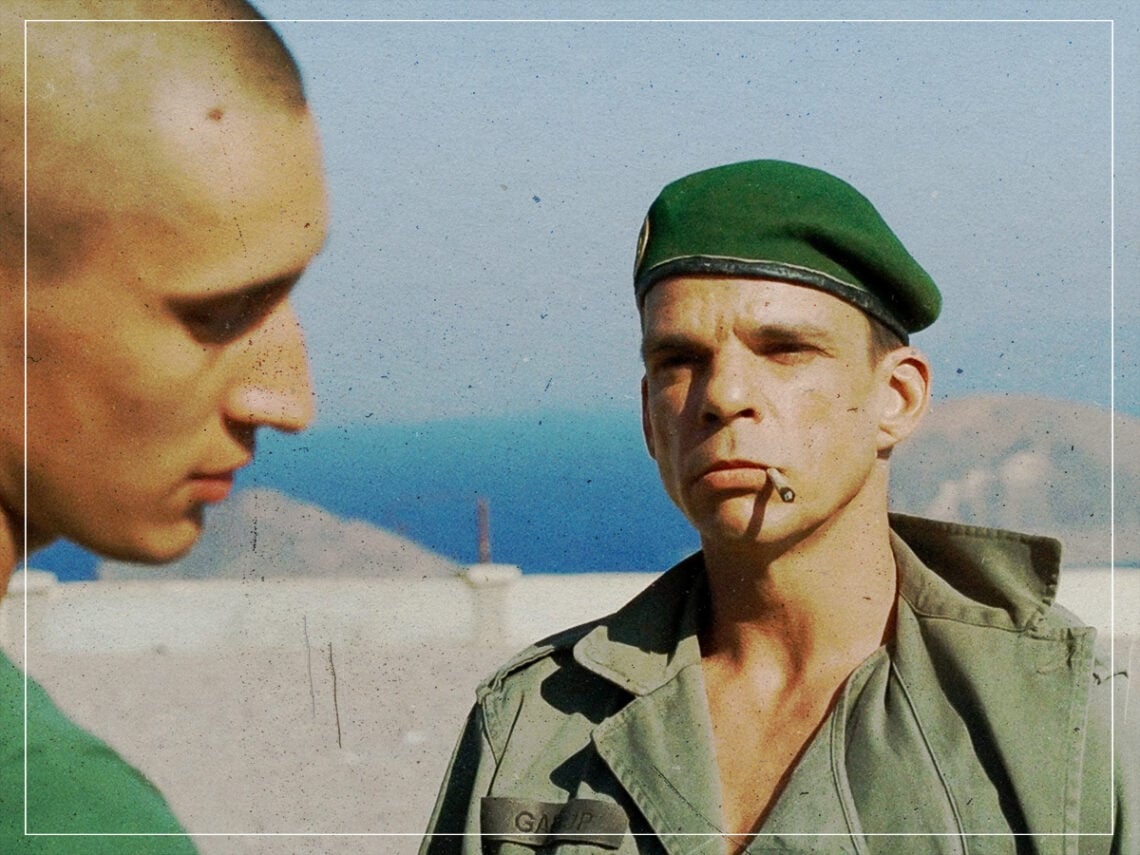
Adjudant-Chef Galoup: the jealous and vindictive French Foreign Legion leader of ‘Beau Travail’

Many great works of cinema have arrived as a result of French filmmakers. While the acclaimed directors of the French New Wave, like Jean-Luc Godard and Francois Truffaut, plus the master of the crime drama Jean-Pierre Melville, are all deserving of their respective legacies, in terms of more contemporary cinema, it’s hard to look beyond Claire Denis and her 1999 film Beau Travail.
A true masterpiece of cinema, Beau Travail is loosely based on Herman Melville’s 1988 novella Billy Budd, with Denis employing pieces of Benjamin Britten’s 1951 opera based on the text as part of the film’s soundtrack. Narratively, Beau Travail focuses on a section of the French Foreign Legion stationed in Djibouti, which serves under the command of Commandant Bruno Forestier and Adjudant-Chef Galoup.
It’s Galoup, played with striking intensity by Denis Lavant, who serves as the main point of interrogation into themes of isolation, masculinity and duty for Denis. Defined by his strict regimentation to the Foreign Legion, Galoup demands military discipline and duty, not only in the soldiers he leads as per his responsibility as a senior non-commissioned officer, but from himself as a man dedicated to the cause of the legionnaire.
As a result, Galoup lacks the kind of emotional vulnerability that might allow him to live with a remote kind of freedom or agency and his very identity is inextricably linked to the rigorous demands of military service. In that light, Galoup admires his senior, Forestier, who so too embodies the ideals of the Legion, although such a high regard of the Commandant leaves Galoup in a state of wanting his validation, yet being unable to admit to such a desire.
At the same time, the arrival of a brave and courteous recruit, Gilles Sentain, who quickly earns the respect and admiration of Forestier and his fellow legionnaires, sends Galoup into a fit of jealousy and vindictiveness. Despite his seniority, Galoup views Sentain through the lens of a rival, not only because of his likeable qualities but because Sentain possesses the kind of affability that Galoup undoubtedly lacks.
Of course, rather than being able to openly discuss his conflicted and complex emotions – bar expressing anger in his personal diary – Galoup can only set out to sabotage the young recruit, leading to both Sentain’s demise and Galoup’s final days in the Legion.
After his dismissal from the Legion, Sentain returns to Marseille, but following years of military routine and structure, he finds it hard to assimilate back into civilian life and the mess that naturally comes with an urban environment. Displaced amongst the banality of the city and far from the quiet and barren landscapes of Djibouti, Galoup wanders aimlessly amongst the buildings and harbours of Marseille, drinking quietly without a friend or foe.
It’s implied that Galoup takes his own life, as per the tattoo emblazoned across his breast: “Serve the good cause and die.” The final scene of the Beau Travail finds Galoup alone in a nightclub, perhaps in the afterlife, where his tension and discipline finally gives way to self-expression and freedom as he gloriously glides and moves across the dancefloor to the sound of Corona’s ‘The Rhythm of the Night’.
Beau Travail is a sparse and yet strikingly intense film and Denis provides a masterful account of the realities of military masculinity. Her portrait of Adjudant-Chef Galoup, captured with effortless control and poise by Denis Lavant, is one of the greatest explorations of repressed emotion in the history of cinema and Galoup’s story is a vital piece of the medium’s expression of masculine identity.
