


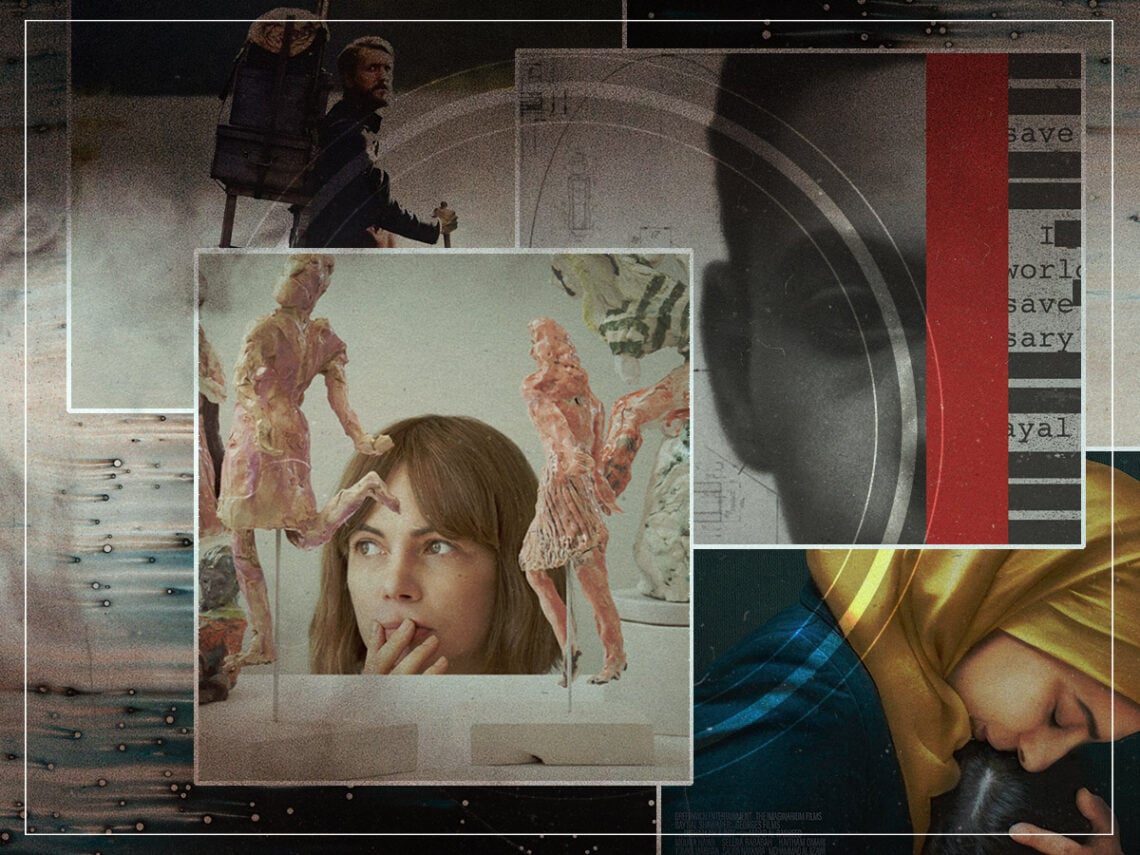
‘Under the Radar’: 2023 movies you may have missed

In a year that boasted the release of box office successes like Barbie and Oppenheimer, the new Martin Scorsese epic, and enormously popular Netflix features like Maestro, it’s easy for more minor films to get lost in the shuffle.
More obscure projects can still be well worth checking out, whether overlooked because they lack established stars in the cast, are low budget, are not actively publicised, or are from a newly emerging director. They might even be ignored because they are from a nation with a still developing national cinema dealing with unpopular subject matter.
Oddly, some works may be award-winners, Oscar nominees, and get considerable attention from critics, yet still remain unknown to a large proportion of the move-viewing public, simply because they are not screened in local cinemas, ousted by more popular thrillers, horror stories, and comic book franchise flicks. Whatever the reason, obscure, inexpensive, or unusual works can be not only entertaining but also unexpected treasures or, in some cases, can expand a cinephile’s horizons in unexpected ways.
Here are ten of the year’s noteworthy films which you might have overlooked.
2023 movies you may have missed:
A Compassionate Spy (Steve James)
Something of a supplement to the more successful Oppenheimer, Steve James’ A Compassionate Spy tells the story of Ted Hall, a physicist with the Manhattan Project, who famously leaked nuclear secrets to the Soviet Union. The detailed, well-organised documentary describes, with some sympathy, Hall’s scientific work, his growing unease with the direction American nuclear research was taking, and his decision to release data to the Soviets in hopes of staving off war and preserving a balance of power.
The movie does an excellent job of explaining the political influences on weapons development, the fears of some that a US monopoly on nuclear weapons would be disastrous, and the involvement of wealthy industrialists complicating the process. Hall’s interrogations and years of surveillance by the FBI are also dealt with, as well as his family’s life from the shock of Hiroshima through the anti-war movements of the 1960s. Interviews with Hall put a personal stamp on his actions, showing a man who, until his death, maintained the need to “compel government policies that don’t put the world at risk again.”
Banel And Adama (Ramata-Toulaye Sy)
This unique drama is a tragic, magical-realism love story between two young residents of a poor but picturesque Senegalese village. Young writer/director Ramata-Toulaye Sy produced this as her thesis for the Fémis film school in Paris. The movie deals with youthful lovers who are gradually driven apart by a combination of bad luck and local tradition, causing the young woman, Banel (Khady Mane), to rebel against established custom and resort to a form of magic to win back Adama (Mamadou Diallo).
Despite being set in present-day rural Senegal, director Sy has said, “I wanted the tale to be universal, [something that] could happen in the 1950s, in the 1800s…” and the story does seem to take place in a world of its own. The characters are believable, the drama intense, and Banel’s struggle against traditional female roles is an effective added conflict. The movie is another submission for Best International Feature Film at the 2024 Academy Awards.
Godland (Hlynur Pálmason)
In this dark, multi-layered film, a stern, devoted Danish priest is assigned to a mission in an isolated part of Iceland. Despite his zeal and determination, he finds even the journey to his post challenging, dealing with the new location and its rustic, eccentric people even more so. He begins to abandon discipline and his ideals and even lose touch with reality, his descent perfectly captured by Danish-American actor Elliott Crosset Hove.
The vistas of the Icelandic landscape are gorgeous and provide a piquant contrast to the priest’s gradual breakdown. The movie’s original title, ‘Vanskabteland’, has a different meaning than ‘Godland’ – something more like ‘cursed land’, which may be more fitting to the general tone, at least from the central character’s perspective. The film is an impressive tale of colonisation, serving as background to the disturbing story of one man’s dissolution.
Inshallah A Boy (Amjad Al Rasheed)
Director Amjad Al Rasheed’s first feature is also the very first Cannes selection from Jordan, as well as Jordan’s entry for the 2024 Oscars. The deceptively simple drama involves a recently widowed young woman, Nawal (Mouna Hawa), with one daughter. It emerges that under Jordanian law, the widow does not inherit her late husband’s property; everything goes to his relations, including the house Nawal has paid for.
Nawal can keep her home only if she gives birth to a son. Therefore, she claims to be pregnant in a desperate attempt to stave off the inevitable. The well-acted, sensitively told story is a combination of legal drama, family conflict tale, and social critique, with a few surprising plot twists.
Monster (Hirokazu Koreeda)
Acclaimed director Hirokazu Koreeda presents a complex human mystery in the guise of a school administration problem. Young mother Saori (Sakura Ando) is startled when her little boy, Minato (Soya Kurokawa), asks her whether he’s had his own brain replaced by a transplanted pig’s brain, claiming that his teacher told him this. Saori visits the school to ask about this surprising statement and visits yet again when signs of bullying and other issues appear.
The school administration’s response, placating and elaborately apologetic but firmly unhelpful, is a masterpiece of half funny, half scary bureaucratic obstruction. As still more vague hints of trouble accumulate and new information surfaces, the film expands into a tense mystery, providing as many misdirections as genuine clues, leading to answers but also a teasingly ambiguous ending.
Showing Up (Kelly Reichardt)
Director Kelly Reichardt’s particular genius is in bringing out the mystery, tragedy, or significance in ordinary lives. In Showing Up, Reichardt follows a group of artists and their complicated relationships with one another and, even more, their relationships with their art, their public, and their own talent while providing a realistic overview of the difficult life of a struggling artist. While not Reichardt’s best film, it is still well above average among the year’s cinematic output.
Michelle Williams plays Lizzy, an artist nervously preparing for a show that may boost her career, just as she is beset by a frustrating, darkly comical array of problems. Her brother, also an artist, insists his incipient mental illness is merely artistic genius; she is continually taken advantage of by her landlady Jo (Hong Chau). She somehow becomes the caretaker of an injured pigeon, which also provides an ongoing metaphor. Lizzy’s artwork is ‘played’ by the delightfully peculiar work of Oregon artist Cynthia Lahti, which provides an appropriate background for this cryptic but entertaining comedy/drama.
The Crime Is Mine (François Ozon)
This old-fashioned farce, set in the 1930s and roughly based on the 1934 French stage play ‘Mon Crime’, is a lighthearted send-up of the era, show business, and murder mysteries. When a despised French movie producer is murdered, aspiring actor Madeleine Verdier (Nadia Tereskiewicz) is accused.
Instead of fighting the charge, she engages her friend, lawyer Pauline Mauléon (Rebecca Marder), to help her use the accusation and subsequent trial as a route to notoriety and future roles. Some of the comedy falls flat, but it works as a period piece and tongue-in-cheek crime drama and features an enjoyable supporting role by Isabelle Huppert as a Bernhardt-like Parisian artist.
The Teacher’s Lounge (Ilker Çatak)
Dedicated and idealistic teacher Carla Nowak (Leonie Benesch) finds herself caught between school regulations and her earnest wish to help and protect her students in this difficult German drama from director/screenwriter Ilker Çatak. When a student is suspected of stealing petty cash from the teachers’ coffee room, Carla is determined to find the truth.
Despite her best efforts, everything she does seems to make matters worse due to a toxic combination of inflexible rules, hostile and racially biased staff, and indignant, defensive students. Carla’s frustration is almost palpable, as is the hopelessness of her attempts to ensure fairness for her students without jeopardising her own career.
Totem (Lila Avilés)
Following an impressive debut with The Chambermaid in 2018, Lila Avilés has followed up with Mexico’s Oscar submission for the year, Totem. Like Avilés’ first feature, Totem is a small-scale, highly personal human drama so realistic it often comes across as a documentary or home movie. It depicts a surprise party from the point of view of a seven-year-old girl, Sol (Naima Senties), daughter of the guest of honour, filmed in a cinema-vérité style. We learn, through vignettes that range from funny to combative, more about guests and their respective place in the family.
Eventually, the audience, and finally, little Sol, come to understand the real reason for the party and what it will mean to Sol and her future life. The camerawork is striking, making the camera a silent narrator who does not always follow whoever is speaking but pointedly brings the audience’s eye where it needs to go for explanation.
White Paradise (Guillaume Renusson)
This straightforward French drama is set in the Italian Alps during a period when police and local residents are hunting migrants and refugees. The recently widowed Samuel (Denis Ménochet) is isolating in a chalet he and his late wife shared. The grieving man is largely indifferent to the migrant problem until he discovers an Afghani woman (played by Iranian actor/producer Zar Amir Ebrahimi) hiding in his basement, having escaped the Taliban.
The film depicts the alarmed and uncertain Samuel’s eventual decision to help and follows the risky and difficult process of hiding the refugee from migrant-hunting locals and finding a way to smuggle her over the mountains to the French border.
