


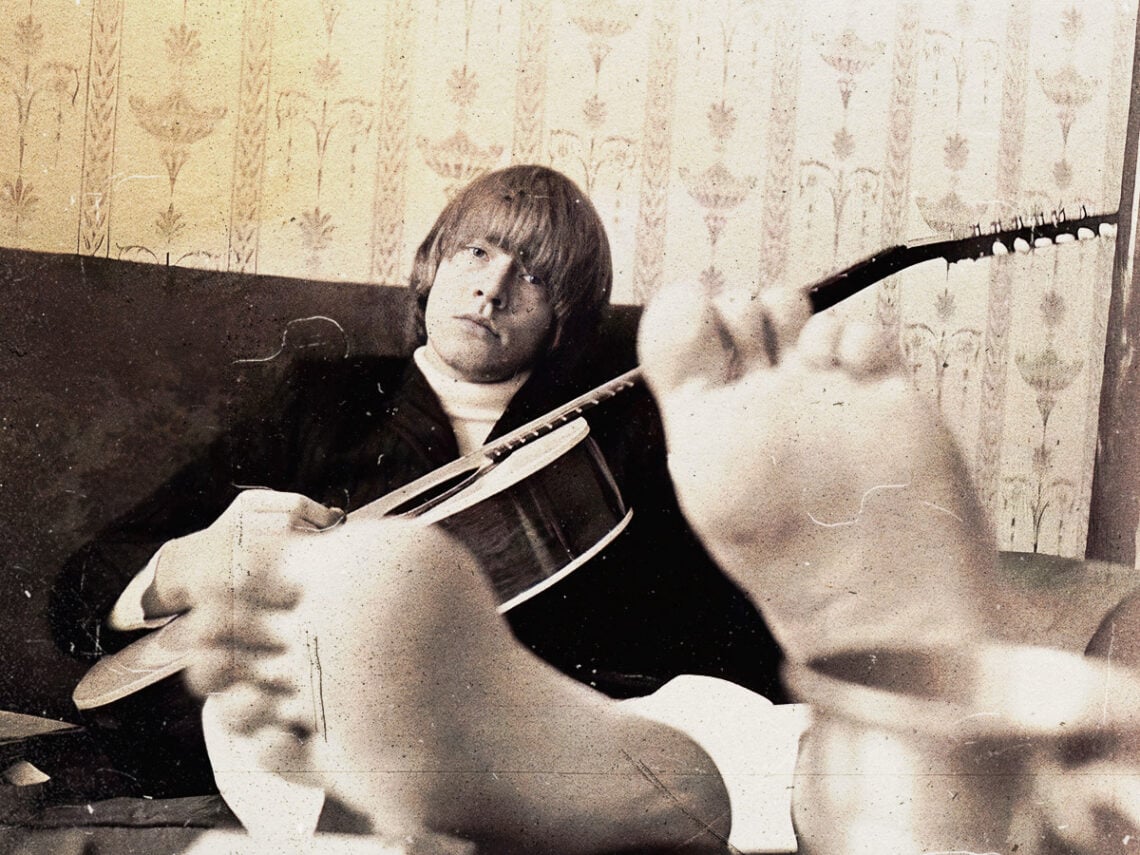
The 1968 Rolling Stones song with Brian Jones’ last contribution “of significance”

It didn’t take long for the band Brian Jones founded to eclipse his captaincy, even in Rolling Stones lore.
To the frustration of fans worldwide in 2015, Dartford station’s platform two in the UK’s Kent county erroneously marked the moment in 1961 when Keith Richards and Mick Jagger crossed paths as young men back when The Rolling Stones was ‘formed’. Dartford Borough Council agreed to an amendment of the blue plaque after the backlash, but such a blunder illustrates Jones being overshadowed.
The Stones were Jones, initially. It was Jones who put the ad for bandmates out on Jazz News, named the band, and even half-stepped up to managerial duties before Andrew Loog Oldham took the budding London group under his wing. Grumbles among the Stones had already begun at Jones’ early string-pulling, but once the Jagger-Richards songwriting partnerships brought in the hits, Jones felt his band running away from his sight.
From then on, the Stones were a different band. Moving away from his beloved pure blues, creative control was diminishing amid a difficult and erratic character who could easily alienate the room depending on his unpredictable mood. Compounded with all the drugs on offer across the counterculture and all the legal headaches meted out on the band from his police busts, the gifted slide guitarist and multi-instrumentalist soon found himself dead weight in the studio and an albatross around the group’s neck.
Despite Jones’ strain on the band, the Stones were ready to kick off their golden era once they’d shaken the psychedelia out of their system. They were more suited to the roots rock counter, all authoritative miners of Americana’s musical sediments and able to play old country twang and bluesy stroll with the best of the earlier veterans. Yet, despite veering a little closer to Jones’ comfort zone, 1968’s Beggars Banquet sessions would mark the beginning of the end for the Stones founder.
“We’d be doing, let’s say, a blues thing,” producer Jimmy Miller recalled to Rolling Stone in 1997, “He’d walk in with a sitar, which was totally irrelevant to what we were doing, and want to play it. I used to try to accommodate him. I would isolate him, put him in a booth and not record him onto any track that we really needed. And the others, particularly Mick and Keith, would often say to me, ‘Just tell him to piss off and get the hell out of here’.”
Obstinacy and unreliability would plague the sessions, but Jones still managed to contribute his own flair to the Beggars Banquet sessions. As well as helping birth the standalone ‘Jumping Jack Flash’ single from a jam with Charlie Watts and Bill Wyman, Jones’ sitar and tanpura can be heard on ‘Street Fighting Man’, a harmonica on ‘Parachute Woman’, the Mellotron on ‘Jigsaw Puzzle’, and slide guitar on ‘No Expectations’, a part Jagger once claimed was the last time Jones contributed anything “of significance” to a Stones record.


Such multi-instrumental flavours no doubt lift the album’s subtly eclectic character, but it wasn’t enough to save him. He would be fired partway through the Let It Bleed sessions in 1969, only counting credits on two of its tracks, and was found dead a month later in July after drowning in his Cotchford Farm swimming pool.
From then on, Jones would form an unfortunate emblem of countercultural casualty that shifted aside his often exotic and creative stamp on the Stones’ biggest hits, and stand as a bookend not just to a chapter of the band’s history, but a sombre close to the swinging decade itself.

Never Miss A Tale
The Far Out Classic Rock Newsletter
All the latest Classic Rock content from the independent voice of culture.
Straight to your inbox.