


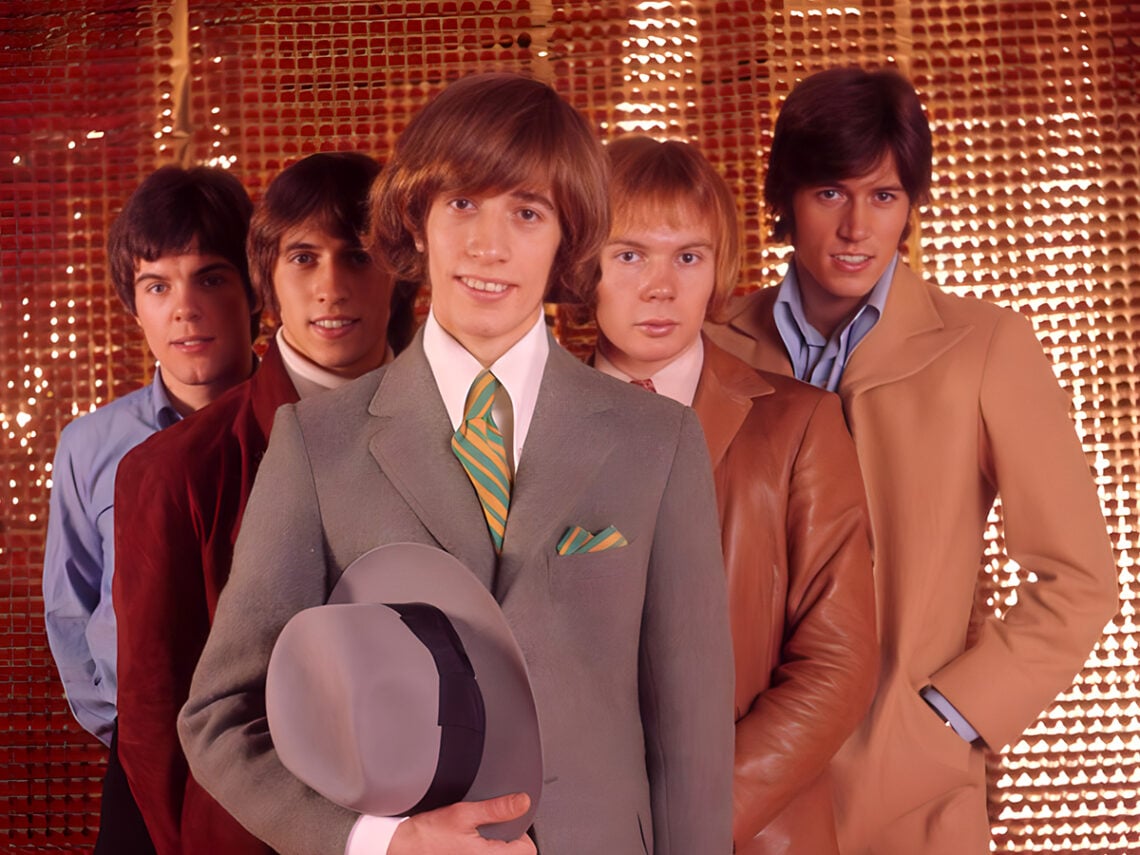
The curious way an aeroplane inspired the Bee Gees’ 1968 masterpiece: “I started to cry”

Nowadays, we have the Netflix download button to amuse us through bone-numbingly long-haul flights, or a seemingly endless array of music, but in the time of the Bee Gees, you had nothing to amuse you but your own imagination.
It was Patti Smith who once famously said that the modern psyche has lost the ability to daydream, the Horses explaining, “We need to daydream more. We need more time for thinking. Daydreaming isn’t lazy, it’s where your mind actually builds before your hands create”.
Daydreaming is the act of taking the present moment and transforming it into a different reality entirely, an ability the Bee Gees always had in bucketloads. So, where do international flight time and the wise words of Smith meet? On the 1968 Bee Gees masterpiece, ‘I Started a Joke’.
The single is melancholic for a few reasons: While the soured melodic refrain running through it is depressive to say the least, it also marked the last song featuring Vince Melouney’s guitar work, as he left the band the same month the single was released.
Despite this, the song itself is an inventive triumph, for Robin Gibb whipped up the tune after finding inspiration on board an aeroplane, recalling a few years after the release, “The melody to this one was heard aboard a British Airways Vickers Viscount about a hundred miles from Essen. It was one of those old four-engine ‘prop’ jobs that seemed to drone the passenger into a sort of hypnotic trance, only with this it was different.”
Any other mushy-brained passenger amongst the crew might’ve been lulled into oblivion from the incessant sound, but Gibb knew he might’ve struck sonic gold, adding, “The droning, after a while, appeared to take the form of a tune, which mysteriously sounded like a church choir“.
From there, he recalled, the band popped out of their seats, accosted the pilot, forced him to emergency land in the nearest village, and accompany them to a small pub, wherein they could finish the track. Bolshy as ever, Gibb followed up, “Actually, it wasn’t a village, it was the city, and it wasn’t a pub, it was a hotel, and we didn’t force the pilot to land in a field…but why ruin a perfectly good story?”

Despite the jovial context and the humorous title, the song is anything but. “I started to cry, which started the whole world laughing, Oh, if I’d only seen that the joke was on me,” Gibb sings wistfully in the second verse, an anthem perfect for the male victim, misunderstood in the harsh, unforgiving light of the patriarchy.
When Gibb’s character, caught in the never-ending skies above us, realises that his tightly-wound ego was zapping meaning from his life, the biblical aeroplane drone takes on a new character, one full of clarity, resplendence, and humility. This charmingly magnetic anti-gravity ballad sat well with audiences in Canada, New Zealand, and Australia, where the song shot to number one, remaining a beautiful reminder that inspiration can come from anywhere.
