


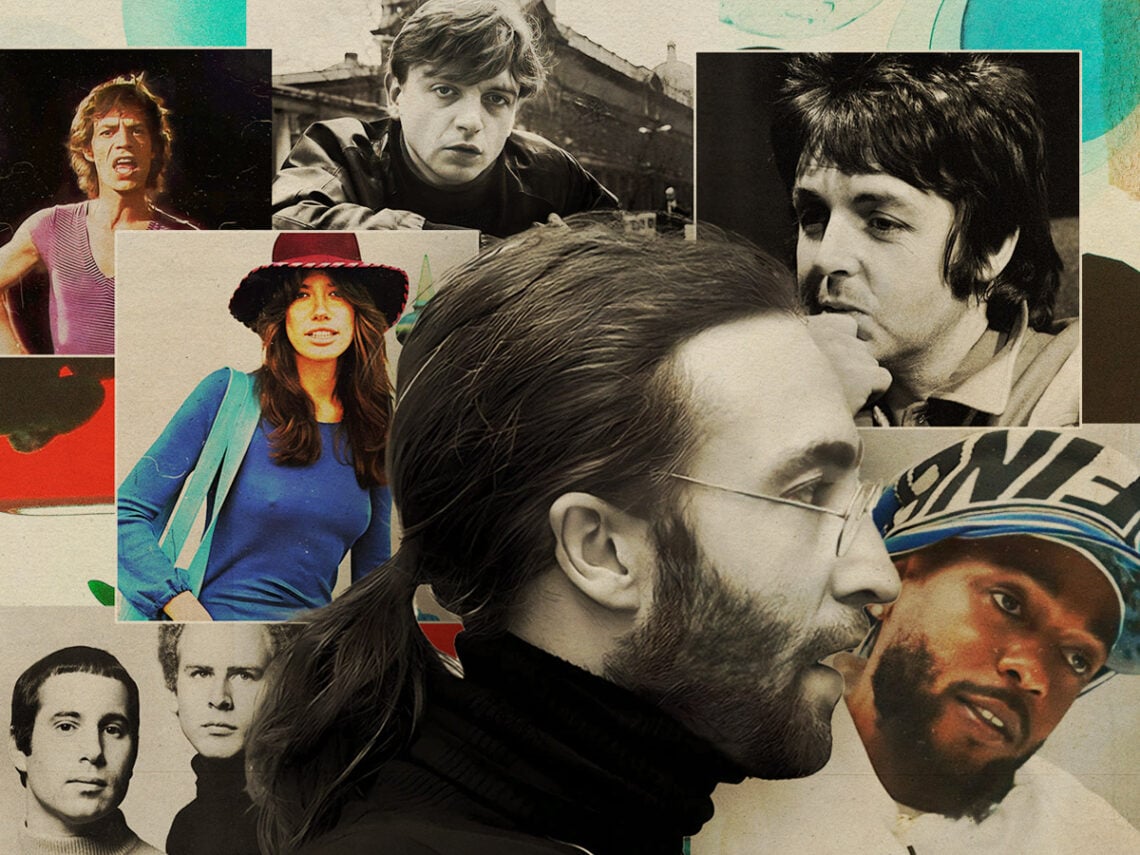
Divine Diss-tracks: 20 great songs that musicians used to mock other musicians

For all the peace, love and flower power of music, it proves to be a bouquet with a fair few thorns in the bunch. Regardless of the generation, feuds have been as ever-present in music as Fender. In fact, spats have basically become a common marketing technique.
Long before the dawn of pop culture, you had Pyotr Ilyich Tchaikovsky calling Johannes Brahms a “giftless bastard”, and before that, you probably had silent bickerings among the Benedictine choirs of old. Simply put, there is a community formed within music, and anywhere that occurs, a pinch of tension and a slug of competitiveness is bound to follow.
Whether rivalry between artists stems from healthy competition or something more personal, it always seems to surface in the candid yet covert realm of song. Over the years, countless chart-topping hits have dropped hints at behind-the-scenes bitterness. Some of these tracks seem ill-advised or childish in hindsight, but others outshine the cynicism and stand as golden moments of music at its most visceral.
Below, we have collated ten of the best of these searing songs. From the almost tongue-in-cheek parodies of Bob Dylan to the brutal and arguably justified rage of others, these tracks serve up anger at its artistic best, with a hint of rock ‘n’ roll irony to boot. But before we begin, that hint of irony is always vital, because it’s always worth remembering the golden words of Kurt Vonnegut: “There’s only one rule that I know of, babies: ‘God damn it, you’ve got to be kind’.”
20 songs used to mock other musicians:
‘Rapaz Folgado’ by Noel Rosa – The target: Wilson Batista

This samba classic from 1933 may well be the first diss-track in history. Rather than a marketing ploy as many seem to have become, it was a pivotally important one, too. At the time, there was a cultural uprising in Brazil. Malandragem culture refused to give in to the harsh capitalist forms of control that the ruling class were trying to impose. Those who heeded the lifestyle spent days at a time at samba parties.
Thankfully, Noel Rosa had no issue with that, but he did think that Wilson Batista was giving it a bad name. So, in an unprecedented first, he decided to take a swipe at Batista. It was a bold move for a poet who was certainly a little more flowery than the street-tough Batista. Fortunately, the result of his jibe was several back-and-forths between the pair that ultimately led to a samba frenzy and helped to illuminate the malandragem situation along the way.
‘You Keep Her’ by Joe Tex – The target: James Brown

Sometimes, a diss-track is a justified inevitability. When Joe Tex found out that James Brown was having an affair with his wife, it was only a matter of time before he used his platform to fire a shot. The dark ordeal played out salaciously in 1962. Pop culture was only just arising, and suddenly this proto-reality TV quirk added its latest novel edge.
“James, I got your letter, it came to me today,” Tex sings, “You said I could have my baby back, but I don’t want her that way”. In the end, everyone in the love triangle moved on and went their separate ways, unaware of the fact that they had just set the tone for the strange offshoot of music. It might not be Tex’s best, and there are a few problematic notions, but there was no turning back from the moment the US embraced the trend of artistic derision arising in Brazil.
‘Not Like Us’ by Kendrick Lamar – The target: Drake

In truth, perhaps the winner of the whole Kendrick Lamar vs Drake battle was actually Macklemore who contextualised the whole headline-grabbing beef when he sang, “I want a ceasefire, fuck a response from,” with the protest song ‘Hind’s Hill’. However, while that line may well have highlighted how facile and vapid the spat might have been, it was also a gripping diversion capable of its own notable moments.
With ‘Not Like Us’, Kendrick Lamar received a Grammy nomination for his uncompromising effort. Rather than simply throw a few offending platitudes, he emboldened a bold beat with genuine accusations and spat them out so uncomprimisingly that it made for a shuddering listen. It was an attack that held the aura of having the last word.
‘Poles Apart’ by Pink Floyd – The target: Roger Waters

The feud between Roger Waters and his ex-bandmates in Pink Floyd is perhaps the most notorious in music. If anything, Waters’ recent political positions have only escalated the matter, pushing it beyond repair. While for the most part, David Gilmour has ushered his post-break-up creativity towards more measured muses, he has occasionally visited the topic.
With ‘Poles Apart’ from the Water-less Division Bell album, Polly Samson, Gilmour’s wife, who co-wrote the song, commented, “It’s about Syd in the first verse and Roger in the second.” Needless to say, the first verse is rather more forgiving, with Gilmour reserving his ire for the track’s second chapter. He sings: “Hey you / Did you ever realise what you’d become? And did you see that it wasn’t only me you were running from?”
‘Lost Ones’ by Lauryn Hill – The target: Wyclef Jean

While Lauryn Hill hasn’t confirmed that ‘Lost Ones’ is about Wyclef Jean, the elusive star hasn’t confirmed much over the years. Nevertheless, there’s enough substance in the lyrics for Pras, who was in the Fugees with Jean and Hill, to believe that she wrote the track about with her old New Jersey partner in mind.
Their relationship was always a very tumultuous one, but the final straw was when Jean discouraged Hill from pursuing a solo career after the Fugees split, despite Hill lending her full support to his, and even featuring on his solo album, Wyclef Jean Presents the Carnival. Although she doesn’t name her target, that only imbues her effort with a sense of dignity and defiance.
‘Song 2’ by Blur – The target: Grunge

There is a bittersweet irony to ‘Song 2’ for Blur. The song is a pointed mockery of the samey sound, loud guitar and cryptic lyrics that typified grunge. In trying to subvert these traits, signified by the generic title of ‘Song 2’, they inadvertently earned their biggest hit in America, a grungy realm where Britpop struggled to get off the ground.
The track was constructed on a sweaty, hungover afternoon, and the band looked to put the world to rights. This lazy imitation was knocked up without a thought, using the grunge jigsaw sound. As Alex James said, “We didn’t think about it at all.” In fact, it nearly never made it onto the album, but in a final dose of irony, the American label loved it and implored them to find room for it.
‘Only a Fool Would Say’ by Steely Dan – The target: John Lennon

Over gentle jangling guitars, Donald Fagen renders John Lennon an artist out of touch with the common folk, living an idealist fantasy that serves as more of a holier-than-thou doctrine than a realist hand to humanity. The era was approaching the crumbling poverty of recession, but Lennon appeared as some sort of cowboy on a national talk show making proclamations that the following lyrics were quick to mock: “Our world become on/ Of salads and sun / Only a fool would say that / A boy with a plan / A natural man /Wearing a white Stetson hat”.
It was Fagen’s belief that the average person can’t simply bed-in-for-peace, and it’s merely a highfalutin example of elitism. He calmly continues: “You do his nine to five / Drag yourself home half alive / And there on the screen / A man with a dream.” All the while, the song is saved from being cynical because of its mellowed melody. It makes it seem like peace might be possible; it just has to be a bit more measured.
‘Sweet Home Alabama’ by Lynyrd Skynyrd – The target: Neil Young

When Young attacked the politics of the South with his questioning song ‘Southern Man’, a lot of folks thought it was a broad stroke. Lynyrd Skynyrd, therefore, cooked up a pointed response. As they wail out, “Well, I hope Neil Young will remember / A southern man don’t need him around anyhow.”
Nevertheless, Ronnie Van Zant and Young actually got on. In fact, Young even went on to play the song at a memorial concert. He asserts that his song was not an attack on an entire region; he just wanted to highlight the recent controversies that unfortunately unfurled in the South at the time in the hope that his platform could help tackle prejudice. Well, ‘Sweet Home Alabama’ is proof that he certainly succeeded in making people take note.
‘London Boys’ by Johnny Thunders – The target: The Sex Pistols

Back in 2019, Marky Ramone and John Lydon nearly came to blows at a Los Angeles punk panel. Marky kicked things off by saying The Sex Pistols simply stole Richard Hell’s look, and Lydon hit back, “this daft c*nt is into drugs,” and, “Look at you, you look like a heavy-metal fucking reject.”
It’s an age-old argument. Punk was certainly born in America with bands like The New York Dolls, but Lydon claimed that these CBGB bands were mere poseurs and that The Pistols added the true working-class substance. They levelled this allegation in their song, ‘New York’.
The legendary Thunders hit back, singing: “Well, you’re telling me to shut my mouth / If I wasn’t kissing, you wouldn’t be around.” Before dropping the finest diss: “You sit at home, You got a chaperone / You need an escort to take a piss / he holds your hand and he shakes your dick.”
‘Teenage Wildlife’ by David Bowie – The target: Gary Numan

David Bowie tended not to feud with too many folks. However, he really took issue with Gary Numan for some reason. Bowie felt more than anyone that Numan lacked originality and was missing the point of the revolution he was trying to spawn. Thus, in ‘Teenage Wildlife’ – one of his most underrated anthems ever – he sang: “A broken-nosed mogul are you/ One of the new-wave boys/ Same old thing in brand new drag/ Comes sweeping into view/ As ugly as a teenage millionaire/ Pretending it’s a whiz-kid world.”
Numan clung to fonder memories when he looked back on Bowie’s lambasting. He told Uncut: “He was still a young man, with ups and downs in his own career, and I think he saw people like me as little upstarts. But later, he said some nice things about me, so that made the whole thing better!”
‘Fourth Time Around’ by Bob Dylan – The target: John Lennon

Bob Dylan blazed a trail of introspection right through the centre of popular music with a golden deluge of electrified poetry that stirred up everything in its wake. It was the sort of luminous pioneering art that led The Beatles themselves to champion him as an idol, but sometimes the adulation delved a little bit too close to imitation for Dylan’s liking.
When it comes to ‘Norwegian Wood’, Dylan claimed that the song was so similar to his style that he set about penning a return parody with ‘Fourth Time Around’. Listening to Rubber Soul, Dylan replied: “What is this? It’s me, Bob. [John’s] doing me! Even Sonny and Cher are doing me, but, fucking hell, I invented it.” In the track, he caustically purrs: “I never asked for your crutch, Now don’t ask for mine” — which makes his thoughts on Lennon hero-worshipping him evidently clear.
‘Go Your Own Way’ by Fleetwood Mac – The target: Stevie Nicks

If Lindsey Buckingham was a bit more willing to excuse the French, this track might well have been called “fuck right off”. It is a full hammer blow of heartfelt fury, and it has only one target, the target being the woman who poignantly lends fantastic backing vocals to the bullet with her name on it, in an act akin to being present at your own autopsy.
“Packing up/Shacking up is all you want to do” is the line that sliced Nicks the cleanest with its tinge of domesticity, but let’s face it, hardly any of the couplets are glowing. The song itself lives and breathes on the firecracker rage behind it. Somehow, the craft of the band gilded this ‘fist-shaped hole in the wall’ of a song into a piece of playlist gold.
‘Can’t Stand Me Now’ by The Libertines – The target: Pete Doherty and Carl Barât

The life and times of indie band members are often tempestuous, and sometimes it would seem that the closer the members are, the more violent the fallout that follows. In fact, the brotherly love between Pete Doherty and Carl Barât reached such a fiery head that Doherty eventually served time in prison for burglarising Barât’s flat.
When they re-entered the studio, they sought some sonic way of burying the hatchet, albeit they still had to be separated by bodyguards. The result is some sort of bittersweet recognition of a bond battered but unbroken, and it’s all pulled together in a piece of quintessential vagabond indie music.
As bassist John Hassell once remarked about seeing the whole thing unfold and the song it spawned: “Maybe the only thing Pete and Carl could honestly sing about was the situation, what they felt about each other. Almost a sort of therapy in itself.”
‘C.R.E.E.P.’ by The Fall – The target: Morrissey

There’s misanthropy, and there’s whatever you’d call Mark E Smith. If the late Fall frontman gave any less of a shit, then he’d be in dire need of a colonic. He was a monolith of sadism, tearing down the icons of all the filthy Bolsheviks and backstabbing bastards that he perceived to be in his merry way as he went slashing through the norm like some demented daemon of the demimonde.
According to the writer Jason Heller, Mark E Smith once professed that the following verse from ‘C.R.E.E.P.’ was about Morrissey: “He reads books; of the list book club / And after two months—his stance a familiar hunch / It’s that same slouch—you had the last time he came around / His oppression abounds, his type is doing the rounds / He is a scum-egg; a horrid trendy wretch.”
‘Stranger Than Kindness’ by Nick Cave and The Bad Seeds – The target: Nick Cave

Another of the in-house insults comes from the late great Anita Lane’s time in the band with one of the few songs not written by Nick Cave, and while the meaning of the lyric in the beautifully layered song might be somewhat obfuscated, it certainly is not a glowing indictment of the frontman.
“She wrote a song called ‘Stranger Than Kindness’,” Cave declared, “Which we still perform to this day, mostly because it’s such a beautifully obscure lyric.” The obscurity stems from the fractious tumult of being in a relationship with a drug-addled Nick Cave. The imagery of ambivalence and the ambiguous helplessness held within the powerful poetry is as stirring as it gets. Despite the song being about him, Cave still happily sings it to this day, and it’s this lustreless allure that makes it one of his favourites.
‘How Do You Sleep?’ by John Lennon – The target: Paul McCartney

Perhaps the most famous insult song in history comes from the lengthy backstory that stands as its crutch. The track represented the sorry moment that the lofty ascent of conquering the world with your old friend finally crash-landed. In fact, in an outtake version, Lennon even goes so far as to label Paul McCartney a C U next Tuesday, which hits with all the more force considering the track is housed on an album all about peace, love and the power of a becalmed mind.
Lennon would later cite: “I used my resentment against Paul… to create a song… not a terrible, vicious, horrible vendetta… I used my resentment and withdrawing from Paul and The Beatles, and the relationship with Paul, to write ‘How Do You Sleep’. I don’t really go ’round with those thoughts in my head all the time”.
However, at the time, he claimed: “There’s really no feud between me and Paul. It’s all good, clean fun. No doubt there will be an answer to ‘Sleep’ on his next album, but I don’t feel that way about him at all. It works as a complete song with no relation to Paul. It works as a piece of music.”
‘Hit ‘Em Up’ by Tupac – The target: Biggie Smalls

In some ways, rap became a genre about insults in its latter years of rap battles and the warring gang culture that it inhabited. When Biggie Smalls dropped ‘Who Shot Ya?’ it was inevitable that Tupac would follow suit with something, but it wasn’t predicted how blunt and utterly unambiguous his response would be.
As Chuck Philips, the journalist who closely followed the investigations into the tragic murders of both men that followed, remarked: “The song is a caustic anti–East Coast jihad in which the rapper threatens to eliminate Biggie, Puff, and a slew of Bad Boy artists and other New York acts.” While the fallout that followed remains condemnable, as a piece of music, ‘Hit ‘Em Up’ remains a jarring blast that proves as unflinching as any song ever written.
‘You’re So Vain’ by Carly Simon – The target: Mick Jagger?

While the radio ubiquity of this song might have rendered it a bit kitsch for a while, it seems to be emerging from the dark realm of the discarded ‘overplayed’ to regaining its glory. Aside from the singalong chorus, it rattles off one of the most beguiling bass intros there is and offers up some golden ensemble musicianship.
Speaking of that sing-along chorus, Mick Jagger might have ended up lending backing vocals, but it has long been speculated that he was actually celebrating the bonfire of his own vanities in the process. The result is a wildly convoluted web of ironies that would take a pop culture Carl Rogers to untangle. While the discussion over whether Jagger is the real target might amount to little more than hearsay, the track itself is a vivid stab, catchy enough to survive the test of time.
‘Too Many People’ by Paul McCartney – The target: John Lennon

Naturally, in the tit for tat world of music, John Lennon’s raging lambast was fuelled by a dig in the ribs from his old pal in the first place. The line that Lennon perceived to be insulting in ‘Too Many People’ was “Too many people preaching practices,” and seemingly it stuck in his craw, even if the vitriol it prompted does seem a little bit disproportionate.
The other line that wasn’t shrouded in any subtlety was, “You took your lucky break and broke it in two.” As McCartney would later reveal in an interview with Mojo: “‘Too many people preaching practices.’ I felt that was true of what was going on with John. ‘Do this, do that, do this, do that.'” While the gloves weren’t quite off, it was clear Macca was at least finding his range with this one.
‘A Simple Desultory Philippic’ by Simon and Garfunkel – The target: Bob Dylan

With Dylan pushing on into electric music around the time that this apparent parody was recorded in June 1965, his folk peers began to weigh in on the hysteria surrounding the star. Paul Simon was one of the first to mock it all. In this clear divergence in style for Simon and Garfunkel, they added the twists of organ and psychedelic guitar sounds that had entered Dylan’s oeuvre.
However, Simon then takes a look at Dylan’s songwriting style by seemingly mocking his penchant to throw in obscure lines and list off literary and pop culture references. In a Dylan-esque vocal affectation, he purrs: “Not the same as you and me, he doesn’t dig poetry / He’s so unhip, when you say Dylan / He thinks you’re talking about Dylan Thomas, whoever he was.”
Simon, however, would treat the track as more of a satirical exploration than a full-on dig at the man whom he has dubbed an inspiration. As he told Rolling Stone: “One of my deficiencies is my voice sounds sincere. I’ve tried to sound ironic. I don’t. I can’t. With Dylan, everything he sings has two meanings. He’s telling you the truth and making fun at the same time.”

Never Miss A Tale
The Far Out Bob Dylan Newsletter
All the latest stories about Bob Dylan from the independent voice of culture.
Straight to your inbox.