


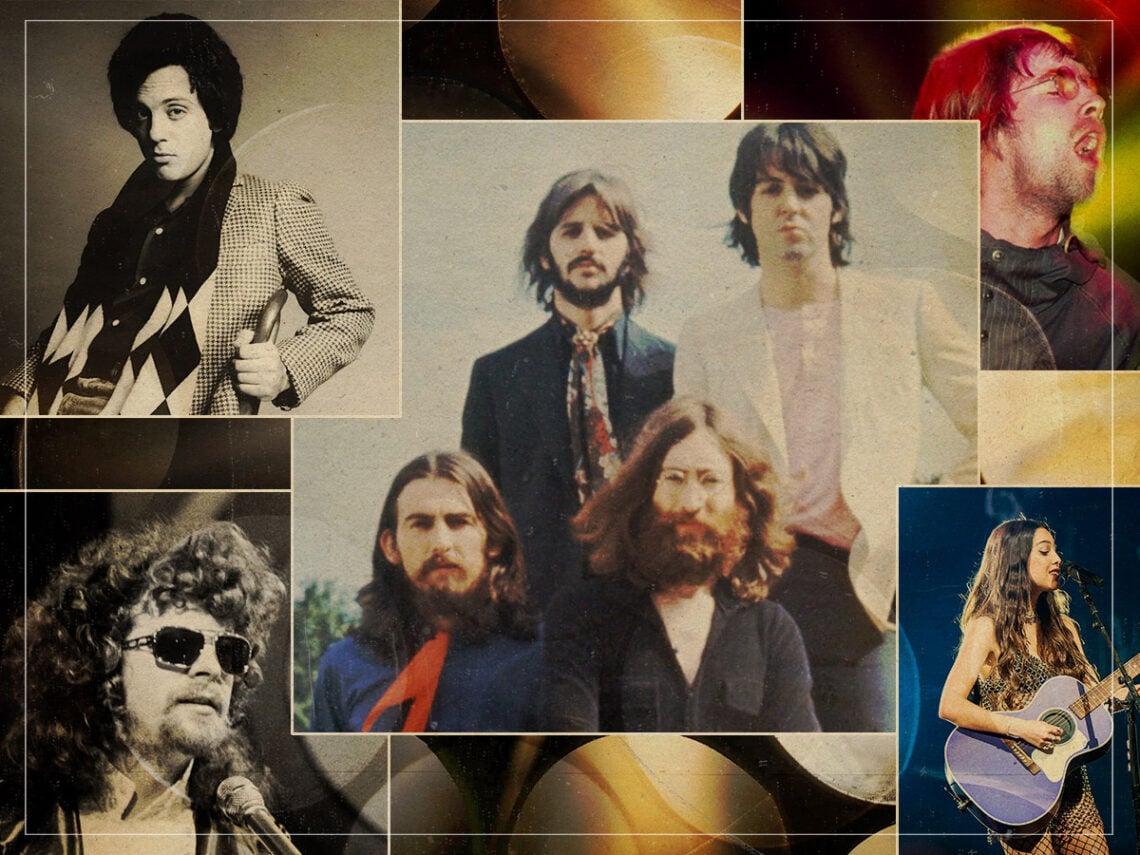
10 songs that sound exactly like other artists

There’s no logical way that any musician can be a singularly original entity. Everyone is going to draw from their influences, and even if some of them wear their favourite bands proudly on their sleeves whenever they play, the magic always comes from them, adding their signature spark to everything. But every now and again, bands like Oasis have been able to put out songs that are a bit too on-the-nose when it comes to the greatest artists in their record collections.
But there’s no real way of judging whether artists are copying their idols or paying tribute to them half the time. Even though it would be easy to fill up a list like this with the massive amount of lawsuits artists have dealt with for plagiarism, it’s a much different beast trying to make something that sounds like an artist without fully stealing their original songs.
While most people would try to avoid this mentality before falling into the dreaded ‘tribute act’ category, all of them are able to stand on their own as fine pieces of musical art. It’s easy to see their inspirations poking through about every note of the music, but when the song still works, it can make an artist sound like they created the kind of song that somehow got lost to history by the artists of yesteryear.
So, when looking at all of these songs, don’t go in with the assumption that every musician was trying to earn a quick buck off of their musical heroes. This was them giving a tip of the hat to those who shaped them, and even if they are a little bit similar, there’s no need to complain when both versions end up sounding this good.
10 songs that sound exactly like other artists:
‘The Greatest Man That Ever Lived’ – Weezer

There’s nothing that does a music nerd’s heart good more than watching an artist pay tribute to one of their heroes. Although most people would want to talk about writing the typical love song, there’s a certain purity that comes with writing songs attributed to those who made people pick up an instrument in the first place. But in the case of Weezer, why not stop at one artist when you can cram every single style you like into one song and see what happens?
While ‘The Greatest Man That Ever Lived’ is by no means the best song they have ever written, it gets major points for ambition alone. Throughout every piece of the track, Rivers Cuomo tried to squeeze in every reference he could to how he thought one of his favourite artists would write the melody. His versions of Slipknot and Aerosmith may be laughable in places, but there are some artists like Nirvana who go over fantastically well.
And during the breakdown of the song where everything turns into a chamber music piece, hearing him draw from people like Bach and Beethoven is a good reminder of where all the great music came from before going back to sounding like a typical Weezer tune. The end result is about as disjointed as a pulled pork sandwich, but if anyone is feeling adventurous and has the stomach for it, this is definitely one of the more interesting sides of the group’s catalogue.
‘Uptown Girl’ – Billy Joel

Billy Joel has never been a man overburdened with a semblance of cool. His rise to the top has always made him look like a sophisticated take on pop music, and even if we all like his songs and sing along with them in closed spaces, there’s a good chance that no one’s going to try to do ‘Big Shot’ at karaoke unless they are among friends. As it turned out, the 1980s saw Billy Joel getting tired of sounding like Billy Joel, and An Innocent Man saw him channel the biggest pieces of his childhood.
While a lot of the tributes on the record are a bit on-the-nose, like using a piece from Beethoven for the song ‘This Night’, ‘Uptown Girl’ is still the greatest Frankie Valli song that the Four Seasons never actually made. Even in an era that was as deadly to nostalgia acts as the MTV generation, it’s impossible to avoid this song, practically being instilled in your brain as a singalong before the track is even finished.
And even if you don’t pay attention to the lyrics, the song never stops being interesting harmonically, going between different keys during the chorus and the bridge before returning to the original key ingeniously for the next verse. Joel may have a music nerd slant to much of his work, but hearing a song like this in practice is partly what makes music so much fun to analyse.
‘A Simple Desultory Philippic’ – Simon and Garfunkel

When talking about people who ripped off other artists, there are a few musicians who are off the table in some respects. Someone like Bob Dylan may have had his fair share of copycats, but it’s impossible to draw through everyone who ripped him off, or else we’d be here all day. When an established artist started to have a go at him, though, it was a much different story, and Paul Simon couldn’t help getting cheeky on this tune.
Because compared to Dylan, Simon didn’t have a non-genuine bone in his body whenever he sang, which made it difficult for him to ape his style directly. But on ‘A Simple Desultory Phillipic,’ Simon’s playful take on the culture that follows Dylan is actually pretty funny, singing in Mr Zimmerman’s conversational vocal style while calling out all of the people who claim to love the poetry behind the folk-rock god but don’t bother to read the actual poets that their idol was referencing in his writing.
While it also gives way to the heaviest guitars heard on a Simon and Garfunkel song, it was clear that this was bound to be a simple experiment. Simon already had found his niche, but seeing the culture shift to people claiming to be intellectuals by doing the bare minimum is one of the most ingenious commentaries on the 1960s counterculture that Dylan didn’t get to first.
‘Glycerine’ – Bush

For anyone growing cynical about the business, the art of trend-chasing starts to get more than a little bit tiresome. Even when someone like Billie Eilish began blowing up in the late 2010s, everyone was wondering how they could somehow manufacture a thousand other women who would talk about their inner pain. And while Stone Temple Pilots barely squeaked by as a legitimate grunge act being from California, seeing the English equivalent to Nirvana try their hand at a ballad was mystifying to see in real-time.
Because by the time Bush released Sixteen Stone, Nirvana was a thing of the past following Cobain’s suicide. And judging by how they angled the image, Gavin Rossdale seemed to be the pretty boy version of what Cobain was supposed to be, even having the luxury of not having to be difficult to work with by the label. But while ‘Glycerine’ is still a decent song, it was pretty clear why they were being pushed so hard.
The age of post-grunge was now officially upon us, and even if Rossdale had a few decent hooks in him, seeing him copying everything Nirvana did down to the letter was more than a little bit comfortable. He may have received a cosign from Courtney Love, who adored the song ‘Machinehead,’ but if Rossdale had begun in 1987 rather than 1994, chances are he’d have tried to sound like Poison.
‘Good 4 U’ – Olivia Rodrigo

All forms of nostalgia tend to happen in waves. Even though people might have some fond memories of listening to their favourite songs from a decade ago, it’s easy to cringe back at the dated fashions for a while before people start seeing them as novel all over again. While the 1980s revivalist age has yet to burn out on some people, hearing Olivia Rodrigo bringing back pop punk is still one of the most promising signs for modern pop-rock.
Compared to the other major pop stars out right now, Rodrigo’s Sour is most reminiscent of what the female rock singers of the 2000s had been doing. While she did get in trouble a little bit for ‘Brutal’ sounding too close to Elvis Costello’s ‘Pump It Up,’ ‘Good 4 U’ isn’t trying to hide who its musical parent is, with the chorus being an interpolation of what Paramore had been doing on ‘Misery Business’ nearly 20 years ago.
But since Hayley Williams has done a lot to distance herself from the uncomfortable lyrics of her masterpiece, this is a welcome substitute, being the kind of kiss-off that wouldn’t have felt out of place next to equally strong fuck-you songs like ‘You Oughta Know’ by Alanis Morrissette and ‘Fuck and Run’ by Liz Phair. And considering how much Sabrina Carpenter’s ‘Taste’ features guitars now, Rodrigo can now be considered an unofficial leader in bringing back the six-string to pop music.
‘Working Man’ – Rush

Any rock band who has tried to make something badass has probably rewritten a Led Zeppelin song without knowing it. The whole process behind Zeppelin’s material was about taking the blues and putting some swagger behind it, and there aren’t many blues rock acts that have come out since that haven’t taken the same blueprint and put their own spin on it. Whereas Rush eventually carved out their own space for themselves, there’s no way they can hide their Zeppelin lineage based on their debut.
Before they got the idea to stretch things out more, Rush was the band’s first step up to the plate with songs that were a big love letter to Zeppelin, down to Geddy Lee’s massive screams on ‘Finding My Way.’ Looking at the debut as a whole, ‘Working Man’ is still one of the most obvious Zeppelin knockoffs they ever made, complete with a riff that sounds like an inverted version of ‘How Many More Times’ that’s been slowed down.
The band wasn’t trying to run away from those comparisons, either, with Gene Simmons saying that he brought the Canadian rockers out on tour with them because he thought they were the Canadian version of Zeppelin. But If you look at anything past Fly By Night, you’d know that Rush were always going to innovate their sound and leave the bluesy rock tunes far behind them.
‘Transistors Gone Wild’ – Green Day

Every band deserves an opportunity to shake things up once in a while. Green Day had already been ridiculed for not being punk enough the minute they released Dookie, but they figured their best course of action was to experiment with whatever they wanted rather than try to give their audience what they thought they should be making. Right before they brought back the loud guitars and made a punk rock opera, hearing them making a new wave record was something no one saw coming.
At least, not by Green Day, that is. Even though they recorded the album Money Money 2020 under the guise of ‘The Network’, this is only Green Day in masks playing a warped version of something Devo would have come up with it. Despite ‘Roshambo’ being more like a punk-ified version of synth music, having Mike Dirnt sing ‘Transistors Gone Wild’ was the perfect choice to capture that signature Mark Mothersbaugh vocal tone.
When Billie Joe Armstrong does come in, he almost acts like the hype man for Dirnt, with the rest of the band playing in lockstep like machines behind them. This is probably the exact opposite of what people come to Green Day, but it’s still an absolute joy for anyone who had a fever dream about pop-punk getting born in 1986 instead of 1994.
‘Cigarettes and Alcohol’ – Oasis

There’s no real getting around Oasis’s connection to The Beatles. From the way that they dressed to Liam Gallagher’s vocal tone to the way they dressed, everything about the band screamed that they wanted to be the Fab Four for the next generation. While they loved their fair share of classics, they also had a fascination with glam, and Noel Gallagher figured he didn’t need to do much else when he found a Marc Bolan riff.
Since most of Definitely Maybe sounds like the band’s attempt at a punk album, this is the other side of the coin where they talk about the excesses of life. While every 1990s kid knows that guitar riff as the beginning of ‘Cigarettes and Alcohol’, there’s the overarching shadow of T Rex’s ‘Bang a Gong’ hiding in the background, especially since the accents of the riff are nearly identical.
But was Noel about to suddenly apologise for lifting the riff? Hell no. He was a punk rocker in every sense of the word, and even if he took what he could from different places, he managed to make something that no one could deny. The lawyers may have had something to say about it, but since the glam scene was meant to provoke, it couldn’t get more provocative than stealing a riff outright.
‘You’ve Got To Hide Your Love Away’ – The Beatles

The Beatles were never satisfied staying with one sound for too long. The Merseybeat style may have helped give them a career, but a life of being in the same league as Gerry and the Pacemakers wasn’t going to be their approach to rock and roll. After all, they had already started to fall in love with Bob Dylan when filming A Hard Day’s Night, and if ‘I Should Have Known Better’ was John Lennon’s wink towards Mr Zimmerman, he had fully embraced his sound by the time of Help!
Even though most of the band’s second film is nothing but madcap hijinx for the better part of an hour and a half, Lennon’s ‘You’ve Got To Hide Your Love Away’ was his way of getting a Dylan song of his own. While he left himself open by refusing to double his vocal, the strain in his voice perfectly matches the weary voice that Dylan had during his prime, even managing to sound more sophisticated once the woodwinds come in towards the end of the song.
It was all meant in good fun, but two could play at the game, with Dylan eventually nicking the riff from ‘Norwegian Wood’ for ‘Fourth Time Around’ in an attempt to keep the band on their toes. Most people can try their best to emulate their heroes, but it takes a special song for the artist to not only notice it but record something in response.
‘Mr Blue Sky’ – Electric Light Orchestra

The entire pop culture landscape as we know it has been built on the legacy that The Beatles founded. Even if not everyone considers themselves fans of the Fab Four, there’s a chance that their favourite artist has loved or at least respected pieces of what they had done in the past. So while it’s virtually impossible to pick out a specific Beatles ripoff, Jeff Lynne has made it his career path to make as many Fab-adjacent songs as he could with Electric Light Orchestra.
Although Ringo Starr and John Lennon had taken playful jabs at Lynne’s projects, ‘Mr Blue Sky’ was where the comparisons stopped being a joke and became a real masterpiece. The chordal movements may have been reminiscent of ‘Yesterday’, but looking at how Lynne arranged everything, this was him capturing the inventive spirit of ‘I Am The Walrus’, the singalong nature of ‘Hey Jude’, and the classical majesty of the final seconds of Abbey Road all under one roof.
Even though Lynne would have enough songs to consider himself an honourary Beatle at this point, it wouldn’t be surprising if the group wanted to work with him for The Beatles Anthology if only for this song alone. Because when you’ve hit an artist’s sweet spot this well, there are only so many places you can go next.
