


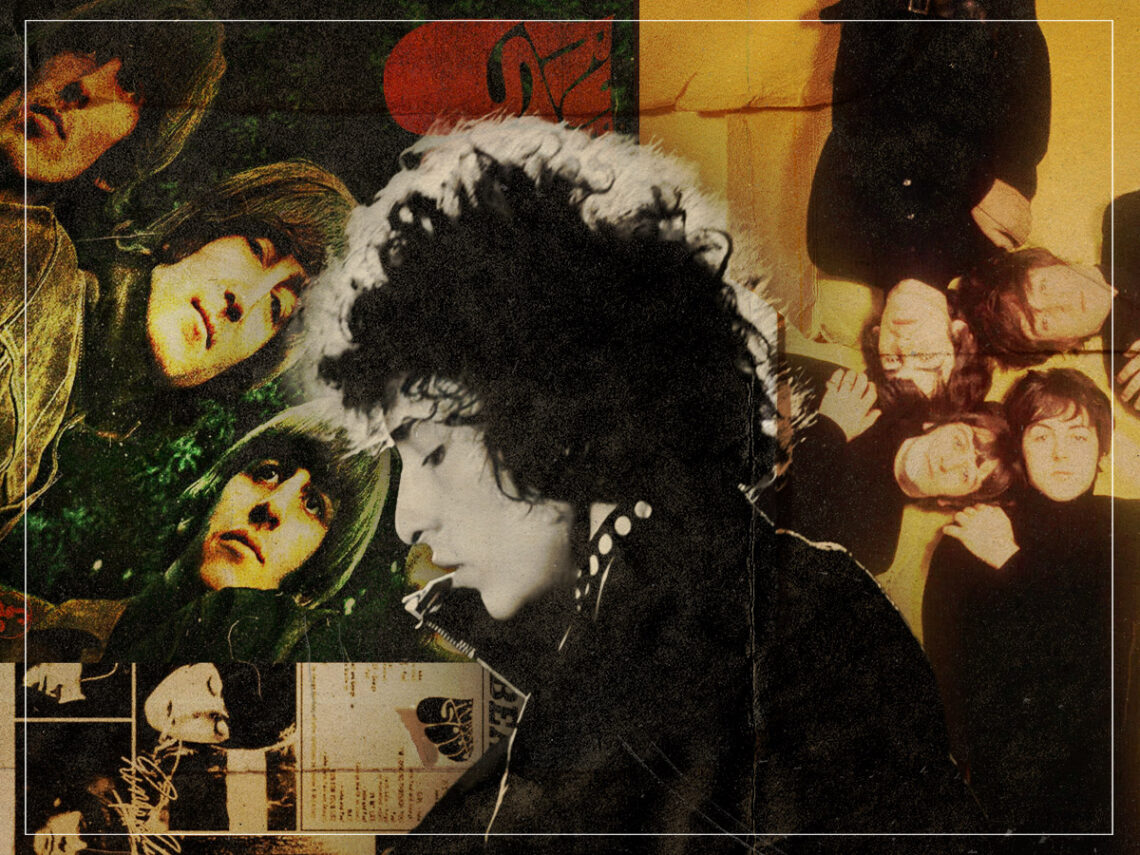
The Beatles song Bob Dylan thought had ripped him off: “I invented it”

There’s a lot to be said about the impact of the two musical behemoths of Bob Dylan and The Beatles on wider music. The two acts provided a dual-pronged attack on popular culture. While the Liverpudlians provided a bouncing sense of unbridled optimism and escapism, Dylan would lay bare the cold, hard facts of a cultural revolution. But what is often forgotten is how much the musicians affected one another, too.
Dylan may well have been one of his generation’s most introspective and literarily-driven songwriters, but The Beatles had something that all pop music politicians needed: cut-through. The quartet were capable of delivering tunes that would scythe their way through the radio airwaves and still deliver a message of youthful hope and love. For a while, Dylan would rely on pop acts like The Byrds to sing his songs to their fullest potential and have them heard by millions. Eventually, though, he would learn the group’s sensibilities and begin to craft choruses and bridges to find a pathway to the population of the world.
Of course, it wasn’t all a one-way street, either. In the 1960s, after meeting Bob Dylan, the Fab Four became one of the most autobiographical pop groups in the world. The group would latch on to Dylan’s more poetic leanings and use his confessional songwriting, lifted from the world around him, and transpose it into their own vernacular. In this style, ‘Norwegian Wood’ is one of the more beautiful numbers by The Beatles, which is some achievement considering their back catalogue, but one man who certainly isn’t a fan of the 1965 track is Dylan, who believes the song was The Beatles’ attempt at trying to more blatantly lay claim to his compositional style.
The track, of course, featured on 1965’s Rubber Soul as a gorgeous acoustic number à la Dylan and it marked the first time that George Harrison would debut his soon-to-be trademark sitar on a Beatles track as his love of Indian music added another dynamic layer to the Fab Four’s sound. That said, aside from the instruments in use, Dylan was disgruntled about the way the band had structured their new tune. It would provoke a scathing retort from the freewheelin’ troubadour.
Dylan was angered to see mainstream pop acts such as The Beatles and Sonny & Cher gain global attention that he could only dream of, a time when he struggled to fight off the folk scene that was still trying to draw blood. He felt as though their sound was directly copying him but without the singer seeing his own benefits. The latter’s ‘I Got You Babe’, Dylan believed to be a rip-off of his own anthem ‘It Ain’t Me Babe’ — then when he heard Rubber Soul, the pioneering artist was not best pleased, to put it politely.

Rather than take this as a compliment that he was clearly doing something right, he was instead fuming that the band from Liverpool were apparently using his trademark style. But, his irritation seemed to land more squarely on one member of the band. He clearly felt John Lennon was trying to steal the gimmick that he invented, the use of his own expression within his pop songs. In reference to Rubber Soul, Dylan said: “What is this? It’s me, Bob. [John’s] doing me! Even Sonny & Cher are doing me, but, fucking hell, I invented it.”
One track from Rubber Soul that especially rubbed him up the wrong way was ‘Norwegian Wood (This Bird Has Flown)’, in which he ended up hilariously parodying on ‘4th Time Around’, a song quite clearly aimed at John Lennon. The Dylan track ends with the lovely, if not bruising, swipe at Lennon: “I never asked for your crutch / Now don’t ask for mine”.
Lennon sat on the fence when asked about his opinion on the track by Rolling Stone in 1968. He wanted to avoid further confrontation with an artist he saw as a contemporary if not an inspiration. Lennon stated: “I didn’t like it…I was very paranoid. I just didn’t like what I felt I was feeling—I thought it was an out-and-out skit, you know, but it wasn’t. It was great.”
Dylan famously first met The Beatles in August 1964 as they partied in his hotel room after a show at New York’s Forest Hills Stadium, a period when the troubadour would introduce The Beatles to cannabis for the very first time. This was a habit that the Merseysiders had well and truly got into when it came to recording Rubber Soul, a record Lennon labelled their “pot album”, so Dylan influenced them sonically as well as recreationally for the LP, something that was clearly not lost on him.
It would all be water under the bridge in the years that would follow, with Dylan ending up being a convert to at least one member of The Beatles. He formed The Travelling Wilbury’s with George Harrison, who became a close friend of his and someone he clearly thought more of than Harrison’s former bandmate John Lennon. “George got stuck with being the Beatle that had to fight to get songs on records because of Lennon and McCartney,” Dylan once said of Harrison. “Well, who wouldn’t get stuck?” He added: “If George had had his own group and was writing his own songs back then, he’d have been probably just as big as anybody.”
In the end, Dylan moved on and continued to find commercial success, and The Beatles eventually peered out. While we’re sure there was some bristling animosity between the two groups for a few periods of time, these were largely fleeting moments of frustration rather than a long-held feud.
The two artists may have held somewhat different positions at the start of the revolutionary decade known as the 1960s, but by the time The Beatles called it quits in 1970, Dylan and the rest of the rock set had started to align with one another. Using influence and inspiration from their contemporaries had now become par for the course and the individuals that started the cultural wave were now all riding the crest to the shore together.

Never Miss A Beat
The Far Out Beatles Newsletter
All the latest stories about The Beatles from the independent voice of culture.
Straight to your inbox.