


10 movies that changed pop culture forever

From the outside looking in, it’s fairly easy to gauge which movies are destined to become hits, but it’s a lot more difficult to accurately guess which ones will take on a life of their own and dominate pop culture.
The most notable recent example is the Barbenheimer phenomenon, which seized the zeitgeist by the scruff of the neck and refused to let go for months. Sure, Barbie is an icon in her own right, and Christopher Nolan is a name that guarantees success, but nobody could have predicted the way it caught fire.
Much in the same way that cult classics can’t be manufactured, and it’s very easy to spot when a filmmaker is trying to do it on purpose, the films that end up being welcomed into the loving embrace of pop culture can’t be precision-engineered from the ground up. It’s a natural phenomenon and one that doesn’t come around too often.
That being said, the following ten films have all done it in their own unique way, to the extent that a lot of time is going to need to pass before they slip from the pedestals they’ve been occupying since they first released.
10 films that changed pop culture:
10. Final Destination 2 (David R. Ellis, 2003)
It might be an unremarkable horror movie that gained the unwanted distinction of being the lowest-grossing entry in its franchise, but the after-effects of Final Destination 2 are still being felt to this day.
More than 20 years have passed since David R. Ellis’ sequel landed in cinemas, but anyone of a certain generation who says the movie hasn’t caused them genuine concern every single time they’ve spied a logging truck while either driving or sitting in a car is a goddamned liar.
The mere sight of a logging truck is enough to cause palpitations in not only the viewers who let Final Destination 2 scar their impressionable minds, but anyone to have seen it subsequently and then sat behind one in traffic. It’s only a single scene, but it made quite the impression.
9. Pulp Fiction (Quentin Tarantino, 1994)
The reverberations caused by Quentin Tarantino’s Pulp Fiction carried far further than the four corners of the silver screen, with the movie becoming a cornerstone of pop culture ever since.
In addition to every filmmaker trying to emulate Tarantino’s signature rapid-fire dialogue, three decades later and its characters, posters, and memorable quotes remain the bedrock of an enduring merchandising empire, not to mention many of the artists featuring on the soundtrack experiencing a surge in popularity as a direct result.
It’s the most ironic inclusion on this list by far, if only for the way Tarantino’s own pop culture obsession was so integral to Pulp Fiction, just for the film to have much the same effect once it had been released.
8. Grease (Randal Kleiser, 1978)
Not content with being the highest-grossing musical ever made at the time, Grease presumably did wonders for sales of industrial-strength hair gel once it permeated the fabric of pop culture.
Suddenly, the 1950s were big business again, and there’s not a chance it was a coincidence the fashions, aesthetics, and music of the era enjoyed a resurgence in the wake of John Travolta and Olivia Newton-John’s star-crossed summer romance.
It’s been almost half a century since Grease was released, and there are still plenty of people out there who based their entire personality around the movie and its vibe, which just goes to show how deeply it sunk its claws into the collective consciousness.
7. Blade Runner (Ridley Scott, 1982)
There’s something cruel about Blade Runner underperforming at the box office and not getting the praise it deserved first time around, because it would be an understatement to say cyberpunk hasn’t been the same since.
Whether it’s literary fiction, cinema, video games, comic books, or any other form of media, almost every notable dystopian future to have been created since 1982 owes at least a small debt of gratitude to Ridley Scott’s seminal sci-fi masterpiece.
Cyberpunk existed well before Blade Runner, but anyone with a vested interest in the culture built on the back of oppressive cityscapes reliant on advanced technology would be foolish to try and deny the monumental legacy left behind by Scott’s neon dream.
6. Enter the Dragon (Robert Clouse, 1973)
Martial arts had been a staple of cinema for decades before Bruce Lee and Enter the Dragon, but it wasn’t until the movie became a global phenomenon that it took off in the Western world.
The film has been credited for almost single-handedly causing the massive uptick in interest in martial arts in the 1970s, when watching Lee dismantle his opponents in lightning-quick fashion encouraged folks from all age groups to take up classes, and there were plenty on offer to capitalise on the craze.
Beyond that, it was a watershed moment for the genre in the eyes of the average international cinephile, with the doors being opened for martial arts movies to become a global concern for the first time.
5. Saturday Night Fever (John Badham, 1977)
The disco era was already in full swing before John Travolta strutted his stuff in Saturday Night Fever, but the film becoming a cultural phenomenon helped propel it to new and untold heights.
Carried on the back of the Bee Gees steering the soundtrack to bestselling status, Tony Manero tearing it up on the dancefloor helped make disco more popular on a global level than it had ever been before, while studios were falling over themselves to partner up with record labels in an effort to repeat the trick.
It didn’t work out to anywhere near the same extent, though, with Saturday Night Fever in a class of its own when it came to influencing music, fashion, light-up dancefloors, pristine white suits, and the way an entire demographic of overconfident young men carried themselves in public.
4. Scarface (Brian De Palma, 1983)
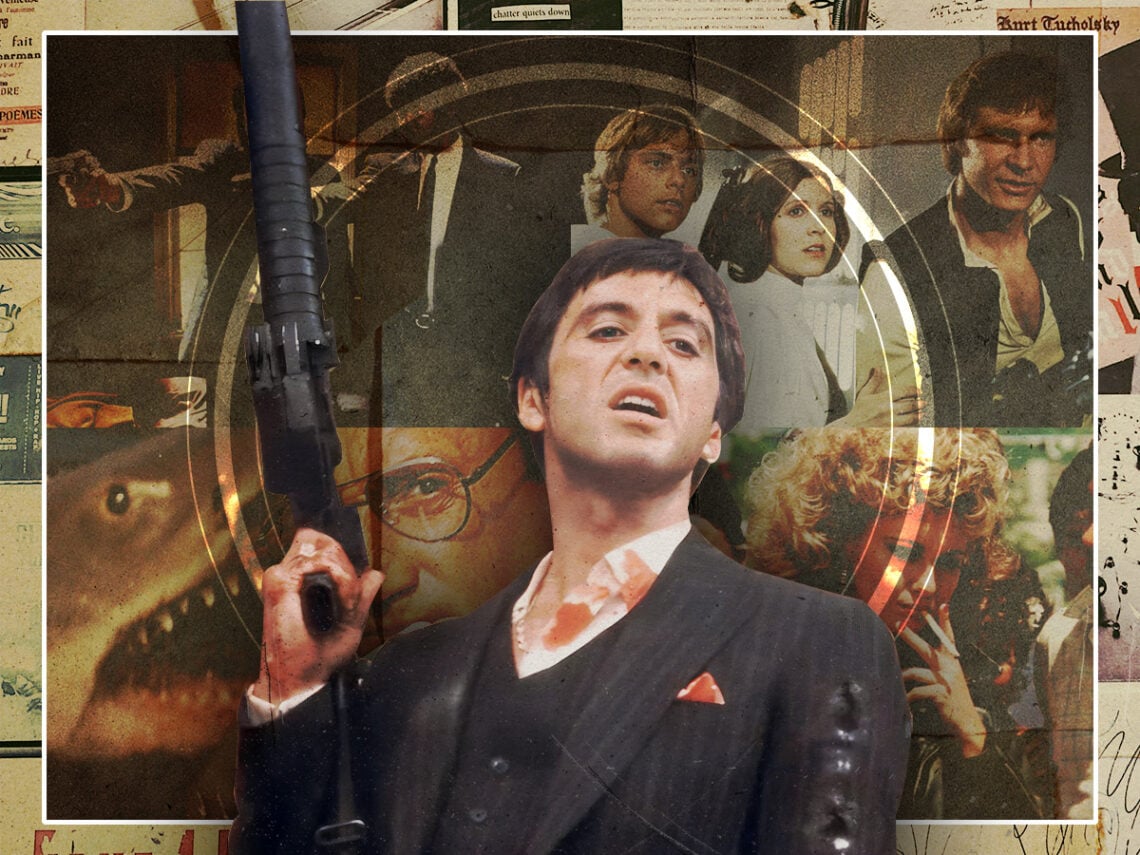
It’s been a long time since any university or college residence didn’t have a poster of Al Pacino as Tony Montana hanging on the wall of at least one room, with Scarface firmly woven into the tapestry of pop culture.
There’s plenty of iconic dialogue to be found, while merchandise and memorabilia has ensured Brian De Palma’s twisted take on the American Dream has never been allowed to cede into the background, but it runs much deeper than that.
Notorious B.I.G., Jay-Z, and Nicki Minaj are just three of the world-famous musical artists to have either quoted or sampled Scarface in one way or another, with the iconography of Tony’s drug-addled and gun-wielding rise to the top as ever-present now as it’s always been.
3. Jaws (Steven Spielberg, 1975)
It wasn’t ideal in the long run that Steven Spielberg convinced the entire world that it wasn’t within its best interest to get back in the water, but he did it nonetheless.
The number of beach visitors plummeted and the increase in shark hunting for sport radically increased when Jaws swam into cinemas, with the director regretting that his film had become one of the first major pieces of fictional entertainment to have noticeablyy negative impact on environmental awareness and conservation.
Jaws also changed the face of cinema forever, with the marketing blitz and procession of trailers, TV spots, and promotional materials for every high-profile motion picture having the filmmaker’s unforgettable aquatic thriller to thank for the industry’s increasingly hefty box office numbers.
2. The Matrix (The Wachowskis, 1999)
At the turn of the millennium, it was impossible to turn around without walking right into something that had been inspired by The Matrix in all walks of life, after the Wachowskis’ breakthrough feature took the world by storm.
Suddenly, everybody wanted to dress in long leather trench coats and sunglasses, regardless of how hot it was outside. Everyone wanted to be a badass computer hacker overnight, and that’s to say nothing of how its various tropes were cannibalised by the whole of Hollywood.
For better or worse, the red pill/blue pill scenario has been part of the cultural lexicon for a quarter of a century, too, with The Matrix continuing to make its presence felt in everyday life.
1. Star Wars (George Lucas, 1977)
Quite simply, there is no movie to have ever been made that’s had a greater impact on pop culture at large than Star Wars, with George Lucas ironically responsible for creating an empire.
The staggering sci-fi decimated box office records, altered the trajectory of cinema’s technological capabilities, completely overhauled the way movies were merchandised to within an inch of their lives, and has long since reached a point where thousands list Jedi as their religion every time there’s a census.
For some, Star Wars is a way of life more than a franchise, as concerning as that may sound in certain respects. Disney may have done a stellar job of chipping away at the unwavering goodwill the saga continues to hold, but it’ll take some doing for anything else to affect pop culture in quite the same way again.
