


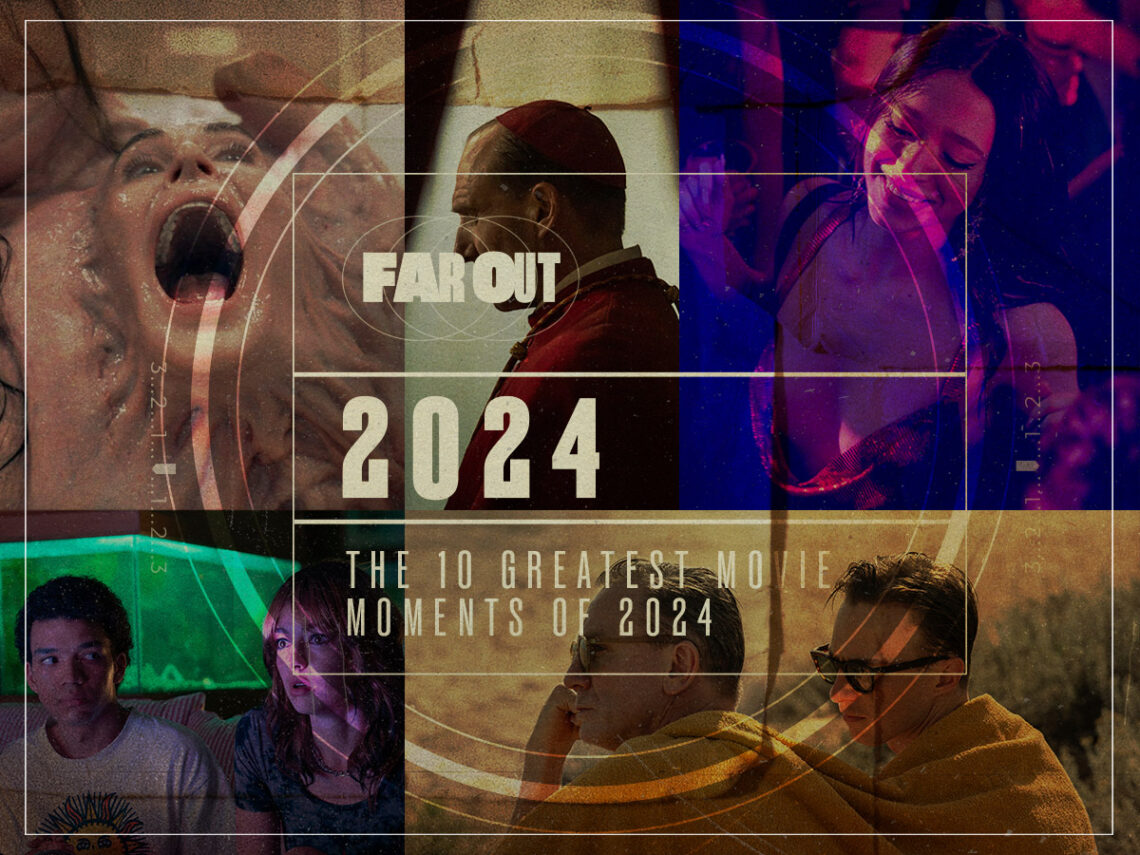
The 10 greatest movie moments of 2024

2024 was full of cinematic surprises. From body horror going mainstream to the Vatican becoming ground zero for the year’s most suspenseful thriller, there was plenty to be delighted by, no matter what genre of movie you chose to watch. Payal Kapadia’s All We Imagine as Light and Sean Baker’s Anora stole audiences’ hearts, while Luca Guadagnino graced us with two very different erotically charged dramas.
Among all the lists of best films and performances, we don’t want to let some of the most jaw-dropping moments of the year go uncelebrated. For all the consistently shocking scenes in The Substance or painful moments in Queer, there are certain scenes that stand out as perfect encapsulations of their respective narratives and dazzling feats of cinema in their own right.
Making the list are also sequences from a few films that have flown under the radar. There are heartbreaking moments, revelatory moments, surreal moments, and downright disgusting moments, but what these all have in common is that they immerse us in the world of each film the way we all hope to be immersed when we step into a theatre or hit “play.”
From a romantic homage to a 1950s sci-fi flick to a surprisingly moving ayahuasca trip, these were the moments that swept us off our feet in 2024.
2024’s greatest movie moments:
10. The dinner scene (A Real Pain, Jesse Eisenberg)
Kieran Culkin is the gift that keeps on giving, and after his portrayal of a charismatic yet troubled lost soul in Jesse Eisenberg’s A Real Pain, one knockout moment from the film had to make the list. The story follows two cousins who visit their dead grandmother’s hometown in Poland, reckoning with the idea of what constitutes true pain while exploring their family’s traumatic history during the Holocaust. While both men are dealing with their own personal failings and problems, they grapple with their right to struggle and the unspoken tensions between them, coming to a head in one scene as they visit their grandmother’s old home.
While Benji appears to be one of those sparkly souls with an unlimited sense of optimism, we learn that he has a complicated personal history. After both men confront the fluctuating nature of their relationship, they attempt to reconcile on the doorstep of their grandmother’s apartment. It’s a perfect moment that is balanced out by nostalgic power and perfectly timed comedy, with the pair attempting to reconnect with their roots but being thwarted by nearby neighbours.
It ends with a poignant and heartwarming tone that reflects the core of the subject matter, looking at our inability to confront certain pains and the guilt we feel over addressing others, especially when comparing them to the grand scheme of suffering. The performances from Culkin and Eisenberg are touching and affecting, creating a layered and wonderfully funny story about what constitutes ‘a real pain’.
9. Meeting your older self (My Old Ass, Megan Park)
When you first see the premise of Megan Park’s My Old Ass, you will inevitably wonder (and worry) how the director can pull it off. Starring Maisy Stella as Elliott, a teenager who meets her older self (Aubrey Plaza) while tripping on mushrooms, it has a sci-fi premise that you don’t often find in an indie coming-of-age comedy, but it feels so natural that all trepidation dissolves instantly when the characters meet for the first time.
Elliott is sufficiently spooked and sceptical when Plaza tells her who she is. “Those aren’t my teeth,” she says. “I don’t have a fucking gap in my teeth” – “Yeah, fuck you, wear your retainer,” Plaza responds. Their banter is instantly reminiscent of bickering siblings, which seems much more plausible than awe or respect.
Part of the charm is Park’s script, but it’s also the magnetic chemistry between Stella and Plaza. Silly, irreverent, and just the right amount of weirdly erotic, their first encounter strikes the perfect tone and lets the viewer know that they are in safe hands. This is a special film, and it’s this initial meeting, handled with so much humour and restraint, that shows its hand.
8. The ending (La Chimera, Alice Rohrwacher)
La Chimera is a beautifully mysterious and heart-wrenching film about someone who is always caught between life and death, unable to find joy in his waking life and becoming eternally burdened by the weight of grief.
Josh O’Connor is completely magnetic, hanging onto life by a thread and desperately searching for something to connect him to an old love and remove him from reality. There’s a feeling of restrained magic that bursts during the final scene, allowing us to feel the full power of Arthur’s relentless yearning as he finds himself trapped underground, sacrificing his life to be reconnected with the dead.
It is enchanting and devastatingly human, with Rohrwacher capturing a lost soul incapable of finding purpose in the wake of a tragedy and instead seeking to destroy himself.
7. Attack of the 50-foot woman (Love Lies Bleeding, Rose Glass)
Starring Kristen Stewart as a woman in 1980s New Mexico who falls for a bodybuilder played by Katy O’Brian, Rose Glass’ film turns into a pulse-pounding crime thriller around the halfway point. Interspersed with the surreal, cosmic tone of a twinkling night sky and steroid-fueled hallucinations, the film is interspersed with surreal, cosmic elements. At one point, however, Glass doesn’t just hint at surrealism; she devotes a whole sequence to it.
Toward the end of the movie, Lou (Stewart) and Jackie (O’Brian) are trying to escape the former’s murderous father (Ed Harris). As he stands over Lou, about to kill her, Jackie begins to expand, her muscles bursting through her clothes. Towering over the others, she grabs Lou Sr just as he presses a gun to his daughter’s temple. Leaving him broken on the ground, the two women flee the scene. Looming over the doll-sized world, they run through the clouds against a purple sky, free and together for the first time.
The scene is a direct homage to the 1958 sci-fi horror Attack of the 50-foot Woman, in which a housewife turns into a towering giant who is both objectified and feared. In that movie, size is a monstrous threat to the patriarchal mores of ‘50s America. In Love Lies Bleeding, it’s a form of liberation and an expression of how Jackie and Lou have found a way to escape the torment of their lives through each other.
6. The trip (Queer, Luca Guadagnino)
As an adaptation of William Burroughs’ novel, audiences eagerly awaited the release of Luca Guadagnino’s Queer, a story about a lonely expat living in New Mexico whose life is disturbed by the presence of a much younger man. Daniel Craig is a revelation as William, embodying the haunted quality of a man who yearns for an intimacy that cannot be fully realized. Guagdanino has described the film not as a tale about unrequited love but a tale of unsynchronized love, with only one scene in which their connection briefly aligns.
During the third act, the characters embark on a journey to find the elusive ayahuasca drug, finally discovering it in the depths of the jungle and taking it together. What ensues is a discombobulating and surrealistic sequence as the characters merge together and become one, melting into each other and finally reaching the level of intimacy that William so deeply desires.
It isn’t enough to be close to Eugene; he wants to absorb and be completely engulfed by him, desperately trying to communicate a feeling that has always been confined to dark and hidden spaces and become one through a connection with another person. It is a feverish and unsettling scene that captures the raw power of Queer and William’s devastating desire to be seen as human, losing himself in a hope that engulfs him entirely.
5. Monstro Elisasue (The Substance, Caroline Fargeat)
Coralie Fargeat’s body horror hit is full of electrifying moments. Starring Demi Moore as Elisabeth, an actress who takes a mysterious substance to create a younger version of herself, it does not pull its punches with gruesome imagery and dazzling setpieces.
There is the activation scene in which Margaret Qualley’s Sue bursts out of Elisabeth’s back, and there’s the kitchen scene, where Moore’s increasingly decrepit character makes one of the most revolting meals of the year, but it’s the scene in which Sue tries to reactivate The Substance that is the most astonishing.
Until that moment, the characters’ descent into physical decay has been a steady evolution. It’s easy for the audience to suspect (and dread) where they’re both headed. But when Sue injects herself with the single-use injection for a second time, absolutely anything could happen. Will another, younger version burst out of her back like the first time? Will she drop dead? Will Elisabeth come back to life? It’s one of the most suspenseful moments of the movie, and Fargeat somehow manages to exceed expectations.
Rising from the floor where she has just torn her way out of Sue’s back is Monstro Elisasue, a lumbering, misshapen creature with three nostrils, a single eye, an additional face on her back, and several sets of teeth. It’s the turning point in the film and the moment when it becomes clear that all bets are off, no matter where you thought it was headed.
4. Mr Melancholy attacks (I Saw the TV Glow, Jane Schoenbrun)
Jane Shoenbrun’s Lynchian journey into teenage dissociation is hallucinatory from the start. Starring Justice Smith as Owen, a lonely adolescent who finds kindred spirits in the characters of a supernatural television show called The Pink Opaque, it explores questions of loneliness, dysphoria, and the unreliability of memory. But one scene takes the consistently unsettling tone into terrifying territory.
As an adult, Owen’s fellow Pink Opaque enthusiast reappears after having gone missing for several years and tells him that she has been living inside the series. At her urging, he rewatches the show’s finale, in which the villain, Mr Melancholy, buries the protagonists alive. The character has the body of a human but the face of a baby trapped inside the moon, a clear reference to Georges Méliès’ landmark 1902 film A Trip to the Moon. But there is nothing comedic about the scene.
Bathed in dark blues and sickly greens, it becomes increasingly nightmarish as Mr Melancholy’s distorted voice and the fluctuating borders of his face fill the screen. It’s the most horrifying moment in a non-horror movie this year, exemplifying the terrors of a life caught somewhere between reality and fiction.
3. Match point (Challengers, Luca Guadagnino)
Luca Guadagnino’s Challengers was a surprise hit when it landed in cinemas this summer. Starring Zendaya, Josh O’Connor, and Mike Faist, it’s a sexy love triangle centred around tennis and held together by a propulsive score from Trent Reznor and Atticus Ross. The film begins and ends with the same tennis match between Patrick (O’Connor) and Art (Faist), interspersed with flashbacks that reveal their history together, their relationship with former tennis star Tashi (Zendaya), and why this match is a turning point for all of them.
The final scene brings all the threads together. Sweaty and exhausted, the men lob the ball back and forth over the net as Tashi watches from the audience, her eyes following the ball from one side of the court to the other. The sexual tension between the characters has been working up to a fever pitch throughout the film. Off the court, they are discordant and unfulfilled. On the court, they are in perfect, electrified sync.
Harkening back to an earlier moment when Tashi compares tennis to a relationship, this scene demonstrates that the characters have never loved or lusted for each other more than when they are playing the game. When the final showdown happens, Guadagnino finds a way to make both men win, collapsing into each other’s arms in exhausted, sweaty ecstasy.
2. Ralph Fiennes’ monologue (Conclave, Edward Berger)
Conclave is one of the most gripping and relevant political thrillers of the year, exploring the selfish pursuit of power in the wake of crumbling democracy and those who exploit tragedy for their own personal gain.
Director Edward Berger asks the question of whether anyone can be deemed as truly good by exploring the motivations of those we typically see as being most moral, exposing the inner workings of the selection process as a group of cardinals elect the next Pope. There are many staggering moments in the film, but there is one monologue from Ralph Fiennes that absolutely takes the breath away, with his character posing questions about the meaning of faith and during times of uncertainty, something that lends itself well to the problems we face in the real world.
Despite being engrossed in his own crisis of faith, his character devotes himself to what is right, never wavering from his duties and remaining ferociously committed to a future that best serves the most vulnerable people, creating a powerful message about the importance of hope and compassion in a modern world.
1. The car scene (Anora, Sean Baker)
Anora was one of the most highly anticipated films of the year, with Sean Baker being lauded for his modern-day rags-to-riches story. While Baker’s earlier films have opted for a sugar-coated ending that mocks Hollywood’s preference for palatable and safe endings, the indie darling chose to do something different, with a final scene that is staggering in its honesty and confrontation of the issues that the film concerns itself with.
After embarking on a nightmarish goose chase to track down her husband, Anora is eventually faced with the sobering reality that the marriage was never genuine and the relationship was entirely transactional, with her worth being reduced to the physical intimacy she offers Ivan, ultimately meaning nothing more than an object.
As she grieves for the life she almost had, she attempts to repay the one person who showed kindness towards her in the one way she knows how before eventually breaking down in tears and allowing herself to feel hurt over her own powerlessness. It is a shattering odyssey of modern love and the misogynistic ideas that have corrupted true intimacy, shattering our expectations of the fairy tale love story with a bitter reality.
