


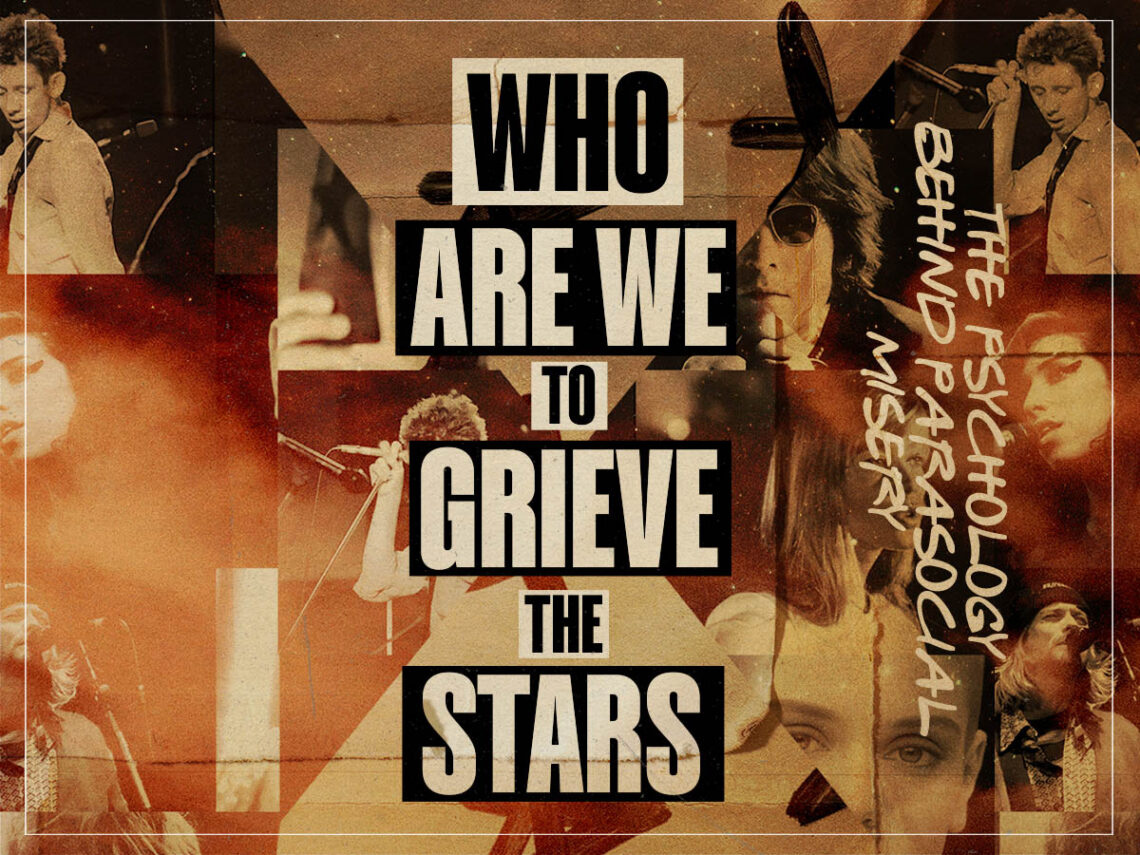
Who are we to grieve stars? The psychology behind parasocial misery

When an icon of culture passes away, it has a ripple effect, sometimes causing millions worldwide to come together and grieve collectively. They have never met this person, and their connection stems from a one-sided appreciation that seems unusual to cut so deep—and yet, memorials and vigils fill with hearts in mourning, while others feel a quiet, private loss at home, their lives suddenly marked by the absence of someone who had, in some way, become part of their world.
Society or groups suddenly plunging into a state of collective grief isn’t a new phenomenon, but whenever it occurs, it can sometimes feel as intense as if it were the first time. For some, it is; not everybody mourns the death of a celebrity, but when there’s that one that suddenly hits harder than the rest, it can feel unsettling, unusual even, like suddenly experiencing the complexities of grief as raw and real as if losing a friend or family member.
The psychology of this relates to a cultural occurrence called parasocial relationships, which are also defined as a strong personal and emotional connection a person develops with a famous figure, one who doesn’t know them personally or is even aware of their existence. These attachments often feel completely real and deeply meaningful, even if they lack any direct interaction.
One of the first major examples of parasocial relationships could date back to Beatlemania when The Beatles generated an unprecedented level of fan devotion and fostered a sense of closeness, even if the experience was one-sided. However, this has occurred throughout history in various factions, evolving into its own energetic microcosms at the hands of social media and churning waves of dedicated fan communities that engage with celebrities and influencers daily.
Therefore, when a high-profile figure passes away, many people can experience an intense wave of sadness, even if they haven’t previously developed a parasocial relationship with that specific person. However, while this is mainly due to the subconscious nature of contemporary entertainment culture, shared involvement in the lives of public figures is also a complex concept and one that receives its share of scrutiny, especially from outsiders observing those who grieve figures they’ve never even met.
Putting people on pedestals can be dangerous, but grieving can be healthy—so, who are we to grieve stars? How do parasocial relationships impact our ability to distinguish real from superficial grief? More importantly, what do the experts have to say about it?

“We are attachment creatures wired to connect”
While it’s natural to mourn the loss of a person who has played a significant role in our lives, even from afar, it’s important to acknowledge the complexities involved. That said, the process of grieving when it concerns a celebrity deserves a lot of credence, and it’s also essential to understand how normal that feeling can be.
Speaking to Far Out, Melissa Gentry, Doctor of Clinical Psychology and specialist in relationships and neuropsychology, says: “It is remarkable how deeply we connect with famous figures, especially musicians and actors, even though we’ve never met them personally. Neuropsychologically, parasocial relationships stem from our brain’s inherent tendency to form bonds, even with those we don’t directly interact with. We are attachment creatures wired to connect!”
Continuing, she added: “The same neural pathways that activate in our personal relationships can also be engaged when we ‘follow’ a famous person’s life and work. This is a reflection of our social brains—built to empathise, mirror, and bond. When we watch a musician perform or hear a familiar song, our brain’s mirror neurons enable us to ‘feel’ what we perceive in them: their passion, joy, or even pain. Over time, repeated exposure to their art creates a genuine, though one-sided, emotional connection.”
When it comes to grieving a famous figure, Gentry says that all of this explains why it “can feel akin to losing a close friend or even a family member.” In this scenario, although unprecedented, “their work becomes intertwined with our own memories and life experiences, becoming part of our personal narratives. Music, in particular, acts as the soundtrack of our lives.” This is notably poignant when the deceased is a musician that we loved because we suddenly begin to grieve “the version of ourselves tied to that music.”
While outsiders often ridicule such occurrences, Gentry assures that parasocial grief is not only normal but healthy. “Processing these emotions allows us to reflect on our own lives and to honour what that artist or their work has represented to us,” she says. “It is a profound reminder of the impact that art has on the human experience—demonstrating that sometimes, the people we never meet can shape our lives in deeply personal ways.”

“Reflect our own mortality”
Defining parasocial relationships in a basic sense is difficult, but when it comes to celebrity-related grief, the parameters of such community-held misery become a little easier to understand. According to clinical psychologist Sally Theran, parasocial grief occurs because of several factors, like serving as a reminder of our own mortality or losing an “extension of ourselves”.
Speaking to Far Out, Theran says: “When we grow up with someone, we may feel more connected to them than someone who is older than us, and look up to them even more, especially if we were the same age as them when they became famous. It can feel like they’re an extension of ourselves. When someone who we’ve grown up with dies, it can be heartbreaking, especially if that death was not of natural causes or it was untimely. Having someone like that die, who seems close to us, can cause us to reflect on our own mortality, which can be particularly painful.”
According to Theran, parasocial relationships and grieving the passing of a famous figure are also completely “healthy and normal”. Not only that, but they signify a significant aspect of development, particularly if it relates to a figure that formed a huge part of someone’s life in their early years or as a teenager. As a result, parasocial grief is as normal as the first time someone sought comfort in someone completely unattainable.
“For the most part, parasocial relationships are healthy, normal, and typical,” Theran explains. “It makes sense for teens and young adults to want to look up to someone and aspire to be like them; it’s just important to know that the image that the particular musician or celebrity is projecting is not really their authentic self, but a polished manufactured persona.”
Aristotle Paulides, an entrepreneur with a psychology background, tells Far Out he has spent years studying the psychology behind emotional attachments. In his view, however, there’s something particularly “unique about how we bond with musicians” and the emotional connection we develop with music. “Their songs become part of our life story; that breakup song you played on repeat, the anthem that got you through tough times, or the track that was playing during your first kiss,” he says.
Using David Bowie’s death as an example of parasocial grief, he adds: “Look at what happened when David Bowie died in 2016. People who never met him were devastated, crying in the streets and leaving flowers at memorials. They felt like they’d lost a close friend. This makes perfect sense from a psychological standpoint: our brains process these parasocial relationships similarly to real friendships.”
“For instance, Taylor Swift fans [also] often talk about how she feels like their friend who just gets them,” he added. “Her lyrics mirror their experiences so precisely that they feel personally seen and understood. This explains why fans would grieve her loss as deeply as they might mourn a close friend; because, in many ways, that’s exactly how their brain processes the relationship.”
Explaining cultural responses to famous deaths, he also says that this occurs because of our inability to process abrupt finality and everything that represents: “The grief hits hard because losing a musician means losing future possibilities too,” he says. “No more new songs that perfectly capture how you’re feeling, no more concert experiences, no more shared moments with the fan community. Plus, it often forces us to confront our own mortality. If these larger-than-life figures can die, what does that mean for the rest of us?”

“Collective expressions of sadness”
When it comes to music, the emotional connection we often develop centres around self-reflection and personal identity, making it feel like a musician or a specific piece of music is a real part of ourselves. Music also forms a major touchpoint in helping us better understand ourselves and learn what resonates—which is particularly poignant when we’re younger and more susceptible to connecting pivotal life moments to works of art.
According to Christine Schneider, Clinical Psychologist at Cambridge Therapy Centre, these experiences and relationships often feel real because the musician or music represents something specific to ourselves, which fosters a sense of comfort in the idea that we are understood in ways that are either difficult to articulate or impossible to source in those around us.
Speaking to Far Out, Schneider says: “Through lyrics and performances, musicians often seem to reveal deeply personal aspects of themselves, which can intensify this bond, making fans feel as though they know the artist in a meaningful way. Because there’s no reciprocity, these relationships often remain ‘ideal,’ with no friction or misunderstanding that can arise in a real-world relationship.”
Expanding on the appeal of parasocial relationships compared to “real-world” relationships, she says: “Fans often project their own idealised views onto the artist, creating a version of them that’s flawless or perfectly attuned to their needs and desires. This dynamic, built on fantasy, often feels like a ‘perfect’ relationship where fans feel understood and supported without the complexities or challenges of a real-life relationship.”
Similar to Theran’s comments, Schneider also notes the intensity of younger fans appreciating a famous figure and how the loss of that figure can make people reflect on how much of an impact they once had on their “sense of identity and self-expression” and how their once “ideal” relationship coming to a sudden end can feel destabilising. “The idealised relationship that fans projected onto the musician comes to an end, which can feel like a very real loss,” she says.
“This grief is often heightened by the shared mourning within fan communities, where collective expressions of sadness and remembrance reinforce the sense of connection fans had with the artist. Parasocial relationships may be one-sided, but the emotions attached to them are real and can be deeply meaningful.”

“Predisposed to be attracted to familiar faces”
On a note of reflection, parasocial attachment can sound like the most intense thing in the world, even if it feels completely normal to the person experiencing it. In this way, although impossible to grasp to an outsider, collective community grief can impact those who may not even acknowledge their own susceptibility. While some entertain parasocial relationships in a more active way, a sudden celebrity death can trigger grief in a broader sense, brushing others with a newfound sense of sadness even if they didn’t feel close to the person who has passed.
While this observation is infinitely harder to explain and analyse, its roots in parasocial attachment likely say more about society’s evolving relationship with celebrity culture at large and how prominent figures in local or global communities can have an impact, even without our knowing it. In the context of music, this rings true as artists often soundtrack many aspects of conscious and subconscious experiences, transcending physical boundaries that aren’t always immediately obvious.
According to Gayle S Stever, Professor of Social and Behavioral Sciences at the Empire State University of New York, familiarity plays a huge role in parasocial attachment, which is conducive to the kind of “safe haven” we seek out as basic human nature. “From a psychological perspective, music is a very intimate form of communication,” she tells Far Out, “We as human beings are predisposed to be attracted to familiar faces and voices.”
Referring to Attachment Theory, Stever explains how “objects give us comfort and relieve stress, a sense of safe haven when we are close to those who give us such a kind of comfort.” Sociologically, she says this also “begins in infancy” and continues later in life when “partners and close friends fill this role”. However, many find solace in musicians and other famous figures, which is also completely normal. “We have always been moved by music and musicians,” she says. “It refers to the person who finds solace from an attachment object who is known to us but we are not known in return.”
Mental health therapist and senior editor at Start Here Parents, Jessi Gholami, echoes Stever’s sentiment, describing parasocial relationships as “intimate” and “intense“, especially when they involve music. “People don’t just listen to songs,” she says; they build their own associations with them, whether that’s nostalgia, comfort, or a sense of shared struggle. When an artist passes, it can feel like losing a part of our own identity or history because their work has intertwined with moments and memories in such a personal way.”
Continuing: “Many musicians share openly about their lives, struggles, and personal journeys, so fans relate to them not just as entertainers but as people who’ve experienced similar ups and downs. Fans feel seen and understood by these figures, which makes their loss feel especially personal.”
“In grief, we don’t just mourn the artist; we mourn the parts of ourselves that their music or persona helped shape.”

