


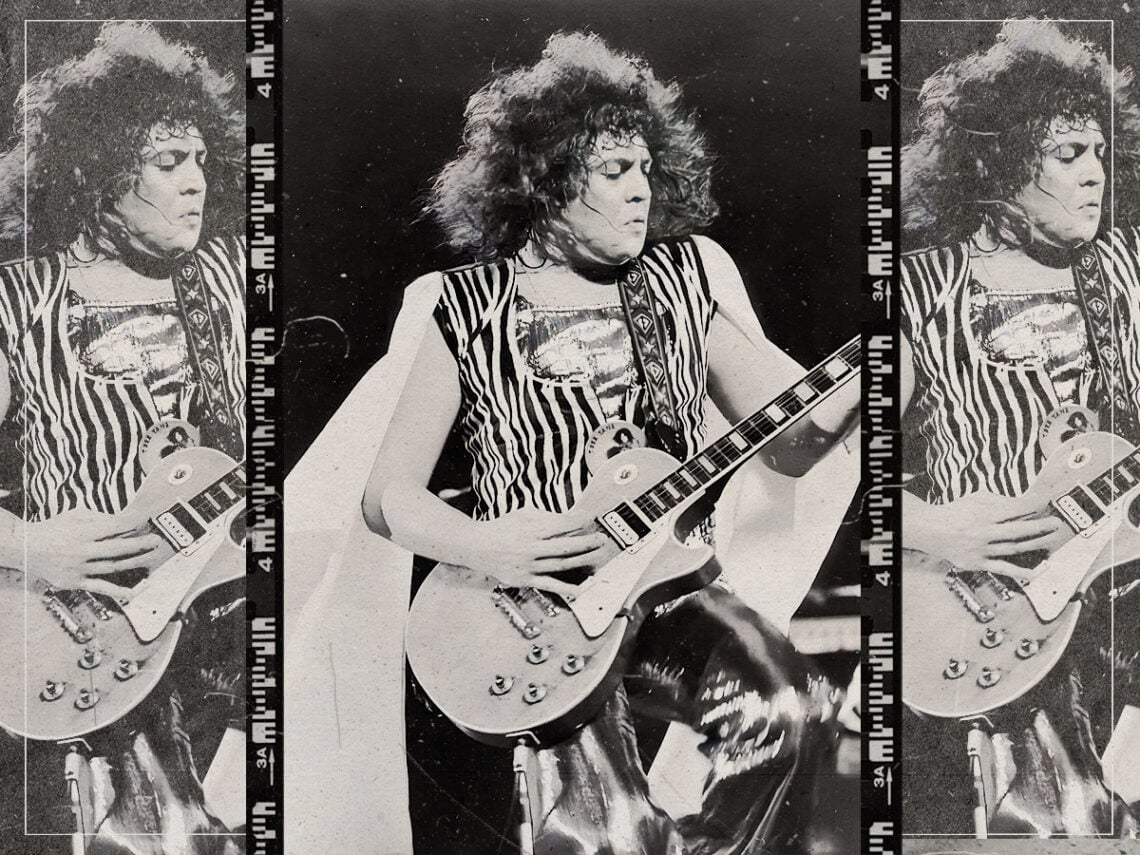
Why T Rex’s ‘Electric Warrior’ remains the blueprint for glam rock

1971 was a very different time in Britain compared with LA’s bustling music scene.
The end of the 1960s brought a sense of uncertainty, and in LA, the pursuit of greater authenticity had sparked a singer-songwriter boom, with pioneers like Joni Mitchell and Carole King leading a movement rooted in personal songwriting.
Over in the UK, however, people were trading their peace signs and flower crowns for leather and glitter, as hippie idealism gave way to music that instead explored science fiction, fantasy and sexual liberation. At the forefront of this change was Marc Bolan, whose era-defining T Rex record, Electric Warrior, helped spark the dawn of a brand new era.
The appeal of Electric Warrior was clear from the off. The music itself was defined by tasteful grooves and infectious melodies; songs like ‘Get It On’ and ‘Planet Queen’ shattered boundaries by combining sexual confidence with fantastical lyricism, with Bolan himself stepping into the role of the suave, fearless leader. Some called it a fad; others deemed it the birth of something else entirely – a new revolution called glam rock.
Early sceptics of this new magical concept weren’t just being dismissive because Bolan represented gender fluidity in a way they couldn’t comprehend; they also saw someone who had ditched their roots in favour of a more mainstream approach, arguing that T Rex was the charting, commercial watering down of their earlier stint as folk pioneers Tyrannasaurus Rex.
The glitter, boots, and Bolan’s obvious prettiness also tapped into something that had long plagued the rock ‘n’ roll scene, blurring gender boundaries and occupying a space many felt should otherwise be taken up by a more traditionally masculine type of rock. Some claimed it was all just a front to appear more interesting, but in 1971, Bolan essentially quashed those rumours by explaining that it was all about the simple art of having fun.
“I’ve always been a wriggler,” he said. “I just dig dancing.”

He also said that he’s “not frightened to go up there and groove about in front of six million people because it doesn’t look cool”, tapping into another significant fact about the everlasting appeal of Electric Warrior: the authenticity of it and all the ways it still holds up. The entire record was recorded live, with nothing replaced later on. Producer Tony Visconti also later recalled how Bolan appeared in full get-up to look the part, pouring his electric on-stage energy into the studio sessions.
“He wore his stage gear and his platform shoes,” said Visconti. “He’d be jumping up and down like he was on stage; everything was really great fun. We also invited friends to the sessions, so he liked to see maybe five or six people bouncing about in the control room. He always loved an audience.”
The response to Electric Warrior was immediate. In the studio, Bolan and his crew knew ‘Get It On’ would be a hit, and the album stayed at number one for eight weeks. Critical response was a little more ambiguous, but nobody could deny just how much of a disruption it was bound to cause, the kind that comes at the dawn of every new era, like a volcano erupting over a once stoic and vapid landscape.
That said, listening to the album now, it’s difficult to say whether it would have the same effect now. As with any record with a reputation that precedes it, it’s easy to misinterpret its quality and cultural significance as a smokescreen, mythologising what could just as easily be reduced to that which hooked people in the first place: just good grooves and rhythms and not much else.
‘Get It On’ is perhaps one of the most overplayed and overhyped songs in all of rock history, so much so that it almost belies the brilliance of the record’s other standouts, overlooked by a famous riff that distracts from some of its other, more important defining qualities. When you look at it from a purely songwriting point of view, it also doesn’t seem quite as accomplished as some of the other defining glam rock projects that came after, or even up to the same standard as what was happening overseas in LA’s singer-songwriter explosion.
That said, none of that really matters that much when you realise that – despite the part that decades’ worth of opinions have to play in all of this – Electric Warrior is still without a doubt one of the best and most important rock records of all time. After all, without Electric Warrior, it’s anyone’s guess whether we’d have many of the other rock masterpieces that followed, including one of the most genre-defining, David Bowie’s The Rise and Fall of Ziggy Stardust and the Spiders from Mars.
This doesn’t exist in a vacuum, either, as even some of the more unsuspecting of culprits across different genres took Bolan’s pioneering rock grooves and made it their own, like Oasis, who pinched the famous ‘Get It On’ riff for their iconic Britpop tune ‘Cigarettes and Alcohol’. Paul Weller, one of Electric Warrior’s proudest champions, once claimed that Bolan effectively kickstarted the entire 1970s, pre-empting Bowie and “looked and dressed and spoke for a lot of kids at that time”.
PJ Harvey’s collaborator, John Parish, once said he frequently listens to Electric Warrior when he starts a new project, usually whenever he has to remind himself “just how good records can be”. Suppose then, all things considered, that that’s the true crux of it – that no matter how much it is taken for granted, nothing will ever come quite as close to setting a brand new standard and completely obliterating an entire music scene for the better as Marc Bonal’s earth-shattering magnum opus.
