


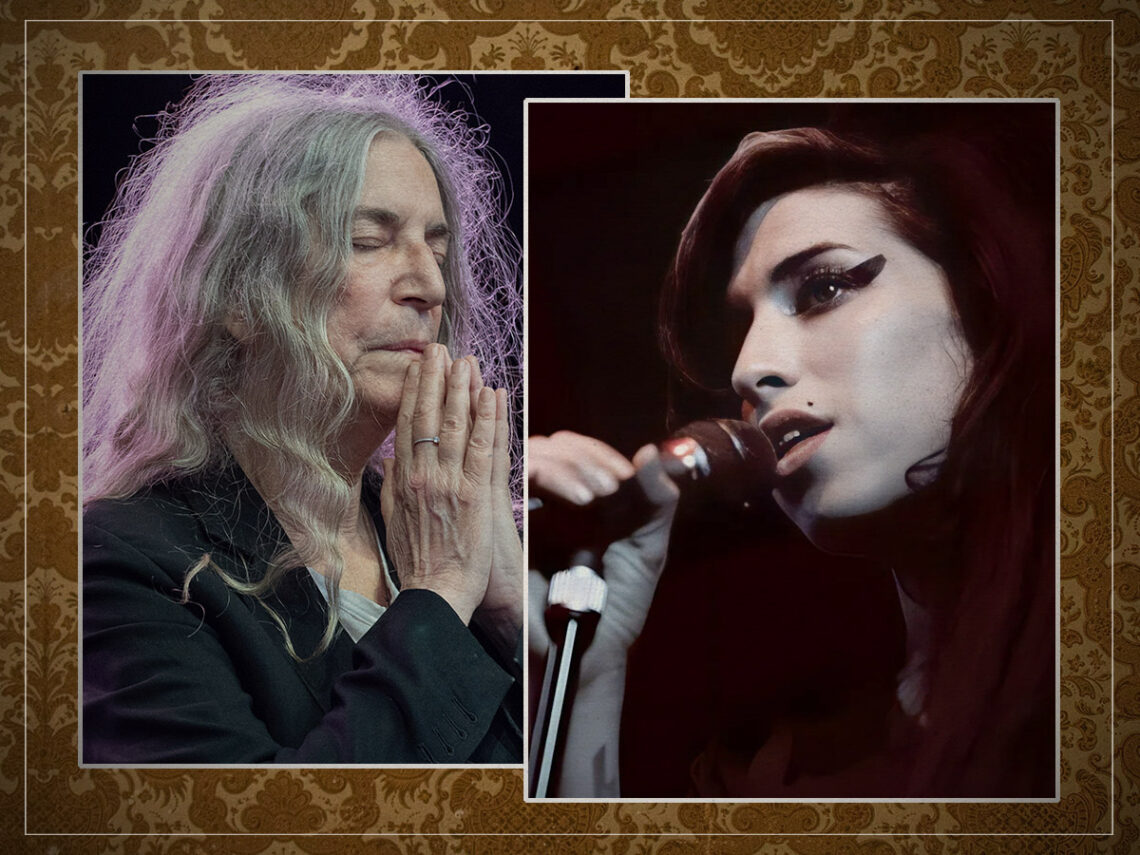
“I worried about her”: Why Patti Smith felt protective of Amy Winehouse

One look at Patti Smith’s social media and her sense of purpose becomes clear.
The punk poet never misses a birthday, a death day or an anniversary as her posts serve as a calendar honouring the people that shaped art and culture. Especially as one of the survivors from a period when so many didn’t, Smith has taken up the task of being an archivist as well as an artist in her own right.
It truly is a sense of duty. Her 2010 memoir, Just Kids, was written for that purpose as she promised her friend, long-term partner and creative soulmate, Robert Mapplethorpe, that she’d tell their story. It’s more than just theirs though, as the book traces their lives together from the tail end of the 1960s and into the ‘70s, encountering so many others and, in turn, holding their memory.
Across the pages, Smith memorialises so many. She recounts a chance run-in with Jimi Hendrix and his supportive words. She wrote of the shock waves felt when Brian Jones died, or how the death of Brian Epstein felt like the end of a chapter for rock and roll. She remembered a night spent hanging out with Janis Joplin and how she wished she could have helped the star more, as even in that brief glimmer, she saw the impact the music world was exerting on her.
As the book returns her to her old hangout, she looks around and sees how many were lost. “Many would not make it,” she writes, “Candy Darling died of cancer. Tinkerbelle and Andrea Whips took their own lives. Others sacrificed themselves to drugs and misadventures. Taken down, the stardom they so desired just out of reach, tarnished stars falling from the sky.”
It doesn’t leave her with any sense of victory as she adds, “I feel no vindication as one of the handfuls of survivors… I would rather have seen them all succeed, catch the brass ring. As it turned out, it was I who got one of the best horses.” But as she still rides that horse, she clearly cares a lot about carrying all of their stories with her own.
It’s not just the names from her own generation. Smith’s sense of duty extends to contemporaries, too, as the empathy the losses of her youth left her with continues to be a powerful compass. In particular, she felt it pang when the world lost Amy Winehouse.
“I was attracted to Amy Winehouse because she had an unbelievable voice,” Smith said, but the admiration went beyond her talents. “Amy was the same age as my children, so my reaction is a maternal one, not as one who found what led to her death exciting and interesting,” she added as her experiences losing so many idols and peers to drugs and alcohol in her youth, merged with her role as a mother, leading to her feeling incredibly tender towards the British singer.
The story felt all too familiar, and she admitted how, if afforded the chance, she would have liked to be there for her: “As I saw that girl’s trajectory, I wished I could have actually spoken to her and been of some avail to her, because I worried about her,” explaining, “I feel for these young people, because as a young person myself I saw Janis Joplin and Jim Morrison do the same thing to themselves.”
But with no ability to change Winehouse’s fate, she did the other thing she thought she could, and memorialised and eulogised her in art, just like she continues to do for so many others. “This is the girl for whom all tears fall / This is the girl who was having a ball / This is the laurel to crown her head / This is the wine of the house it is said,” she sings, as ‘This Is the Girl’ was written in remembrance.
