


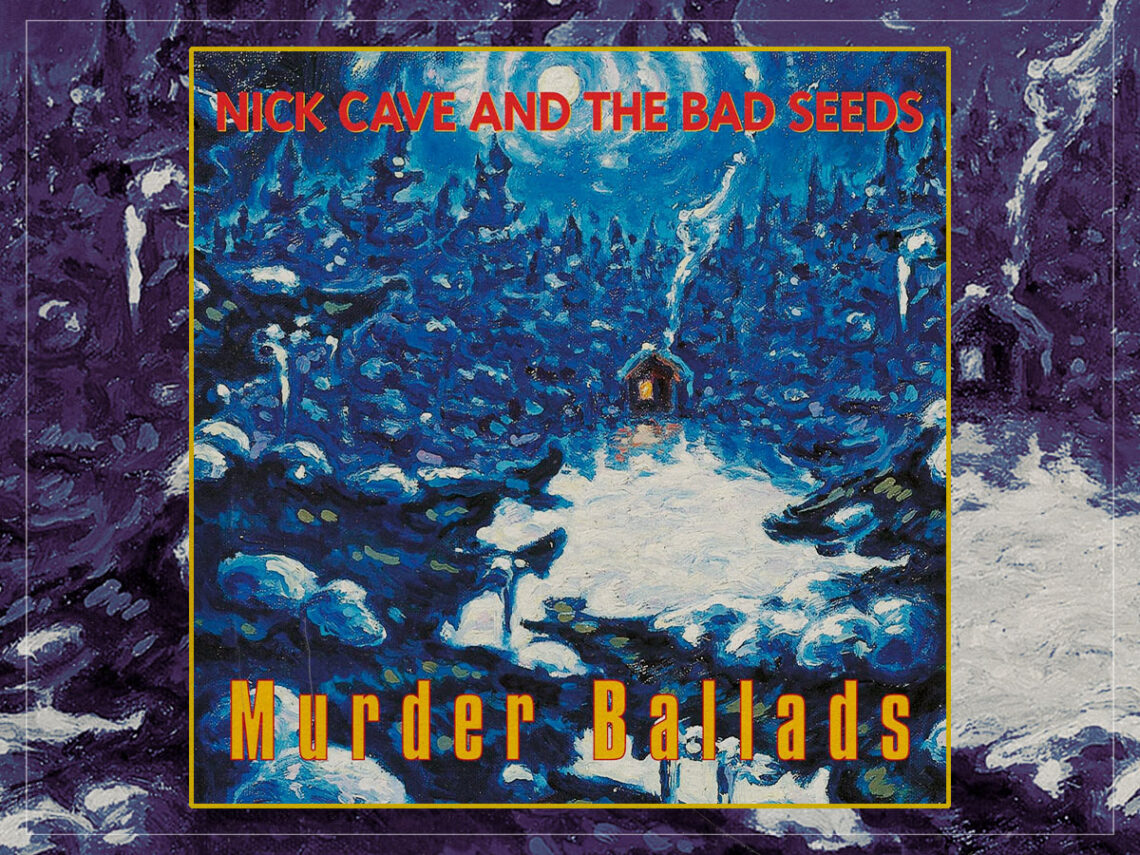
Why Nick Cave called his ‘Murder Ballads’ album “a comedy record”

After writing and recording an album largely inspired by the heartbreak of a divorce, the idea of moving away from painful introspection on one’s follow-up project certainly makes sense. When Nick Cave found himself in this scenario after the release of 1994’s Let Love In, however, his approach to a “fresh start” unsurprisingly looked a little different from your average pop star’s.
“My state of mind was quite bad at that time,” he told the Los Angeles Times in a 1995 interview. “I wanted to push the [self-reflective] approach to one side and write a record where I didn’t have any emotional attachment—a series of songs about invented characters.”
Again, that sounds healthy and logical. Get out of your own head and try to occupy the mind of some fictional people. Maybe Nick forgot about his troubles by writing from the perspective of a friendly ice cream salesman, or a scientist on the verge of a great discovery, or a little girl headed to her first day of school.
Or not.
Nick Cave and The Bad Seeds’ 1995 album was, of course, Murder Ballads, an instant classic to be sure, but also a devastating line-up of depressingly romantic tales of obsession, revenge, and horrific violence; partially in the time-honoured tradition of old English folk tunes and country-western ballads, and partly from the very unique mind of a great songwriter who was still openly relying on heroin as a writing aid.
“Essentially, Murder Ballads is a comedy record,” Cave explained to the LA Times, shrugging and puffing on a cigarette. “It’s not supposed to be a serious look at murder and its social ramifications. It really ended up being a record about storytelling more than anything else. The murder side of it is treated quite lightly. Overall it’s quite funny, I think.”
He has a point. Murder Ballads does elicit some unexpected chuckles, but more by tapping into a nervous discomfort the way a horror movie does rather than, say, a Judd Apatow movie.
Despite its graphic content, Murder Ballads became one of the best-selling records of Cave’s career, buoyed by two very notable guest appearances from female vocalists. One of them, Cave’s friend PJ Harvey, was already considered one of the leading young talents in alternative rock, and her voice fit so well into the song ‘Henry Lee’ that she might as well have been the feminine reflection of Cave’s typically masculine tortured soul. The other guest musician, by rather stark contrast, was a pop princess by the name of Kylie Minogue—a person who hails from the same country as Cave (that’s Australia), but couldn’t have seemed more diametrically opposed to him as a pop cultural figure.
Even when talking about how they came to work together, Cave can’t help sounding more like he’d been actively stalking the former soap star. “I’ve watched her career very closely,” he said. “I actually started writing songs for her, but I never felt the time was right to send them.”
In the end, an apparent bug in that Cave-Kylie dynamic was actually a feature. Their beauty-and-the-beast interplay on ‘Where the Wild Roses Grow’ made it a crossover hit and really helped Cave reach a new audience almost 20 years into his career. He and Minogue also remained unlikely friends in the years that followed, with no hard feelings from Kylie about Cave’s ‘Roses’ character bashing her in the head with a rock.
Remember, it’s a comedy record.
