


Why did Michael Haneke remake ‘Funny Games’?

In 2007, Michael Haneke decided to remake one of his earlier movies, not an unheard-of concept for a filmmaker; for instance, Alfred Hitchcock did it with The Man Who Knew Too Much or Yasujirō Ozu with Floating Weeds, but it’s still a curious and rather bold choice to make.
Yet, judging by the fact that many highly acclaimed directors have remade their own films, suggests that it’s often the result of a dedicated artist, a perfectionistic auteur, wanting to give a previous project another go, only with more confidence the second time around. For Haneke, though, the decision to remake Funny Games was slightly different.
His first attempt came in 1997, with Susanne Lothar and Ulrich Mühe starring as a couple who bring their young son with them for a lovely stay in their holiday home. What transpires, however, is unimaginable torture and terror, all at the hands of two young men who, on the surface, appear trustworthy. Lothar’s Anna allows them entry into her home when they come knocking, asking to borrow eggs, and she puts her trust in them purely because she’s staying in an affluent area, they look well-meaning, and they appear to know the neighbours.
Soon enough, though, Mühe’s Georg is whacked with a golf club and unable to walk, beginning the pair’s cruel game, which also includes making the family hunt for their dog, which they’ve killed, and forcing the couple to watch them shoot their son. The violence that they, and we, the audience, are subjected to is heinous, but that’s the entire point, even if some critics were utterly disgusted by the endless nature of it.
Yet, Haneke’s film deliberately disrupts conventions and stereotypes, using satire to poke fun at the social codes and myths that define middle-class society, making for a darkly comic tone standing alongside such horrors, which make Funny Games such a whiplash experience; it’s so traumatising and bleak, with no end in sight with the pair enacting their games just because they can, and that’s the scariest part of it all.
The film’s examination of violence and its consumption in the media is explored with meta precision, with Haneke breaking the fourth wall various times, which includes a sequence in which a character picks up a TV remote and rewinds a scene that has just taken place, directly drawing our attention to the artificiality of the medium and how things can be manipulated. And of course, by having Arno Frisch’s Paul directly turn at the camera and wink at us, we become involved in the narrative as helpless onlookers.
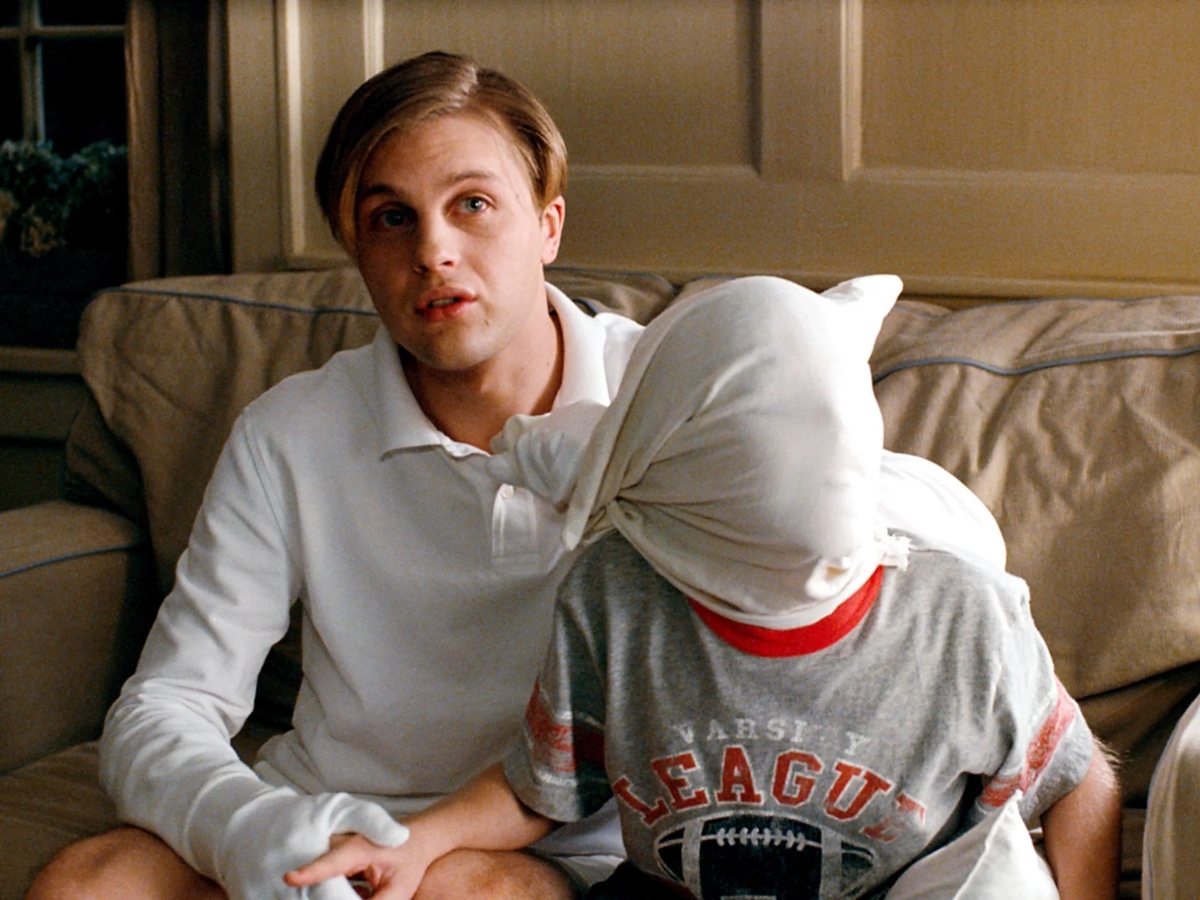
In one sequence, he even asks the audience a question, “What do you think? You think they stand a chance? You’re on their side, aren’t you?”, and Haneke manages to pull all of these bold choices without coming across as corny, instead honing in on the pure terror of the world he has dropped us into.

Then, ten years on from filming the original in Austrian, Haneke felt the need to remake it, which saw him return to the story with English-speaking actors, recruiting some recognisable faces like Naomi Watts and Tim Roth, while Brady Corbet (who’d later go on to direct The Brutalist, no less) and Michael Pitt became their captors. Shooting the film shot-for-shot with the exact same script, identical sets and music choices, like Naked City’s ‘Bonehead’, led some people to deem this an utterly pointless artistic exercise, but it wasn’t just a cash grab, and neither had Haneke run out of ideas.
The filmmaker knew that mainstream American audiences were less likely to watch 1997’s Funny Games because it wasn’t in English, and a decade on from its release, he felt like the people whom he believed needed to see it most hadn’t, so he decided to make a more accessible version of his film, one that Americans would actually go and see.
“The first film didn’t reach the public I think really ought to see this film. So I decided to make it again,” Haneke told the Sydney Morning Herald, “When I first envisioned Funny Games in the mid-1990s, it was my intention to have an American audience watch the movie. It is a reaction to a certain American cinema, its violence, its naivety, the way American cinema toys with human beings.”
By giving his story the Hollywood treatment, Haneke was able to reach a wider audience, those whom he believed were the true target audience. Hollywood cinema’s preoccupation with violence has long been the subject of intense debate, raising the question of whether movie violence desensitises us or makes people more likely to commit crimes, and Haneke tackled this head-on with Funny Games.
It could only ever be made with such meta brilliance, and only someone as skilled as Haneke, who has previously been outspoken in his distaste for Hollywood films and their manipulation of the audience, most prominently Schindler’s List, was right for the job.
