


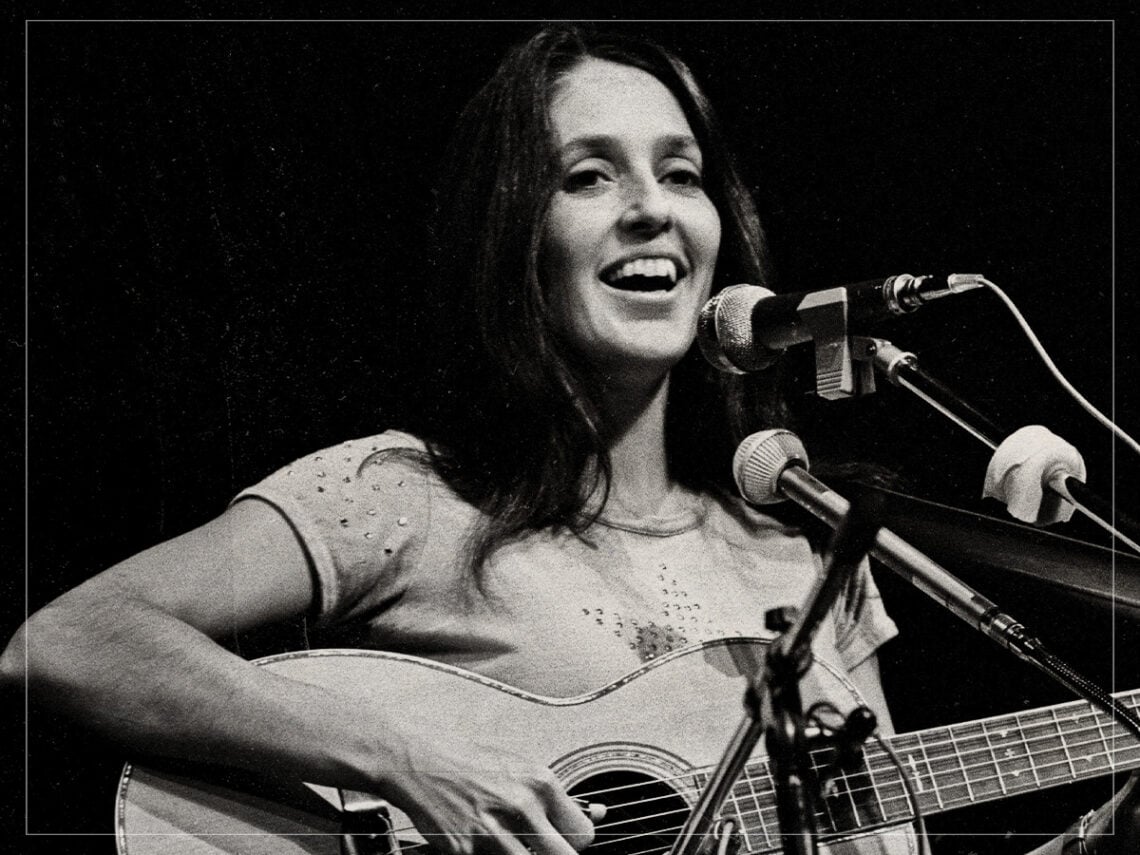
Why did Joan Baez call ‘The Boxer’ a protest song?

A song with a chorus purely consisting of “Lie-la-lie-lie-lie-lie-lie” may not seem the most obvious choice for stirring the soul, but Joan Baez has the opposite opinion.
Of course, any song could technically be considered a protest anthem if placed under the right guise, and Baez is certainly a master of spinning words and context to make a whole different story. In this sense, she took the Simon and Garfunkel tune ‘The Boxer’ and gave it a completely new meaning in her own mind, even if that might have left the original writers more than a little bemused, to say the least. But when you let a song out into the world and leave it open to other people’s interpretations, there’s frankly nothing you can do to stop it.
Yet even though ‘The Boxer’ was plainly never intended for political associations, it is perhaps easy to see why it could have been construed in this way, for all the startling imagery it evokes on the mountain to overcome some of life’s biggest challenges. “I am just a poor boy/ Though my story’s seldom told/ I have squandered my resistance/ For a pocketful of mumbles,” they sing in the opening lines of the track, instantly evoking not just the vision but the plight of one of life’s greatest underdogs.
But you have to understand: if you ever want to see steam coming out of Paul Simon’s ears, it would be if you described him in any way with any sort of political guise. The man simply hates it. Famously known for blasting similar peace effort songs by the likes of John Lennon and Paul McCartney as “condescending,” “manipulative,” and “garbage”, it was clearly something he went to pains to avoid in his own music, particularly when still under the shackles of Simon and Garfunkel.
However, when you gift your music over to the world, part of the pain is somewhat relinquishing your control, and having to accept the fact that people will come to interpret your songs in completely different ways, even if you sigh in disappointment that it was never what you actually meant. Simon would have undoubtedly felt no different when he came across Baez’s reimagining of ‘The Boxer’, which she argued was the ultimate political anthem in the context of what she used it for.
“You could consider this a protest song even though Paul Simon wasn’t a political person,” she later tried to reason. “This song is just so singable. I’ll sing it at my concert right after ‘Imagine’ and it becomes a protest song too. It takes on a whole new meaning.” It really was like she was trying to completely ragebait him by throwing that added insult of the mention of ‘Imagine’ in at the end there, wasn’t she?
But regardless of the original intent, artistic license allows for whole new sprawling worlds to be created off the bounce of one springboard, and in this case, ‘The Boxer’ was the ultimate trampoline. Taken as a pen from Simon’s mind, lamenting his periods of poverty and loneliness, you can understand why he might not like to see something so personal manufactured into a song symbolic of a wider cause.
Yet the truth is that, no matter what walk of life or circumstances anyone finds themselves in, we can all relate to those feelings of destitution in one way or another. In this sense, it’s very easy for a song like ‘The Boxer’ to be adopted amid a wave of political fire, championing the spirit of people’s struggles all over the world. That’s certainly the message Baez wanted to send, but it just didn’t necessarily translate to Simon himself.
