


Why couldn’t David Lynch get funding?

“People solve problems with money normally; well, I don’t have any money,” David Lynch said in 2006. At the time, he’d just released what would be his final movie, Inland Empire, and there he was, sitting on Hollywood Boulevard with a sign asking the Oscars team to consider Laura Dern for ‘Best Actress’ and, randomly, a cow.
The cow was simply used to get attention, really. “I ate a lot of cheese during the film, and it made me happy,” Lynch said as his reasoning and no one needed to question it further than that. But primarily, the reason was that he wanted his actors recognised by the big leagues, and without the money to throw behind it that other major studios would, he did what he could, touring the US with a cow, making a splash in his own way.
But the cow is really besides the point. The point is that David Lynch had no money, and he said he didn’t, repeatedly, and in that same 2006 interview with Wired, he mentioned it several times.
Talking about the new technology he uses to neaten his footage, he said, “There are some artefacts in a few places, and those could be gotten rid of if you had the money to go in there and hand-correct it frame by frame.”
Talking about the making of Inland Empire, he said, “Well, it’s a big risk. I put a lot of money into this film already, and I don’t have a lot of money”.
In one interview, touching on everything from the making of a movie to the editing, to the release and the promotion, Lynch punctuated every step with the reminder that, despite being one of the most revered and respected directors of all time, he didn’t have big budgets to play with.

It all leads to one question: how?
In the entertainment world, we assume that everyone famous must be rich, and no one will ever deny that Lynch wasn’t pretty well off. Just take a look at his house, sitting on 11,000 square feet, designed by the famed architectural family, the Lloyd Wrights, which ultimately sold for $15million after his death. Even when accounting for inflation and the fact that his legacy definitely hiked that price up, it still wouldn’t have been a cheap purchase at the start.
However, as we know, personal wealth doesn’t always make a difference. Take Francis Ford Coppola, for example, another famed director with a powerful family dynasty and a hefty net worth, yet he still couldn’t convince anyone to make Megalopolis and had to sell plenty of stuff when he decided to fund it himself.
As for what it all comes down to, Lynch laid that out as well in this seemingly tell-all 2006 chat: “Advertisers are not going to give away any money without getting results”.
David Lynch had no money to promote his films, making his films on incredibly tight budgets, because he rarely got funding. Part of it comes down to the fact that he preferred to do it all himself, liked to keep things in-house with his own production company and avoid, as much as possible, studio interference.
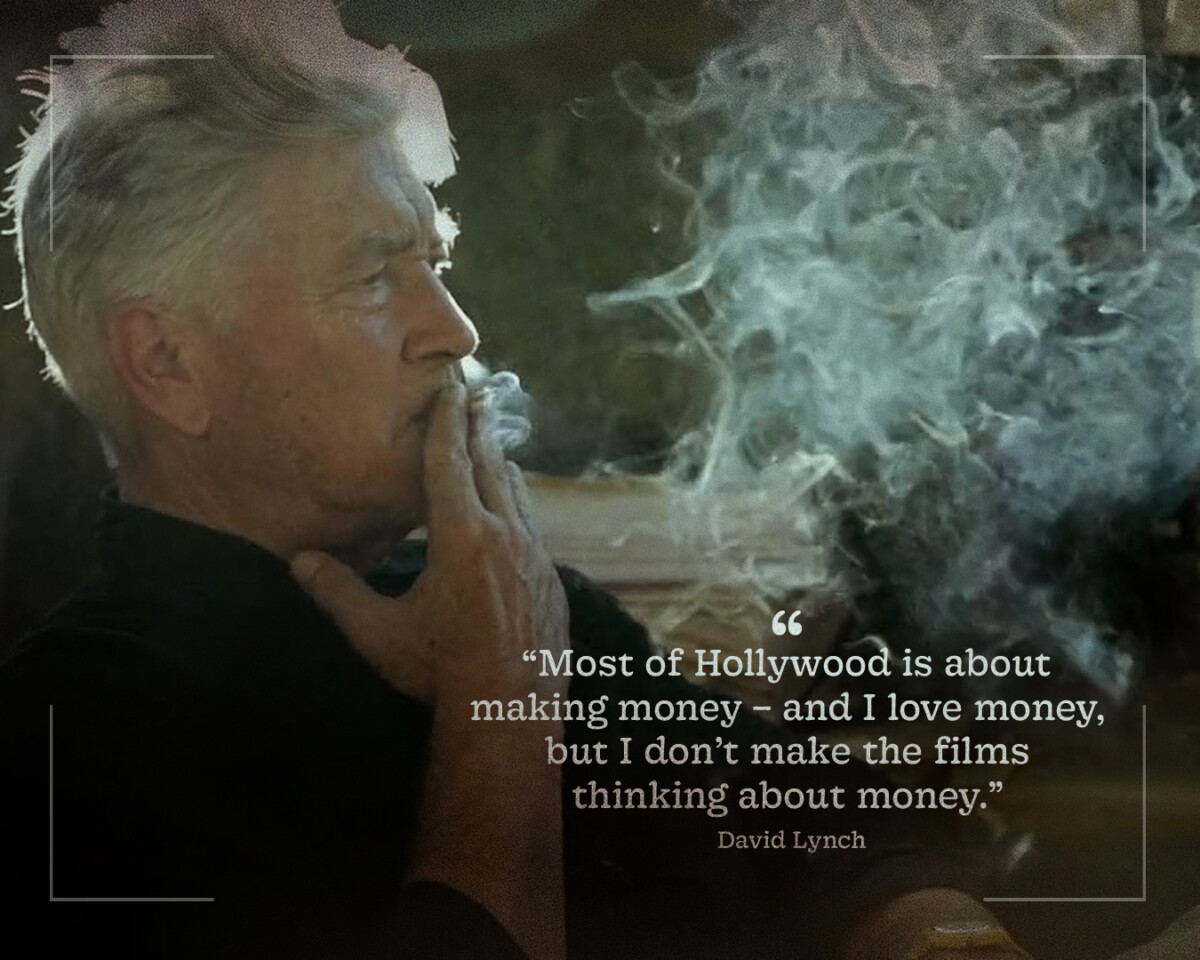
Despite being his most popular release, Twin Peaks wasn’t even a high earner, but it taught him how much he needed to keep to himself. “I stopped watching that show because it got so bad,” he even said to The Times as he stopped working on the show in season two, wanting to end it after Laura Palmer’s killer was revealed but being forced to bend to ABC’s will. After that, his passion for DIY projects was fiercer than ever.
But also, if Lynch did want funding, the reason is that, simply, he wasn’t a safe bet. The Lynchian world is infamously niche and strange, and his creations are like Marmite, which you either love or hate, and that doesn’t make for a good investment for a studio, vindicated by some abysmal box office stats.
Lynch made Inland Empire with only three million, which is a truly tiny budget in the grand scheme of things, yet still, he only grossed $0.85m. The Elephant Man was nominated for eight Oscars, but only grossed $26.01m, which is a tiny fraction in comparison to the $90m made by the ‘Best Picture’ winner that year, Ordinary People.
Even one of Lynch’s bizarrely highest-grossing projects, Dune, made only $30.9m against a $40m to 42m budget. So even as his reputation was powerful and ever-growing, any company looking to work with him would take one look and those stats and strike him off the list as a risk too big to take on.
“Honestly, I’ve never seen a nickel from every distribution deal I’ve ever done in this country,” he said as the director would shoulder the loses and accept not even breaking even to get his films made and out there, adding, “That’s the long and the short of it. And that sucks!”
