


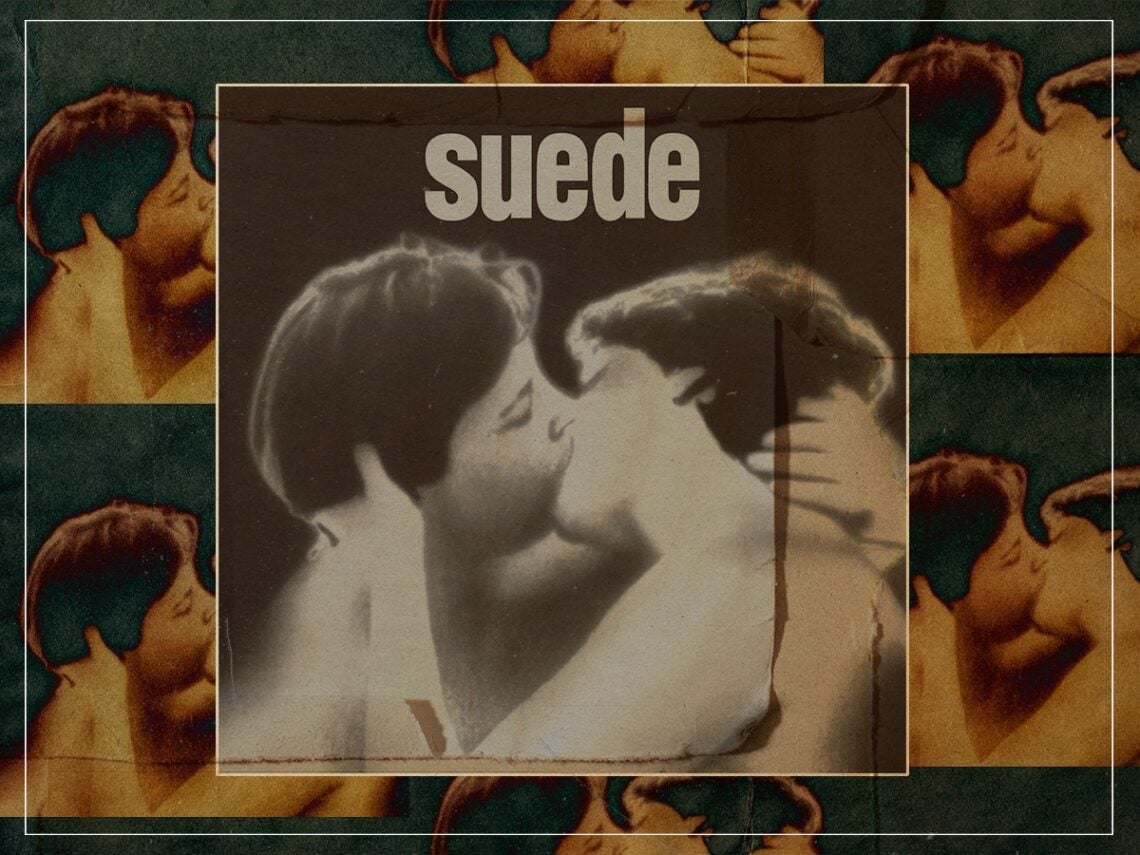
Who is kissing on the ‘Suede’ album cover?

In Britain, discussions about the game-changing music of the 1990s typically revolve around two camps: Nirvana and Britpop. Nirvana, with their 1991 debut Nevermind, spearheaded the resurgence of rock music, making it the cultural zeitgeist once again, while Oasis and Blur helped move the world beyond the moribund grunge scene as the decade progressed. While this narrative holds a significant truth, it often overlooks other key acts that contributed to the decade’s musical greatness, including Suede, who played an essential role in shaping the era’s sound.
There are many reasons why Suede are so often discussed after Oasis and Blur regarding resurgent British rock in the 1990s. One of the most unavoidable is the nearly unrivalled cultural significance of the once-warring Mancunian and London bands. However, Suede played a pivotal role in facilitating the wave of Britpop bands that emerged after them and offered an intriguing counterpoint to the filthy darkness of grunge in the early 1990s.
Their music was undoubtedly sordid and atmospheric, too, and placing them at the forefront of this great wave of six-string refreshers, Bernard Butler was one of the best guitarists around, touted as the second coming of Johnny Marr. Yet, frontman Brett Anderson’s androgynous image and transgressive lyrics cut a different image from the largely America-specific grunge and its frontmen’s pained bellows. Although there was also a clearly jaded, Generation X essence coursing through Suede’s work, Anderson’s vocals and lyrical palettes brought to mind Bowie in his glam era and the early Velvet Underground, and not the 1980s punk underground and the nightmares of being trapped inside one’s psyche.
Suede were also distinctly British. Through Anderson’s deeply glam presence and Butler’s dynamic playing, they straddled the cultural faultlines between British indie of the 1980s and grunge, a masterstroke, even if incidental, that put them at the vanguard of British music at the time. In image and sound, they pulled together the elements that would ensure British music was well-primed to survive the slow dissipation of grunge and continue pushing forward as the world around them evolved quickly and the new millennium approached. This is despite Noel Gallagher’s protestations.
Another reason Suede aren’t praised as much as Blur and Oasis is that they are still going. They might have split in 2003 and not reconvened until 2010, but they have withstood the passage of time and continued to be exceptional on record and live. Their most recent album, 2022’s Autofiction, reflects this perfectly, with it one of the best moments in their entire oeuvre.
It must be said, though, that their first two albums are universally regarded as their best. While the hipsters among us would say that the darker second effort, 1994’s Dog Man Star, is their finest, the purists sit firmly on the hill where their 1993 self-titled debut is their ultimate offering. It’s a tough call, but one thing is for certain: the debut is one of the most emphatic introductions to a band in the decade. It is brimming with staples, including ‘Animal Nitrate’, ‘Metal Mickey’, ‘The Drowners’ and ‘So Young’.
While the music is what makes Suede such a masterpiece, like every influential album, the cover played a part in selling its spirit to the masses. It has also long had mystery attached to it, augmenting the transgressive essence of the music.
Who is on the front cover of Suede?
Although the group had several potential names in mind when producing their debut, they ultimately settled on the name Suede, which seemed a perfect fit for the gloriously sleazy music. As a total package, the title, music, and artwork proved a match made in heaven. Famously, the cover art is gender-ambiguous, featuring two people kissing, and as a sign of the times, it prompted a fair share of controversy.
“‘I chose it because of the ambiguity of it, but mostly because of the beauty of it,” Anderson explained to The Independent in 1993. “There’s an elegance and a beauty to our music that people haven’t heard yet, and I want that to come across – the flow of it, the swoon, to a certain extent.”
The cover image is taken from the 1991 book Stolen Glances: Lesbians Take Photographs, edited by Tessa Boffin and Jean Fraser. The photograph on the front was taken by American photographer Tee Corinne, who explored sexuality in her work. She denied the band’s request to use the full original shot of the two naked women and asserted that they could only use a head and shoulder close-up.
She did this to protect their identity, meaning that the identity of those featured on the front of Suede remains a mystery. Let’s be honest, though; it’s perfect this way. The fact that Corinne only allowed such a version of her image to be used created one of the most iconic covers of the 1990s and one of the best examples of image reflecting sound.
