


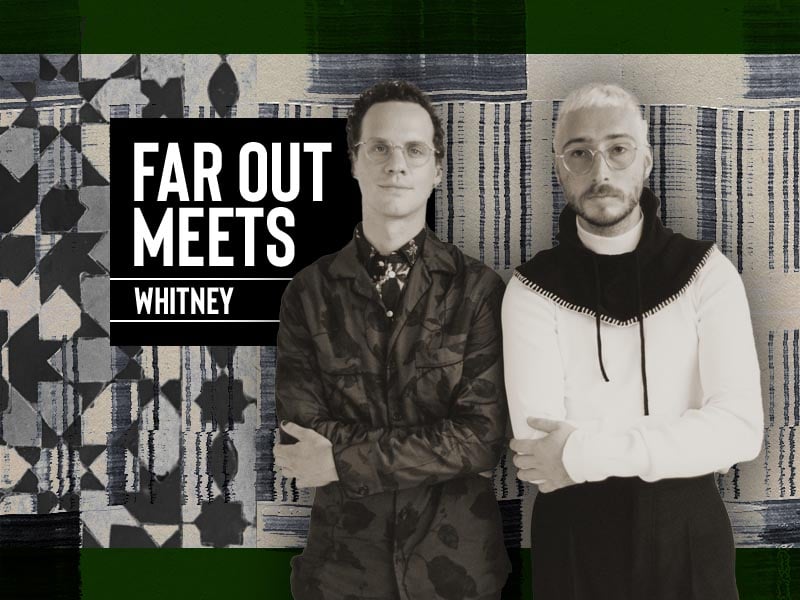
Far Out Meets: Whitney talk about their brand new LP ‘Spark’

We’re still living in the era of the post-Covid album. Just like how the virus hasn’t gone away, neither have albums directly inspired by the isolation of the pandemic. Chicago indie rockers Whitney aren’t immune – when the world stopped in early 2020, the duo had just released their covers LP Candid and were planning more tour dates behind the album. Instead, Julien Ehrlich and Max Kakacek found themselves holed up in Portland house, unsure of what to do.
“Similar to the entire world, for a while there, I feel like we went through the classic kind of pandemic vibe of feeling really pessimistic at times and being teased with some optimism,” Kakacek explained. “Like vaccination happening, if you remember that whole storyline, at first is like ‘Next month, it’s going to be fine.’ It kept on getting put off for months and months. And I think mainly when we started writing the record was at a point where we finally realized that we are going to be not touring. We thought we were going to have more time to write and just really embrace that time as a space to create new music.”
That new music turned into Spark, the pair’s fantastic new album. Featuring a mix of woozy keyboards, soulful R&B, and just a hint of the band’s original roots rock sound, Spark is an engrossing exercise in restraint and vibrancy. Even though they’ve embraced more electronic sounds, the duo made sure not to get too icy in their approach.
“I think something that was really important for us, in the mixing process, and the arrangement process, was to keep the sense of warmth that Light Upon the Lake and FTA [2019’s Forever Turned Around] both had,” Ehrlich says. “Which, maybe on first listen to ‘Real Love’, you’re probably like, ‘Oh, man,’, it’s just so aggressive. And that’s probably the most aggressively arranged and produced song on the record. But I think when you spend a little bit more time listening to the record, you discover the comfort still exists, and the warmth still exists, which we’re proud of.”
‘Real Love’, the album’s first single, is a potent mix of hip hop beats, gentle keyboards and Ehrlich’s signature high-pitched vocals. If most of Spark is a warm blanket, ‘Real Love’ is the cold draft that makes you need the blanket in the first place. Settled right in between the ambient tones of ‘Twirl’ and the upbeat rhythms of ‘Memory’ on the album, ‘Real Love’ is a noticeable turn in a new direction for Whitney.
But if you ask the band members, it’s still classic Whitney, especially in the new arrangement that the pair have composed for live performances. “For that song, specifically, we just got back from New York, and we did some sessions out there and performed a lot of the songs on Spark with Julian, myself and two members of the band and string quartet,” Kakacek says. “We perform ‘Real Love’ we’re doing is actually playing the chords on acoustic guitar. It’s a lot more, I wouldn’t say folky, but it’s maybe…”
“It’s really powerful,” Ehrlich jumps in. “It’s intense because I don’t even think we’ve fully realized when we were making it that we were writing a song that can work in any arrangement, or any style or whatever. And that was the first time that we did it.”
“It’s the same when you bring the new songs back to the band and try them out in different ways,” Kakacek concludes. “They still hold up and are beautiful in their own kind of way. We were really attached to kind of like everything about the way that ‘Real Love’ is produced and everything, but it’s really refreshing to know that it also can exist in a different way as well, as more of a nod to the songwriting.”
“What’s kind of strange about this record is like track one [‘Nothing Remains’] was the first song that we wrote and the first song that we recorded in the studio,” Ehrlich says. “So ‘Nothing Remains’ kicked it off. And that song came together so quick, and it like felt really refreshing versus Forever Turned Around, which we really pored over that record and drove ourselves completely crazy while writing it.” When ‘Nothing Remains’ turned out to be a much smoother process, that’s when the duo knew they were going in the right direction.
“I think it was just really important that the first song that we tried to write clicked and came together. We were like, ‘Damn!’, and then we sent it to one of the producers that we have worked with, Brad Cook, and he immediately hit us back and was like, ‘This is the best song you guys have ever written. Keep going.’ That was like really early pandemic, and he was just like, ‘I’m so glad that you guys are together right now: to make something special.'”
The new technology embraced by the band wasn’t exclusive to expensive synths and cutting-edge instruments. Throughout the album, you can hear producer Brad Cook adding contributions from his iPad. “Brad was playing the iPod quite a bit,” Ehrlich laughed. “Like a glandular synth app.”
“Boarderlands,” Kakacek clarified. “On ‘Self’ especially. [Cook] had Will [Miller] record like a trumpet part, drop a tune, then he had the different bass waveforms. The way that you play that instrument is you use your hands to activate waveforms at different times. He’s kind of playing the trumpet on my path. And it’s also kind of synthesising it at the same time and kind of altering the fillable digital artefacts. So when you hear like this trumpet solo and stuff, they were played by Will, but they’re kind of reimagined by Brad.”
The pair also went back into the long history of non-digital keyboards in order to find the sounds they were looking for. Specifically, Kakacek was able to pick up a Mellotron, the same instrument used by Paul McCartney to record the intro for ‘Strawberry Fields Forever’, was employed to give the album a more retro sound.
“We kind of dove into Mellotron land out of necessity on this record, just because during the pandemic, it was impossible to like get the homies to come over and just play strings,” Ehrlich explains. “But yeah, we were also pretty conscious of the Mellotron sound being so one of one that we were conscious of it. We had to stop ourselves from using it.”
After a nearly two-year break, the longest that the band has ever stayed off the road, Whitney will be returning to life on the road to translate the songs from Spark to the stage. Just because the album is slightly more digital doesn’t mean that the guys are afraid of a challenge when it comes to translating the music to live shows.
“I mean, it’s more exciting than anything,” Kakacek says. “And finding a way to use our skill set as performers to get the sounds that we create on the album, I think is like a welcome challenge. I think one of the benefits, and there aren’t many, so it’s like trying to find a positive spin on what the pandemic caused, but one of the things that I think is easy to fall into when you tour an album for a really long time is you’ve fallen like these kind of performance-based habits on whatever instrument you’re playing. It’s really easy to fall into a formula that you’ve done before, from repeating playing songs in that same aesthetic over and over again.”
That pause from the road caused Whitney to regain their creativity with crafting live performances. “Having a break from the live show really helped us just open up,” Kakacek says. “Now when we’re going to get the live band together, we kind of get to learn a whole new way of presenting music. That also is true to the recordings, but it’s playable in an organic sense as well.”
The live setting allows a greater level of spontaneity to come up. “I think they’ve all we’ve all toured enough to know that you start to change the parts like after like, three, four months in,” Kakacek says, “where it’s just like, ‘Alright, I’m just going to let myself kind of rip on this start doing the things that originally felt kind of corny.’ For some reason, maybe it’s because you’re losing perspective on who you are as a human being, but it’s here that you’re like, ‘You know I am going to play there.’
One notable instance of spontaneity involved referencing a specific theme song from The Legend of Zelda video game series. “The lowest and highest moment of that was Malcolm [Brown], when we were in the UK, started playing one of the Zelda theme songs over a solo section. And one of the other members of our band was so mad,” Kakacek laughed. “Like, ‘What are we doing? What the hell are we doing? Why is video game music being played?'”
All in a night’s work for Whitney. Spark is available to buy and stream now. Whitney will be spending the rest of 2022 touring across North America and Europe, so check your local venue to potentially hear your own Legend of Zelda solo.
