


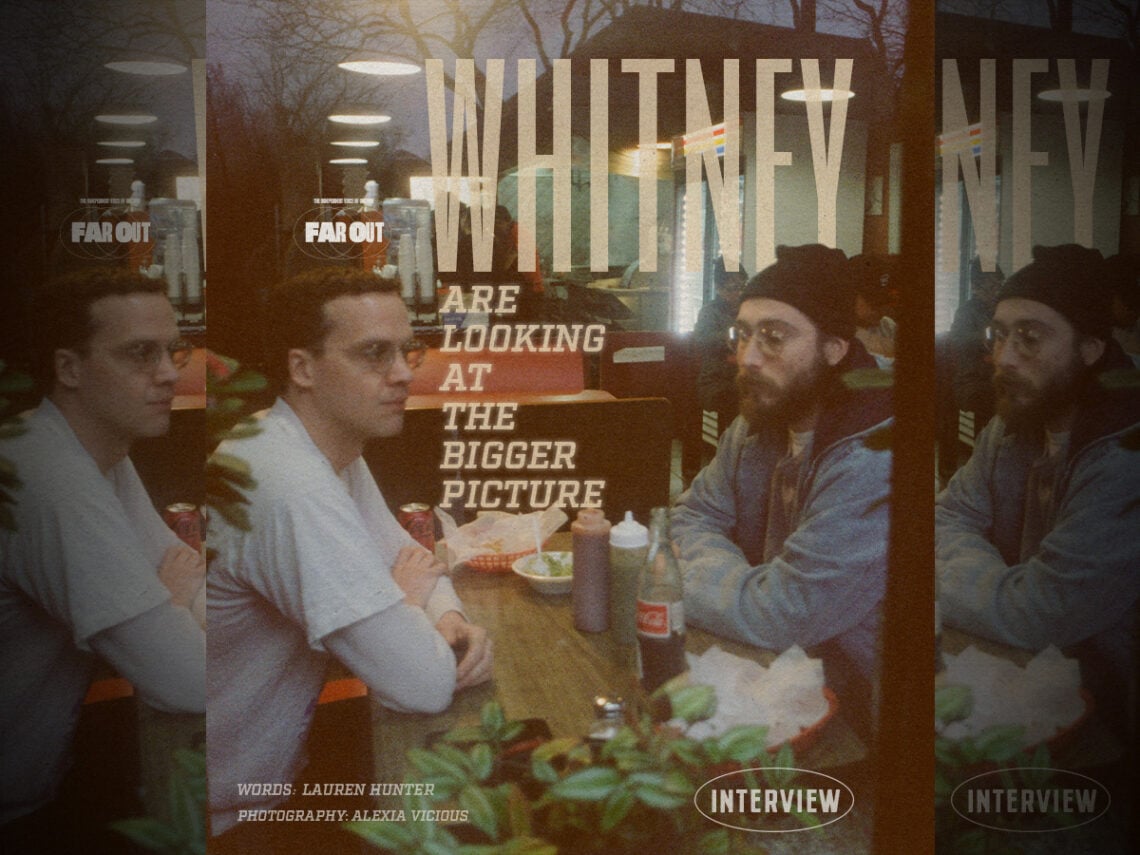
Whitney are looking at the bigger picture: “We can be self-sufficient”

It’s early morning in America as indie rock band Whitney sit on their sofa, huddling over their laptop screen.
They sip on iced coffees and water as they wake themselves up to the chat. Diving headfirst into discussing the genesis and inspiration behind your most vulnerable album yet isn’t the easiest first task of the day, I suppose.
But this is where we begin with Max Kakacek and Julien Ehrlich, the two main brains behind the indie rock machine of Whitney. Their latest album Small Talk is slated for release in November, and although they haven’t spent much time out of the spotlight leading up to it, it’s clear that some form of soul-searching has gone on to get them here.
“It’s been two years since we released an album, but I think at this point in our careers, we’re always trying to release new music as soon as possible,” Kakacek explains. “I mean, this record has been done for about eight months or so, and we’ve just been kind of slowly rolling it out. We’re ready at any moment to drop it. Really, we’re just excited.” The reason for this is mainly because, for the pair, it feels like a homecoming.
Whitney’s previous album, Spark, released in 2023, saw the band branch off in a new direction away from their indie wheelhouse towards electronics, which was a very unexpected move for them, by their own admission. But it also gave the band a renewed focus when they came back to what they know and love for Small Talk.
Ehrlich notes: “We needed the bigger picture. We needed to go and switch the tools and the actual sonics that we were working with for Spark, so that we could come back and actually have a fresh perspective on some of the more organic instruments that we started the project with.” That sense of searching for the “organic” subsequently meant they had to strip everything back, both literally and metaphorically.
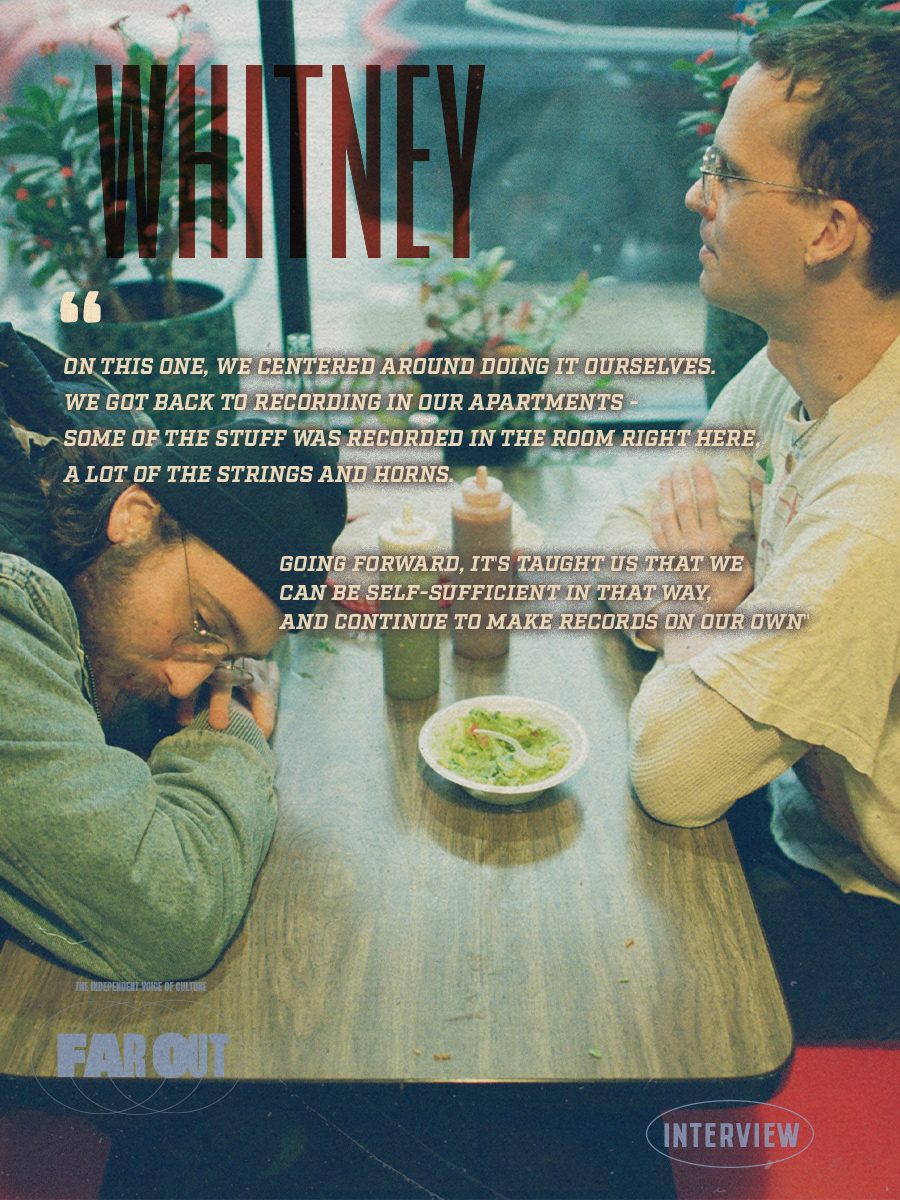
“We spent the past two and half albums working with a producer in professional studios and stuff. On this one, we centered around doing it ourselves. We got back to recording in our apartments – some of the stuff was recorded in the room right here, a lot of the strings and horns. Going forward, it’s taught us that we can be self-sufficient in that way, and continue to make records on our own, while also leaning into the charm of something between a home recording and a professional recording,” they enthuse.
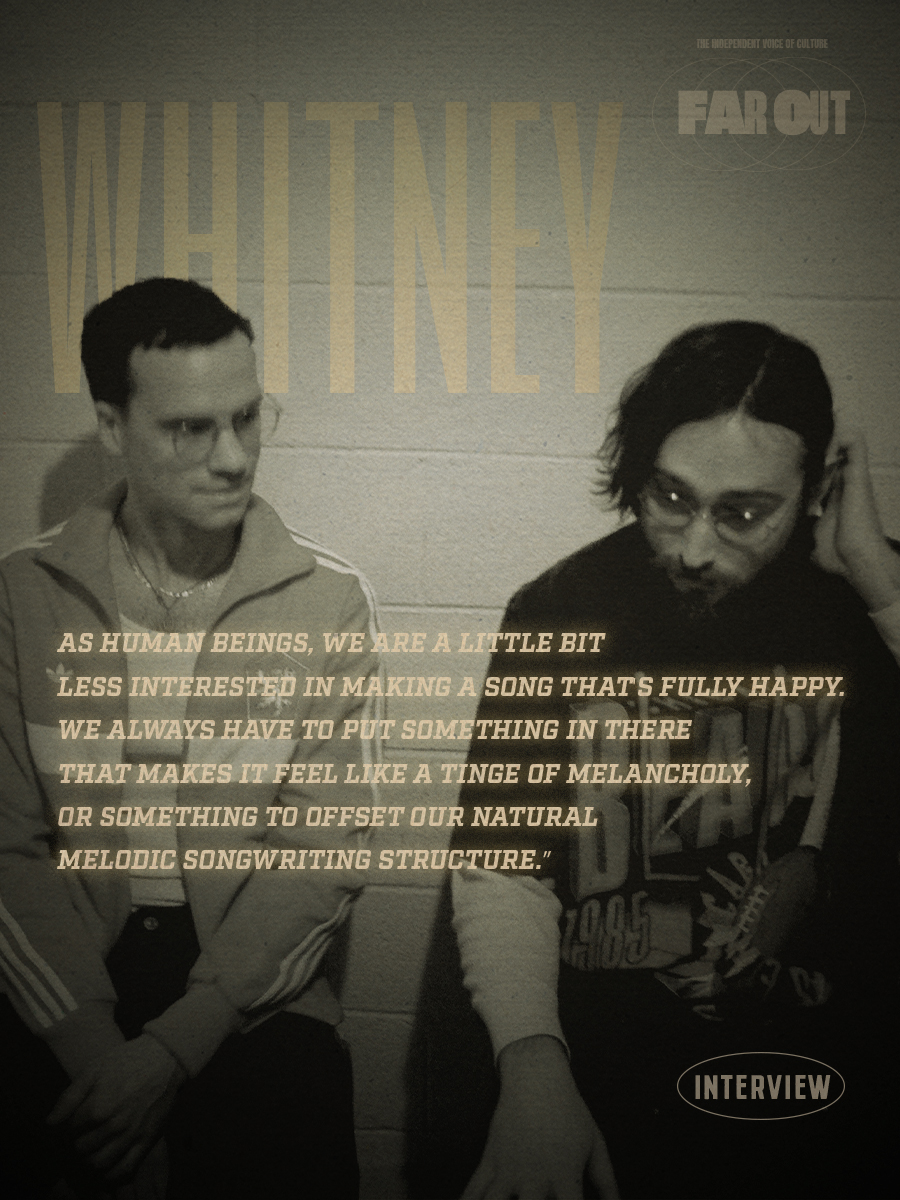
With a renewed sense of confidence in what they know best, their current singles ‘Dandelions’ and ‘Darling’, as well as the latest release of ‘Back to the Wind’, showcase the band at their quintessential peak – uplifting, but not without a sucker punch of sadness in between. Kakacek and Ehrlich admit they veer naturally to “pop melodies and arrangements”. But that’s almost like a musical veneer, they say. “As human beings, we are a little bit less interested in making a song that’s fully happy. We always have to put something in there that makes it feel like a tinge of melancholy, or something to offset our natural melodic songwriting structure.”
But this stylistic intent doesn’t just spawn out of one’s brain from the minute they sit down to start penning an album. Like all writers, Whitney draw inspirations from across the cultural zeitgeist that inform their songs, ranging from the mundane to the absurd. Whether it was watching Poor Things on mute while working out melodies or being “terrified” by the niche 1989 art film The Cook, The Thief, His Wife and Her Lover, Small Talk has a wide array of muses. Yet the last thing you would expect is prog rock.
Kakacek and Ehrlich explain that when the outside ears of their friends and family first heard the album, particularly its titular song, they were taken aback by certain elements. “You guys made a prog song,” they say is what their producer, Brad Cook, told them. But Ehrlich is keen to stress that this influence was not intentional nor consistent; more of a “piecemeal” approach, as he puts it.
“In ‘Really Something’, it’s like, there’s [a part] that I think is like a Robert Fripp solo, but it’s just in that one moment on the whole record, that’s the only time we’re here. And it doesn’t really have an overarching thing that affects everything,” he explains. “It’s like a very stagnant Robert Fripp solo that just creeps up on you,” Kakacek interjects.
It’s clear that this new era the band are entering into is full of a selection of new, typical, and classic muses. But perhaps more than ever, they are doing this against a societal backdrop as volatile as it has ever been, and that’s where Whitney have made the biggest change so far. They’re standing up to fight. A few days before we spoke, they were one of the acts to perform in the Fighting Oligarchy tour of the US progressive independent senator Bernie Sanders, in a moment they said was an “honour” to join the political sphere.
“He’s the only American politician that makes even a semblance of sense,” they say. “So when we got asked to do it, it was just like, ‘of course’. It’s the first time we’d ever done anything even semi-political. What was important [was the fact that] we have a band of seven people who are individuals. But the second we brought it to the group, like, ‘Hey guys, we want to do the Bernie Sanders thing’, every member of the band said yes immediately. That shows the alignment with artistic minds in America and where their heads are at. Bernie is just like a hero of all of ours.”
In many ways, the band’s leap into throwing their weight behind a political cause for the first time is emblematic of the newfound sense of confidence that the Small Talk era has given them. After a tangent of experimentation, they’ve realised more than ever that it’s their classic sonics they do best, and so it’s time to put their entire heart and soul into it. Ehrlich coined an interesting phrase about “doing things the Whitney way” – if one thing’s certain, that’s clearly the motto they’re set to live and die by.
Whitney’s latest album, Small Talk, will be released on November 7th.
