


Which musician started the “melting pot” of 1960s Laurel Canyon?

Where the myth of Laurel Canyon‘s music history began is often lost in a lysergic haze.
The glamour of Laurel Canyon’s musical lore may be slightly contrived, sure, but the mountainous neighbourhood remained a vital source of inspiration, nonetheless. From my East Coast perspective, Laurel Canyon persists as a West Coast hub of glamour and vitality, a place where ‘celebrities’, both established and burgeoning, could unwind and be at their most vulnerable, and establish a semblance of normalcy in the otherwise chaos of Los Angeles.
In its mountains, early silent film stars from Clara Bow to Harry Houdini famously made their homes; actors could once live (somewhat) secluded from the glare of the public eyes of Hollywood. Later, when the musicians came to town, they could coexist in an idyllic, communal space of artistry, one simultaneously driven by sex and drugs as much as by genuine creative sparks.
Chris Hillman is believed to be the earliest of the musicians from the Laurel Canyon scene to move to the neighbourhood, coming from his native San Diego in 1964, when he was just 19 years old. As the story goes, he was shopping at the cultural centerpoint of the Canyon Country Store, when he met someone offering a place to rent, a moment that Hillman later described to The Bluegrass Situation as “purely by accident”.
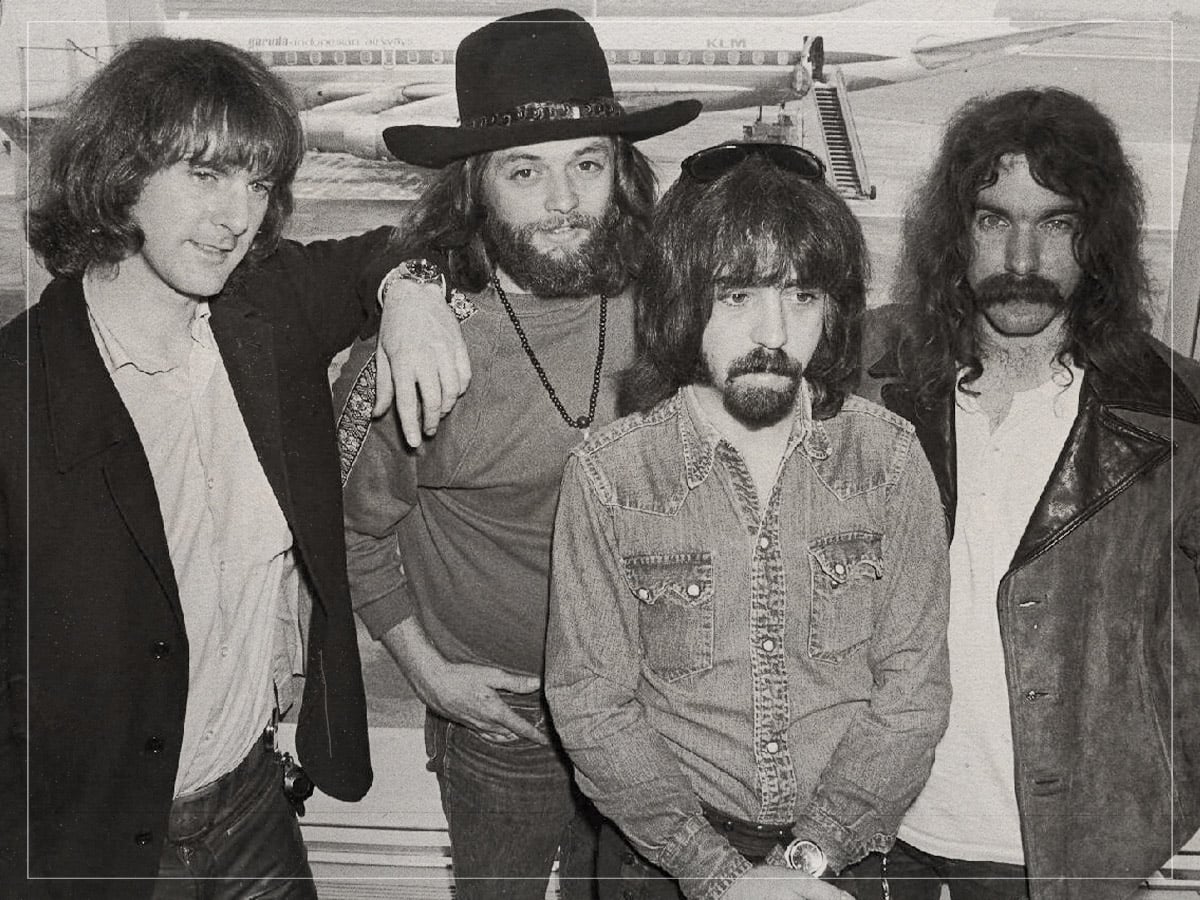
His band, The Byrds, had formed the year prior, and Hillman, alongside Roger McGuinn, David Crosby, Gene Clark and Michael Clarke, joined as their bassist. In the following year, The Byrds would achieve fame with their rendition of ‘Mr Tambourine Man’, solidifying their niche of country-rock within the counterculture.
“It was wonderful. It was up on this road overlooking the entire city of LA. You can imagine how beautiful it was at night, with all the lights on and everything,” Hillman described his first Laurel Canyon home, explaining that Crosby and McGuinn soon followed in his footsteps and made the neighbourhood their new home, too. As he asserted, “The Byrds were very early occupants of the area”.
Other origin stories have circulated over the decades since Laurel Canyon was properly placed on the musical map, and these origins become more difficult to directly pinpoint as the influx of artists arrived. “It was a melting pot,” Elliot Roberts, manager to Neil Young and onetime manager of Joni Mitchell, Crosby, Stills, Nash & Young and The Eagles, told Vanity Fair, “People came from everywhere. Joni and Neil were from Canada, Glenn Frey was from Detroit, Stephen Stills and JD Souther were from Texas, Linda Ronstadt was from Tucson…”
The appeal of Laurel Canyon went beyond its mountains: For one, the rents were cheap, which allowed for up-and-coming musicians to escape from the city without too much worry. The surroundings were the perfect enclave for an artist looking to live within a sense of calm, while having close access to the city within Los Angeles, where the clubs they performed at along the Sunset Strip and the like were just a short drive away, down the hill.
As more musicians moved in, including James Taylor, Carly Simon, Jim Morrison, The Mamas & the Papas, among many others, the neighbourhood’s charm only grew stronger; there was a palpable romance in the air, and a tangible beauty in its quiet nature. Some believe that the neighbourhood’s true musical history did not begin until Frank Zappa moved into town, on the corner of Lookout Mountain and Laurel Canyon Boulevard in 1968, which would be his home until his passing in 1993.
On the other hand, many cite Joni Mitchell as the first star to grant Laurel Canyon its fame, where music was concerned. Famously, she followed the writings of an old book found in a flea market, which advised (or warned, rather) that the craziest people in America live in California, those crazier live in Los Angeles, and then in Hollywood: “Ask anyone in Laurel Canyon where the craziest people live and they’ll say Lookout Mountain,” she once paraphrased, “So I bought a house on Lookout Mountain”.
Her house, 8217 Lookout Mountain Avenue, to be specific, was where Crosby, Stills & Nash was born, and later immortalised by them in the aptly-titled 1970 tune ‘Our House’, their song with Neil Young as CSNY. Still, Hillman may very well have planted the seed for Laurel Canyon to grow into an unprecedented nucleus of culture that lasted into the 1970s, with countless artists honing their talents in the neighbourhood’s inexplicable well of creative powers.
