


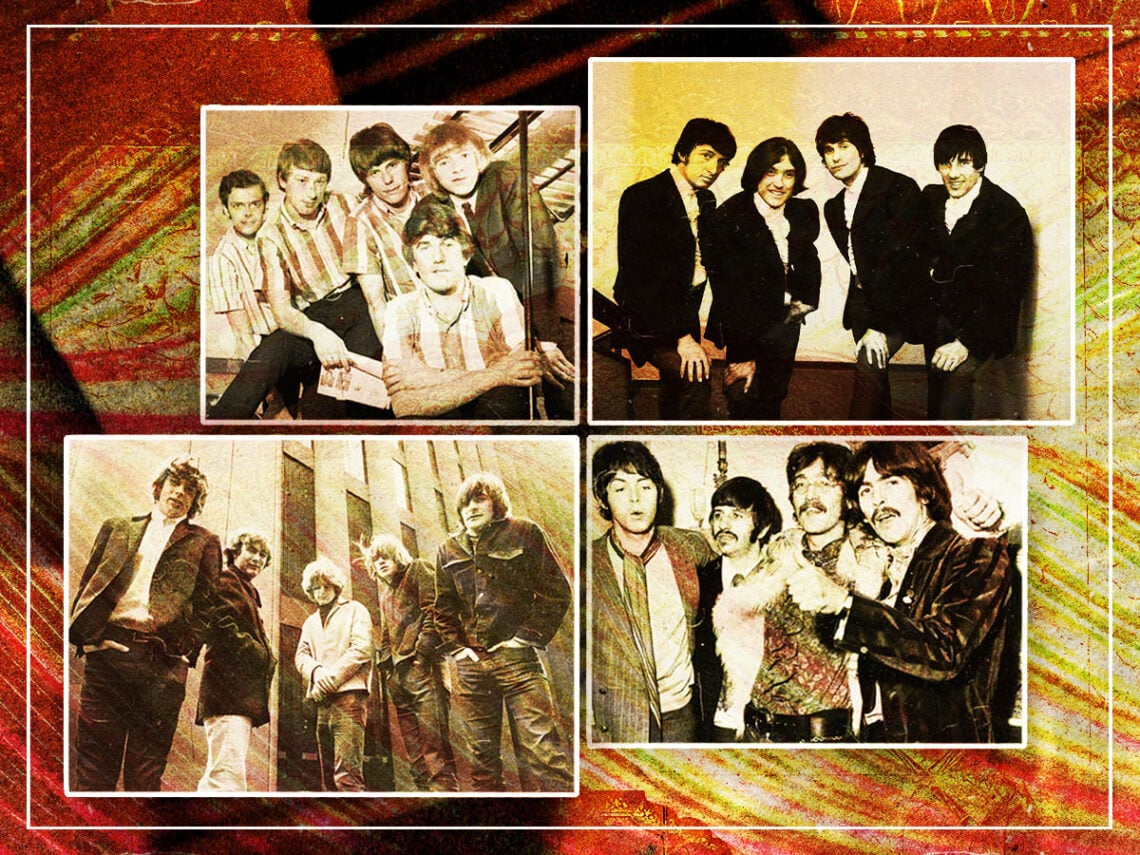
Which band invented raga-rock?

The Western world’s fascination with the culture of India has stretched back hundreds of years. But just 15 years after the country became a republic independent from British rule, the Brits were once again trying to steal something from India. This time, it wasn’t artefacts or soldiers – it was instruments and sounds. Starting in 1965, a massive wave of inspiration from traditional Indian classical music was making its way into British pop music. It was such a profound shift that a new genre tag was deemed necessary: raga-rock. In the spring of 1965, The Yardbirds were ready to ride that wave.
After guitarist Eric Clapton departed the group due to their embrace of pop music on the single ‘For Your Love’, The Yardbirds recruited Jeff Beck, a player whose expertise was in experimenting. Beck’s arsenal included a fuzz box, overloaded amps, and slinky guitar tones that immediately revolutionised the band’s sound. When songwriter Graham Gouldman came to the band with his follow-up to ‘For Your Love’, Beck took note of the sitar-like drones created by Gouldman’s open chord strumming.
‘Heart Full of Soul’ was recorded specifically to tap into the Indian raga. At first, the band even hired a pair of professional Indian musicians – a sitar player and a tabla player – to lay down the song’s central riff and rhythms. But after being dissatisfied with the results, Beck decided to replicate the sitar sound himself. “The sitar player couldn’t get the 4/4 time signature right; it was a hopeless waste of time,” Beck explained in the liner notes to his 1991 box set Beckology. “So I said, ‘Look, is this the figure?’ I had the fuzz machine, a Tonebender going. We did one take, it sounded outrageous. So they kept the tabla player, who could just about make it work. They rushed that out, and the rest was a rollercoaster ride.”
Jimmy Page, who helped facilitate Beck’s recruitment into The Yardbirds, observed the session and became obsessed with the sound of the sitar. “Let’s put it this way: I had a sitar before George Harrison got his,” Page told author Brad Tolinski in the book Light & Shade. “I wouldn’t say I played it as well as he did, though; I think George used it well. The Beatles’ ‘Within You Without You’ is extremely tasteful. He spent a lot of time studying with Ravi Shankar, and it showed.”
‘Heart Full of Soul’ was recorded in April of 1965, leading the charge for what would eventually evolve into raga-rock. But just down the street two weeks later, The Kinks had their own take on the upstart genre. After experiencing a layover in Bombay while attempting to get to Australia for touring commitments, Ray Davies heard a group of fishermen chanting while preparing their boats early in the morning. Those chants would be the earliest basis for the song ‘See My Friends’.
“I always liked the chanting. Someone once said to me, ‘England is grey, and India is like a chant.’ I don’t think England is that grey, but India is like a long drone,” Davies explained about the origins of ‘See My Friends’ in the 2013 book God Save The Kinks. “When I wrote the song, I had the sea near Bombay in mind.”
The Kinks also decided to replicate the sound of the sitar on guitar, with the Davies brothers using a similar combination of overdrive and compression to achieve the effect. Ray Davies recalled that the droning riff was created with a 12-string guitar. Davies’ central vocal melody was a strong deviation away from The Yardbirds’ bluesy take on the raga, having been directly inspired by the melismas of traditional Indian music. ‘Heart Full of Soul’ was released a month before ‘See My Friends’, but Dave Davies was sure that The Kinks started the raga-rock trend.
“I think everybody copies to a certain extent,” Davies told Melody Maker shortly after the song’s release. “I’m not really annoyed when groups copy us – it happened a lot in the past. One thing does bother me – we didn’t get any credit for making a very Indian-sounding record with ‘See My Friend’. Since then, over the last six months, groups have all been doing this Indian thing.”
Even though both The Yardbirds and The Kinks were the first groups to embrace Indian sounds on their records, it would be The Beatles who brought the sitar and raga-rock to the world. While filming the band’s second feature film Help! in April of 1965 (two weeks before The Yardbirds recorded ‘Heart Full of Soul’), George Harrison became interested in the sitar that was being played by a musician who was hired for a scene in an Indian restaurant. George Martin had composed a medley of Beatles songs to be played in the traditional Indian style for the film’s score.
Harrison’s fascination was solidified after having a discussion with The Byrds guitarist David Crosby, who was one of the first American rock musicians to embrace the skills of sitar virtuoso Ravi Shankar. Harrison’s resolve to learn sitar was still in its infancy when John Lennon brought in the song ‘Norwegian Wood (This Bird Had Flown)’ to record. Harrison picked up the sitar and picked out the notes by ear, having not yet had any professional lessons on how to play the instrument. Harrison’s rudimentary playing would still be enough to catapult raga-rock into the mainstream.
Thanks to his influential effect on Harrison, Crosby was determined to get in on the ground floor for raga-rock. With his Byrds bandmates, Crosby co-wrote ‘Eight Miles High’, a song that paired the group’s signature folk-rock jangle with explicit Indian influences, psychedelic touches, and even jazzy improvisations. During the initial press conference to promote the single on March 28th, 1966, The Byrds’ publicist coined the term “raga-rock”, although both Crosby and Roger McGuinn dismissed the genre tag.
“It’s rock ‘n’ roll, it’s neither jazz nor Indian music. But we listen to their music, and we like it, and it influences our minds and our playing,” Crosby said in 1966. “Rock is going to keep growing. It has in it now African, South American, jazz, folk, church, Bach, Indian, Greek, country, bluegrass.” The band’s press conference featured McGuinn demonstrating sitar techniques, solidifying the instrument’s prominence in pop music.
In the months following ‘Eight Miles High’, nearly every band adopted raga-rock as the new sound of rock music. The Rolling Stones had ‘Paint It Black’, The Hollies had ‘Bus Stop’, The Doors had ‘The End’, and Donnavan had ‘Three King Fishers’. American blues rock band The Paul Butterfield Blues Band experimented with extending raga-rock into jam rock with the 13-minute ‘East-West’. In June of 1966, ethnomusicologist Harihar Rao teamed up with Los Angeles session players The Wrecking Crew for Raga Rock, an album of rock covers that officially codified the genre tag.

Never Miss A Beat
The Far Out Beatles Newsletter
All the latest stories about The Beatles from the independent voice of culture.
Straight to your inbox.