


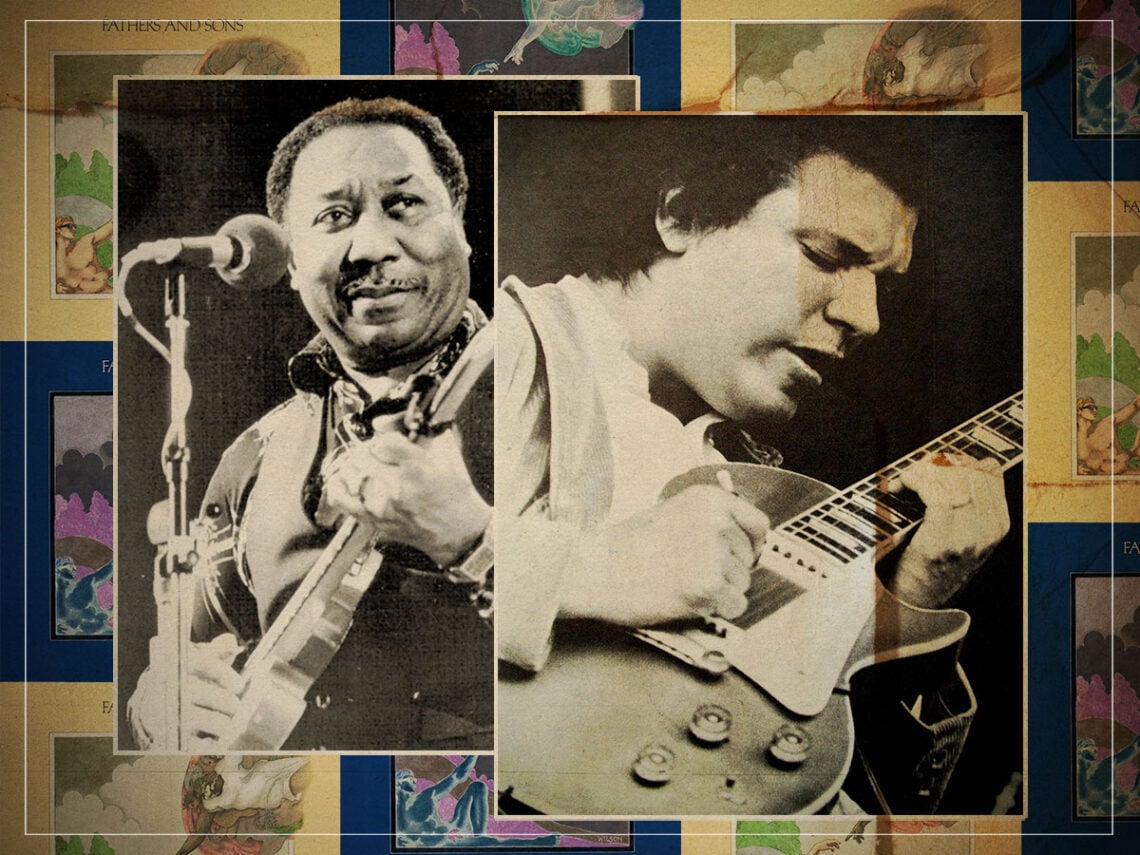
‘Fathers and Sons’: when two generations of blues greats got together

Muddy Waters’ music is the bedrock upon which almost all of the electric blues and blues rock of the 1960s was inspired and built. He is the foundational stone, rolling along and gathering no moss. He was the original and originator of the modern Chicago sound and the father of the modern electric blues.
Born McKinley Morganfield in 1913, Muddy Waters was raised on the Stovall Plantation near Clarksdale, Mississippi. From a young age, Waters worked as a sharecropper on Stovall, but in his teens, he turned to music to break up his days and nights. Emulating the styles of his favourite singers, like Son House and Robert Johnson, Waters played an acoustic slide guitar, harmonica and sang. He’d work the land all day long and would work the crowds all night, playing music at fish fries, cookouts, and juke joints.
In August 1941, with Waters approaching his 30s, ethnomusicologist and folklorist Alan Lomax paid a visit to the Stovall Plantation. Having been sent on behalf of the Library of Congress to make field recordings of the blues singers of the South, Lomax was looking for Robert Johnson. Unbeknownst to him, Johnson had already been laid low in mysterious circumstances three years previously. Instead, he found Muddy Waters and so set about making the first-ever recordings of McKinley Morganfield.
“He brought his stuff down and recorded me right in my house, and when he played back the first song, I sounded just like anybody’s records,” Waters later remembered. “Man, you don’t know how I felt that Saturday afternoon when I heard that voice, and it was my own voice. Later on he sent me two copies of the pressing and a check for 20 bucks, and I carried that record up to the corner and put it on the jukebox. Just played it and played it and said, ‘I can do it, I can do it.’”
Lomax returned to Stovall twice more to record Waters again. Emboldened by hearing the power of his songs on record for the first time, the singer soon set out from home, hopped a train, and traded in the deep South for the South Side of Chicago. There, he plugged in and picked up where he’d left off back in Mississippi. Bringing his raw, visceral brand of the blues with him and energising his performance with electric amplification, he was soon lighting up the city with his new sound.

Following the release of songs like ‘I Can’t Be Satisfied’ from the Lomax recordings and ‘Rollin’ Stone’, ‘Honey Bee’ and ‘I’m Your Hoochie Coochie Man’ with Chess Records in Chicago, it wasn’t long before Muddy Waters was the hottest property in town, the leader in a new musical direction and could have his pick of any of the finest players that he wanted. Over the years, his bands included such luminous and legendary musicians as Otis Spann, Little Walter Jacobs and Willie Dixon, among many others.
It was Muddy Waters’ music which initially brought Mick Jagger and Keith Richards together (and gave their band its name), and it inspired Eric Clapton, George Harrison, Jimmy Page, and countless other rockers in the 1960s to plug in and play the blues. Two other prodigious talents who heard his songs and felt shaken to their core were native Chicagoans Paul Butterfield and Michael Bloomfield.
Thanks to Waters’ seminal recordings and mesmerising performances, such as the one he gave at the Newport Jazz Festival in 1960, as well as the works of fellow Chess stars like Howlin’ Wolf, John Lee Hooker and Bo Diddley, the blues became the beating heart of the growing rock movement in the early 1960s. These bluesmen inspired the next generation, and their music became the domain of the white rockers who were now taking centre stage, both in America and, especially, in the British Invasion. The blues had been passed—or some might say watered—down and travelled a thousand miles away from its roots by now but informed almost all of the revolutionary works which artists like Bob Dylan, The Rolling Stones, The Beatles and, of course, The Paul Butterfield Blues Band in the decade were making.
To bring Muddy Waters back into the conversation, which he had been instrumental in starting, Chess Records co-founder Marshall Chess came up with the concept of Electric Mud. If the young groups had taken the electric blues into a psychedelic realm, why couldn’t the founding father follow in their footsteps for once and do the same thing?
Electric Mud is a fierce, heavy album on which Waters goes further into the darkest realms of his songs than ever before. The psychedelic elements of the album may have predated the sound of Albert King’s later work by a full ten years, but at the time of their release, they were too far out for the American music-buying public. The album initially sold well—over 150,000 copies in its first six weeks, becoming Waters’ biggest-selling record at that time—but interest soon dropped amid a backlash of negative reviews. Some critics claimed that the album “bastardised” the blues and watered down Waters’ iconic sound. Marshall Chess couldn’t believe the negative response but pointed out that not everyone was so quick to dismiss the album, saying that “it was the biggest Muddy Waters record we ever had at Chess, and it dropped instantly. The English accepted it; they are more eccentric.”
Following the Electric Mud experiment and a further psychedelic album, After the Rain, guitarist Michael Bloomfield came up with a much better idea for how to bring Muddy Waters to the attention of a younger audience. Instead of getting Waters to try and sing in a more contemporary rock style, why not surround him with his musical progeny and bridge the generation gap in a more natural and real way?
Bloomfield first sat with Muddy Waters during live sets at clubs like Pepper’s Hideout before he was even old enough to be officially allowed inside such a venue, cutting his teeth on the South Side of Chicago with the old master, learning and earning his chops. Now a sought-after star in his own right, Bloomfield found himself in the studio with his hero, as well as legendary pianist Otis Spann—the other father from the album’s title—and former blues band bandmate Paul Butterfield, the other son. To complete the lineup were Donald ‘Duck’ Dunn on bass and Sam Lay on drums.

Over the course of a few days, Waters, Bloomfield, and company cut arguably the finest collection of recordings in Waters’ career. With a much more natural feel than Electric Mud or After the Rain, each member of this musical family has space to show off their genius and true mastery of their instruments, but it’s always in service of the song and always in service of elevating Muddy Waters into the highest of heights, where he belongs.
The group are locked in on every track, playing as if they were one singular unit and delivering definitive renditions of songs like ‘Forty Days and Forty Nights’ and ‘I Love the Life I Live (I Live the Life I Love)’. ‘Walking Thru the Park’ is an unbelievably and undeniably funky groove, which switches time and strides, struts and swings along. It bounces and bounds, and it gets you every time. ‘Blow Wind Blow’ blows right through you and blows you down. ‘Can’t Lose What You Never Had’ slowly lurches along, and ‘I’m Ready’ really grooves. ‘Sugar Sweet’ sweeps you off your feet with a breathless and audacious piano, while Butterfield goes toe to toe with Waters’ vocal with his harmonica throughout.
The album is warm, groovy, greasy, and gutsy. It gets low down, and it flies up high. The band bends together and rolls and tumbles into territory that is not found on a lot of other blues records from this era, or any other, for that matter. It takes the classic Muddy Waters sound that he’d so well established in the ’50s and expands on it in a more natural, more real, and more bluesy way than had been attempted on his last two releases. There are no gimmicks needed here to put the songs over; there are just six men who have got the blues down to their bones and the spirit to move you through and through, flowing out of them with every breath and with every beat.
The album wasn’t recorded without its problems, though. Bloomfield walked out on the sessions amid a crisis of confidence. Despite the album being his idea, and with him being the greatest guitarist of his generation, he didn’t feel that he belonged in the same room as a great like Muddy Waters and fled a few days into the recording sessions. He had to be coaxed back into the studio and later onto the stage, where the group cut some masterful live recordings of the songs that they’d worked up together a day after the sessions wrapped, which went on to become the second side of the album.
Thanks to its monumental studio sides and the blistering live portion of the album, Fathers and Sons became Muddy Waters’ biggest-selling record on its release and his first foray into the top half of the Billboard 200. The album reached Number 70 in the charts, where Electric Mud had stalled at 127. Waters himself was pleased with the results, saying that “we did a lot of the things over we did with Little Walter and Jimmy Rogers and Elgin Evans on drums. It’s about as close as I’ve been to that feel since I first recorded it”.
The album so reinvigorated Waters that it encouraged him to return to his roots and end the psychedelic experiments. He assembled yet another crack band of veteran musicians for his future dates and sessions, but he would also continue to work with the younger generation of bluesmen throughout the rest of his career, as well.
Waters reunited with Bloomfield for the 1974 Soundstage: Blues Summit show, which also boasted contributions from Johnny Winter on guitar, Junior Wells on harmonica, Buddy Miles and Willie ‘Big Eyes’ Smith on drums, and Dr John and ‘Pine Top’ Perkins on piano, among others.
Waters went on to work with Butterfield again as well in 1975, on an album that also featured Levon Helm and Garth Hudson from The Band, and then with Johnny Winter on his 1978 album Hard Again, his next ‘comeback’ record and his first away from the Chess label which he had called home for so long. Among other younger acts, he also performed with both Bob Dylan and The Rolling Stones in the mid-’70s, but all the while, he always maintained that no one could sing the blues like the musical fathers.
In a 1971 interview, Waters said that the new generation could play “more blues than I could ever dream of playing, but you know, they’ll never be able to vocal like me”. When the reporter asked to clarify that Waters was saying the new kids could learn to play the guitar like he could but not to sing like him, the elder bluesman replied, laughing, “Like me? You mean white kids? Oh, naw! You know better than that! They ain’t got enough soul. They ain’t had enough hard times!”
His musical sons may have brought his songs back into the public eye and public ears, but his influence as The Father of the Chicago Blues will always be much more enduring and important.
