


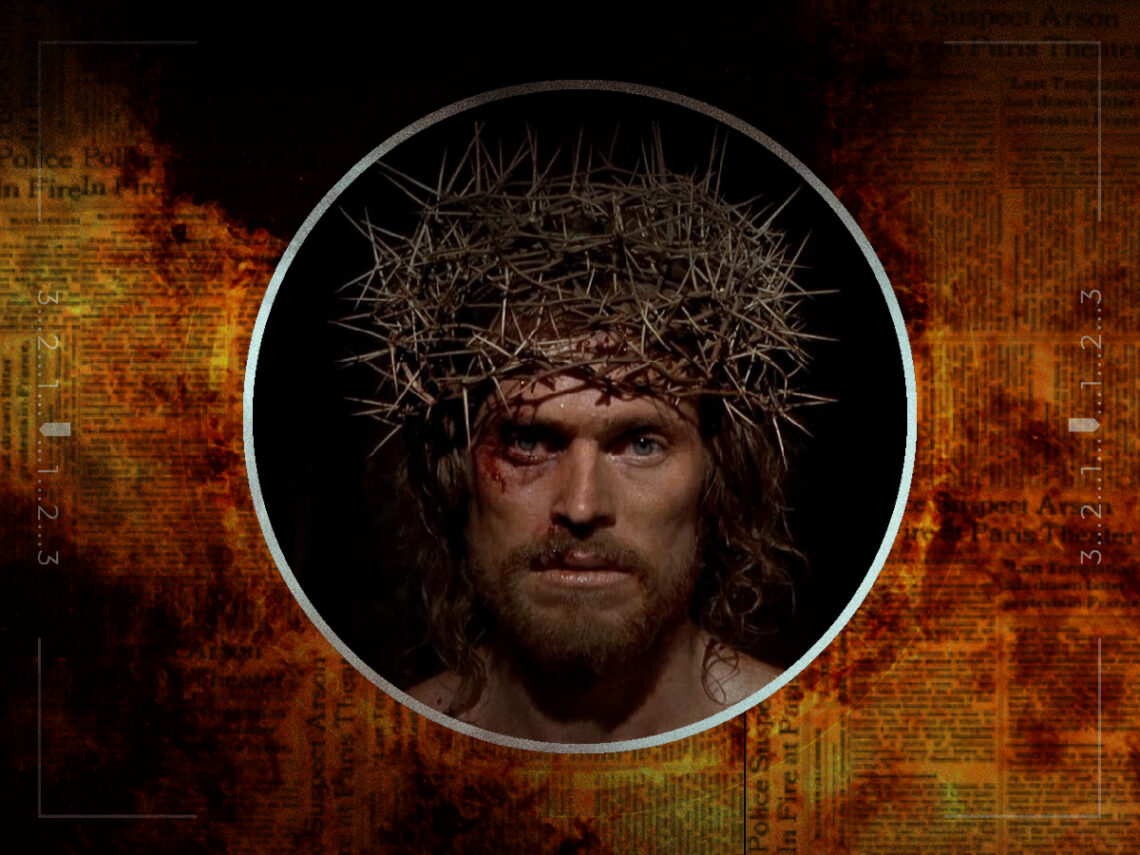
When art meets arson: the movie screening firebombed by fascists

Martin Scorsese‘s films are typically defined by violence, either by individuals, groups, or entire institutions, so you should expect to see something controversial every time.
Even something like The Age of Innocence, which is set in the upper echelons of 19th-century New York, is full of controlling behaviour and psychological warfare, but if you want his most controversial film, you’re going to have to go a lot further back in time than the 1870s.
In 1988, Scorsese took on one of the textbook filmmaker follies and decided to bring the story of the Bible to the big screen, and while The Last Temptation of Christ is technically an adaptation of Nikos Kazantzakis’ novel of the same name, it featured many elements familiar to those who had to suffer through Sunday school.
Willem Dafoe plays the titular Christ as he resists worldly vices in order to preach the word of God, in the film that was received well by critics and even earned Scorsese a ‘Best Director’ nod at the Oscars, but not everybody was thrilled.
As you can imagine, a film depicting the central figure of the world’s largest religion rubbed a few people up the wrong way, which resulted in the movie being banned in several US states, and it is still banned in Singapore and the Philippines, but the strongest reaction came from France.
On October 22nd, 1988, the Saint-Michel in Paris was holding a late-night screening of the film, and just after midnight, a firebomb detonated from under one of the seats, an attack in which four people were severely burned, and a total of 13 were left injured. “It spread quickly, and the flames got as high as two meters,” said theatre manager Pascal Gerard (via UPI), who explained that the screen and most of the seats next to the device had been completely destroyed.
The group linked to the attack was called General Alliance Against Racism and for Respect of the French and Christian Identity, which has got to be the longest name of anything ever, an integrist group with links to a disgraced Archbishop and a member of the far-right Front National party, who had been connected to other disturbances at cinemas across France, including occasions where moviegoers had been physically assaulted.
The Catholic Church and other religious groups have a long history of disapproving of popular movies, but it’s very rare that things escalate to this extent, and for what it’s worth, Jean-Marie Lustiger, the Archbishop of Paris, who condemned The Last Temptation of Christ, also spoke out against this attack. At least nine people were arrested in conjunction with the crime, with five of them receiving prison sentences.
Ultimately, this attack and every other instance of violent censorship achieved was a strengthened resolve from the other side, and The Last Temptation of Christ continues to be enjoyed by millions of people decades later. In attempting to silence Scorsese and his message, all this group did was make his voice even louder.
