


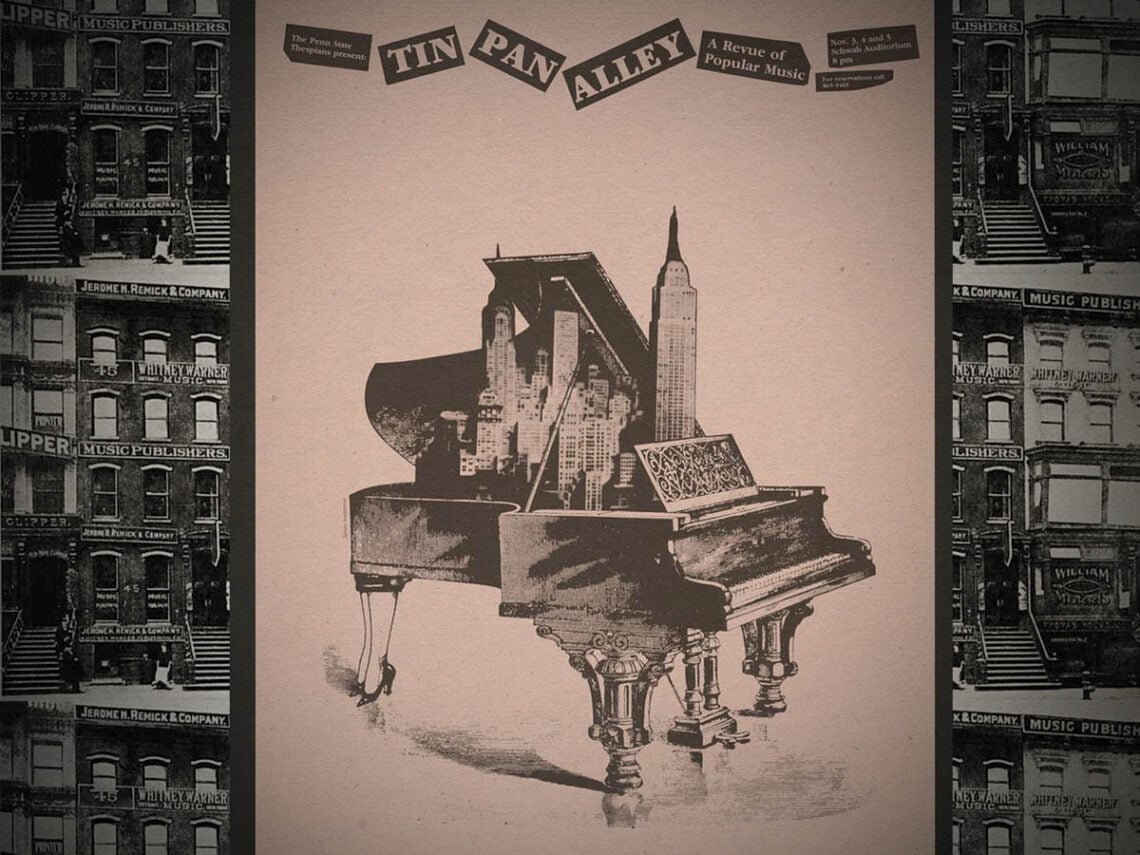
What was the first big hit from Tin Pan Alley?

Nestled within 28th Street in Manhattan, between Fifth and Sixth Avenues, several buildings housed the combined genius of music publishers and songwriters to form Tin Pan Alley.
The establishment of Tin Pan Alley goes back to around 1881, when a number of music publishers settled in the same district of Manhattan. The name itself has a long-debated history, but regardless of its origin, in time, the term quickly grew into being associated with success in the music industry and became world-renowned, associated with the generalised American music publishing industry and, in turn, the United Kingdom adopted its own ‘Britain’s Tin Pan Alley’, on Denmark Street in London’s West End, encompassing its numerous music shops.
Meanwhile, in New York, the original Tin Pan Alley was established in response to the mid-19th century’s lesser copyright control methods, which meant that publishers would often print their own versions of then-popular music. Later on, copyright protection laws grew stronger and, for their mutual benefit (especially where finances were concerned), songwriters, composers, lyricists and publishers began working together. The popular music publishing industry moved along from its start in Boston to Philadelphia, then Chicago, followed by Cincinnati, before finding its home in New York.
Willis Woodard and TB Harms, the two most ambitious publishers, were the first to specialise in popular music, instead of hymns or classical. They moved from Manhattan’s downtown Union Square area, then known as the entertainment district, to 28th Street, and most publishers followed in their footsteps uptown. Today, in place of what once was Tin Pan Alley, a plaque rests on 28th Street between Broadway and Sixth, and the area remains co-named ‘Tin Pan Alley’, with several of its buildings now commemorated and protected as New York City landmarks.
The nation’s largest music houses settled in New York City, while smaller, local publishers still thrived, usually in connection with commercial printers or music stores; alongside them, regional music publishing centres across Boston, Chicago, New Orleans and St Louis remained pivotal. The process for a song’s publishing was as follows: when a given song became a local hit, the rights to the song were typically purchased from the local publisher by one of the larger New York companies.
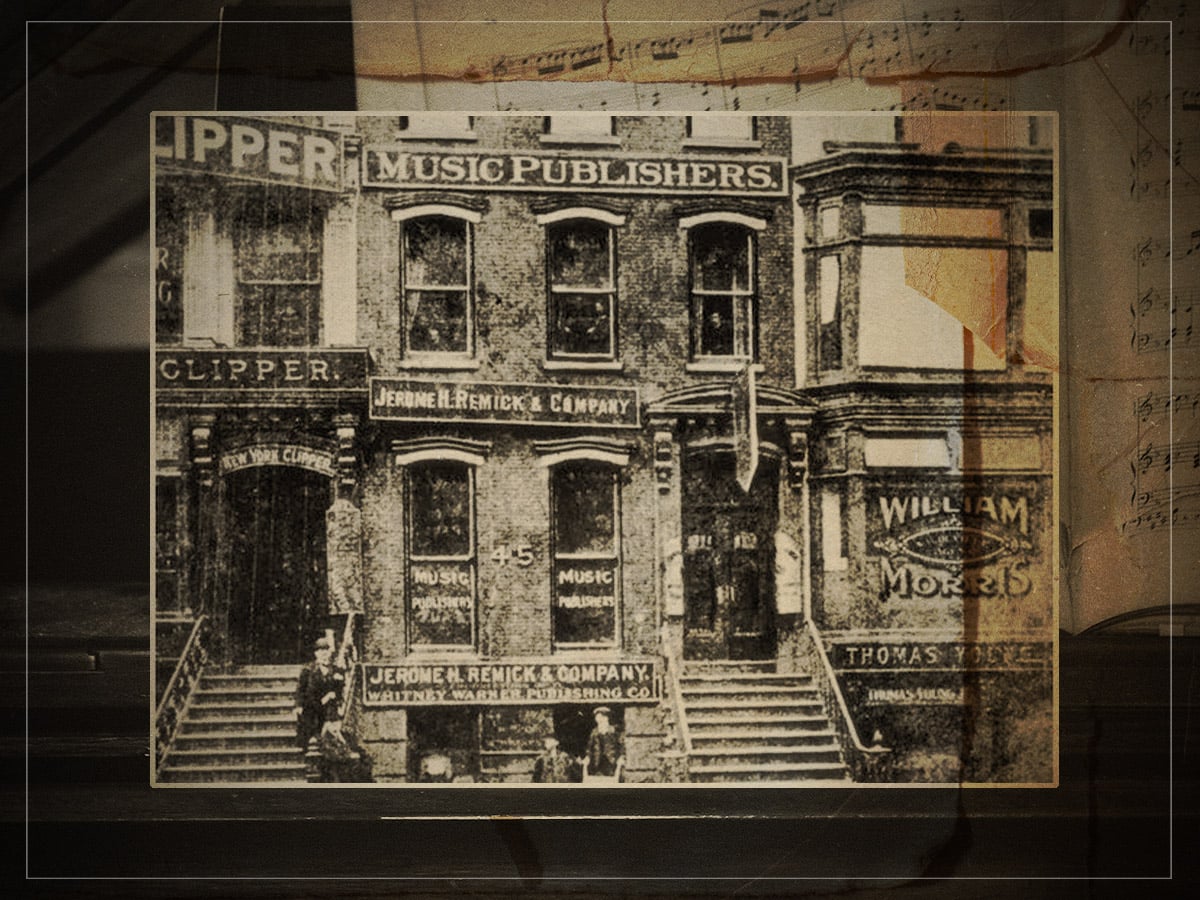
Former salesmen made up the majority of song publishers who helped establish Tin Pan Alley. Joe Stern and Edward B Marks, respectively, were once necktie and button salesmen, while Isadore Witmark sold water filters and Leo Feist sold corsets. The community that brought the scene to life alongside them saw a cast of songwriters and musicians, vaudeville and Broadway performers, and a new phenomenon: ‘song pluggers’, (often songwriters and musicians, as well) whose job it was to perform the organisation’s most recent songs at events like sports games, to gain public interest and sell sheet music. ‘Booming’ often followed, which was the practice of song pluggers buying dozens of tickets for a show, being members of the audience, only to sing a song to be plugged.
As Louis Bernstein, under Shapiro, Bernstein & Co, recalled of his plugging crew days, who attended cycle races at Madison Square Garden, “They had 20,000 people there, we had a pianist and a singer with a large horn. We’d sing a song to them 30 times a night. They’d cheer and yell, and we kept pounding away at them. When people walked out, they’d be singing the song. They couldn’t help it.”
Settling within the apartments, offices and various rooms and spaces of the buildings, the publishers and songwriters made 28th Street their headquarters for production. Songwriters got to work within these walls, as did both freelance and permanent composers who, all together, worked collaboratively to source music’s next big thing, writing and having songs published on sheet music within just a few days. Tin Pan Alley produced the likes of George Gershwin and Irving Berlin, and while there was the obvious incentive of concentrated monetary gain in the establishment, there was also a clear creative boom happening in the area.
What was Tin Pan Alley’s first big hit?
Tin Pan Alley began with specialising in ballads and comic novelty songs, slowly but surely expanding into newer popular styles of music, including ragtime, jazz and blues. The area’s first hit was achieved with ‘Wait Till The Clouds Roll By’, released in 1881 by TB Harms & Co, the year it was established on 28th Street. The song was originally a ‘parlour piece’, one intended, as the name suggests, to be performed in the parlours of houses by amateur singers and pianists, and shared via sheet music.
When asked what their most successful song had been, thus far, Harms said, in an 1884 newspaper interview, “‘Wait Till the Clouds Roll By’ had by far the greatest scale. We sold over 75,000 copies in a single month. It was the easy, jingly music [that] did it, and the sentimental words”.
Credited as being written by JT Wood with music by HJ Fulmer, the song actually came to Harms & Co from Charles Pratt, an American musical arranger who worked under these pseudonyms, and is acknowledged as being behind the first of many hits to come out of Tin Pan Alley.
Things began to shift for Tin Pan Alley some four decades later, in the 1920s, with the influx of musicals with full storylines and soundtracks, which began to take favour over vaudeville-style revues. Hollywood’s growth in the emergence of talkies over silent films meant that the West Coast was also a site of success, not just Manhattan.
Then, in the midst of the Great Depression in the 1930s, radio and phonograph records overtook sheet music, and the consumption of popular music radically changed. Tin Pan Alley persisted into the 1950s, but as music publishing practices shifted, over time, the dominance of the area diminished. As Bob Dylan is said to have declared in 1985, “Tin Pan Alley is gone. I put an end to it. People can record their own songs now”.
