


What was the first movie shot in colour?

The invention of colour filmmaking is often considered a landmark moment in cinema history. It became commonplace in Hollywood in the late 1930s thanks to three-strip Technicolour film, which allowed the full spectrum of colours to be represented on a final print for the first time in mass production without manual additions.
Some of the most celebrated and influential movies of the period, such as The Wizard of Oz and Gone with the Wind, were shot using this process. They paved the way for many more big-budget Hollywood productions in Technicolour over the following two decades, including some of Alfred Hitchcock’s greatest cinematic works.
Once colour motion picture film negatives were introduced in the early 1950s, the use of colour in movies ceased to be an expensive and time-intensive luxury. By 1960, it had become the standard format used for most films.
But this wasn’t a linear transformation from purely black-and-white to mostly colour cinema during a 25-year period. Long before Dorothy was following the yellow brick road or Clark Gable was professing not to give a damn, people were making motion pictures shot entirely in colour.
So, which feature film came first?
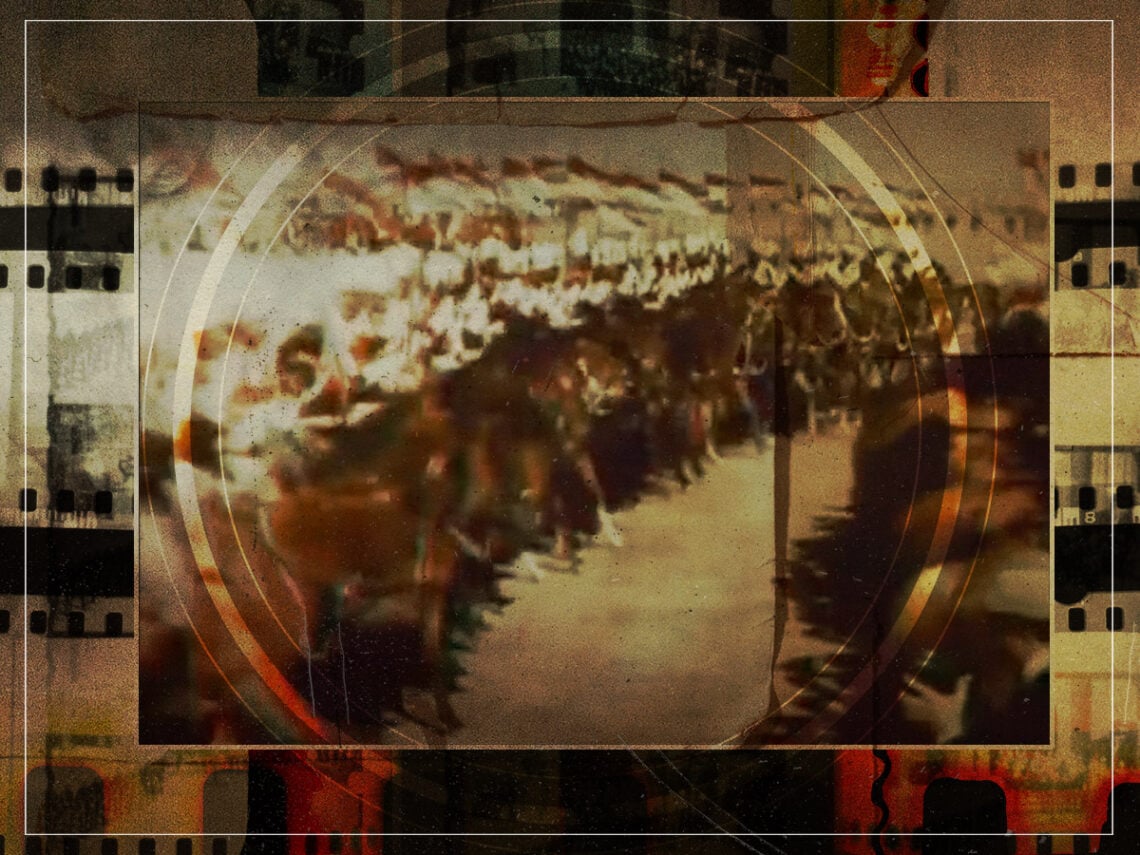
If we include movies which were shot using the Kinemacolor process, the British 1912 documentary film With Our King and Queen Through India was the very first feature-length production to be “shot” in colour. That is, it was shot through red/orange and blue/green filters, which affected what was rendered on the film negative. This process wasn’t quite as accurate as three-strip Technicolour and could result in some unnatural or blurred colouration.
The 150-minute documentary followed the journey of newly crowned King George V and his wife across the Indian subcontinent. The first narrative film shot with Kinemacolour was also British. 1914’s The World, the Flesh and the Devil, which is now lost, was a 50-minute drama dealing with class inequality.
If we exclude Kinemacolor-shot movies, the first film to be shot entirely in colour was the 1917 American comedy-drama The Gulf Between. Another lost film, this movie couldn’t be mass-produced as it required a specially-made projector to be shown.
The first mass-produced movie shot in colour was The Toll of the Sea, which premiered in 1922. And the first movie shot entirely in three-strip Technicolour, four years before The Wizard of Oz, was the 1935 historical drama Becky Sharp, which was an adaptation of William Makepeace-Thackeray’s novel Vanity Fair.
As this selection of films shows, the history of colour cinema isn’t nearly as straightforward as a couple of big-name Hollywood productions in the 1930s. Excluding the necessity for films to have been “shot” in colour, we can, in fact, go right back almost to the beginning of filmmaking itself and find even earlier examples of colour movies.
Yet none of the films mentioned that were made prior to Becky Sharp remain available to us in full. Only certain sequences of With Our King and Queen Through India have survived, for instance. Still, in these sequences we can catch a glimpse of what it must have been like seeing colour cinema in the world for the very first time.
