


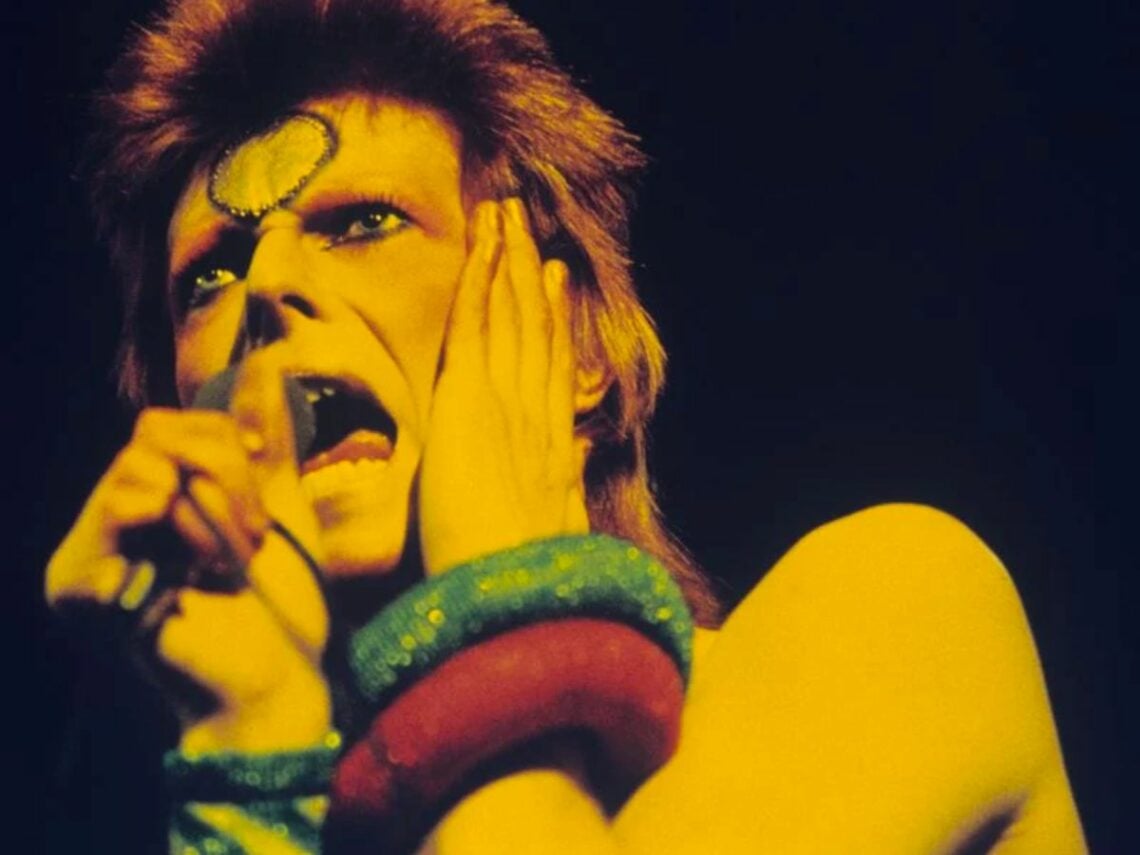
What is a ‘Moonage Daydream’ and why was Ziggy Stardust caught up in one?

Ziggy Stardust, and therefore David Bowie, always had a weird pull to the realms of outer space. In other words, does a bear shit in the woods?
While it probably wins the award of being one of the most obvious statements of all time, it does warrant repeating when considering the character’s crash-landing into the world. Yes, he was strange and bizarre and an alien concept – but for an artist who made their break by longing after the moon landings, he also made complete and utter sense.
Indeed, in the evolution that began with ‘Space Oddity’ and resulted in The Rise and Fall of Ziggy Stardust and the Spiders from Mars three years later, in 1972, Bowie’s psyche had morphed from an appreciation of outer space to a total obsession with the supernatural, leading to Stardust taking the helm as his greatest charge.
But on the aforementioned album, it isn’t until the third track, ‘Moonage Daydream’, that Stardust gets his first foray. From that point forward, he was unforgettable, unstoppable, and entirely unique. But it also begs a perhaps naive question: what on Earth does a ‘Moonage Daydream’ actually mean?
In typical Bowie fashion, the answer is never straightforward, but through a series of space-age speculations and guttural instincts, a pretty clear picture can still be formed. Through the moon, the stars, and all the planets, Stardust had made his way to Earth, but he did so to impart a message about his spectral and spellbinding true home.
So, what actually is a ‘Moonage Daydream’?
Without wanting to pop any bubble of anticipation here, the honest answer is that there is no singular, clear definition of what a ‘Moonage Daydream’ exactly is. It’s spectral and daring, certainly, and phallic to some degree – but part of its allure is that it’s also somewhat unspecified and enigmatic, just as Bowie and Stardust themselves were designed to be.
As the character roundly proclaims himself as an “alligator”, “mama-papa”, “space invader”, “rock n’ rollin’ bitch” and “pink monkey bird” throughout the song, it elicits the sense that a ‘Moonage Daydream’ is that ultimate moment of carelessness, euphoria, and electric energy that the character, and the rest of the world, so deeply craves.
Whether that ends up being achieved through sex, gender exploration, or simply existing as a figure on Earth with a distinct identity is open to interpretation, but Stardust being caught in the midst of that storm speaks volumes as to the wide-eyed realisation that modern society had at the time: people could go to the moon. Anything was possible.
It still remains one of the most powerful fascinations in all of music history that Bowie felt so intensely drawn to the outer galaxy that it prompted not just a litany of his most iconic songs, but a staple of his career. They say that dreams of tomorrow died with the 1960s, but if Ziggy Stardust was anything to go by, the intrepid journey of new ambition was only just taking flight.
