


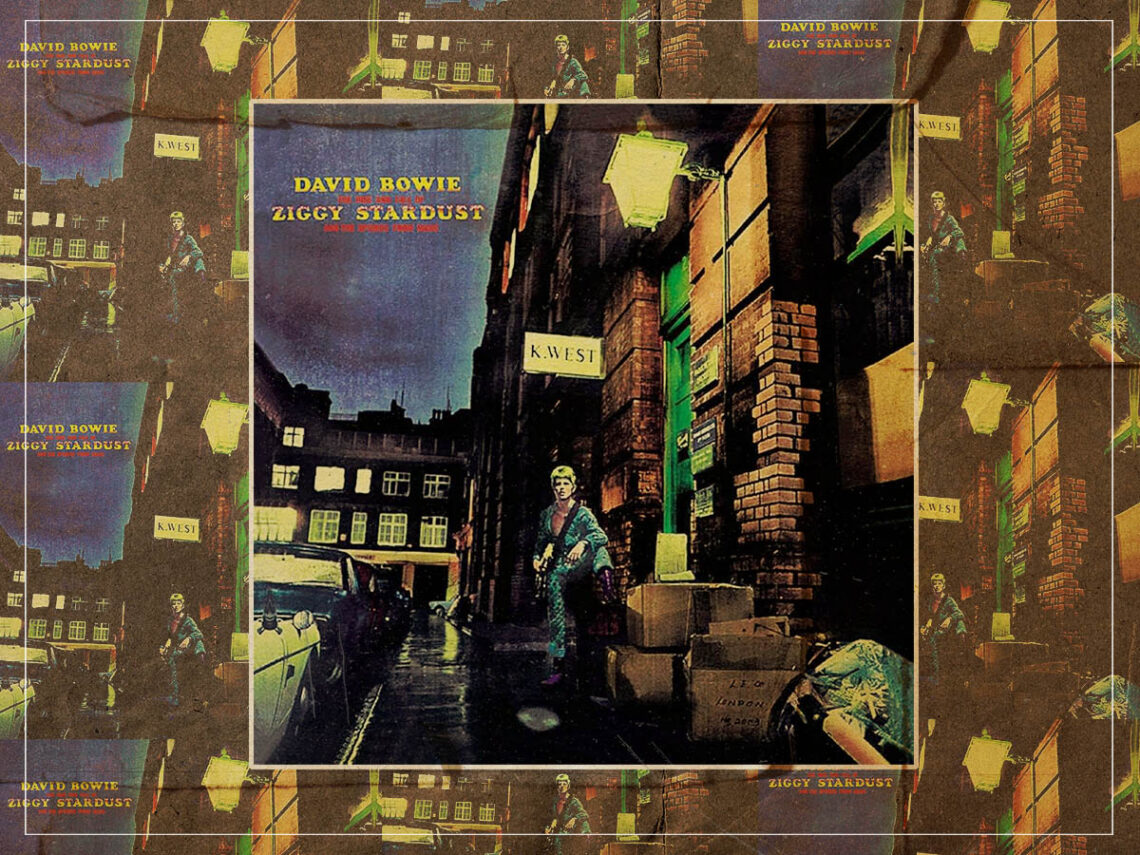
The Cover Uncovered: David Bowie’s alien rock star lands with ‘Ziggy Stardust’

There is perhaps no more famous alter ego in music than Ziggy Stardust, the alien rock star counterpart of David Bowie who was sent down from space as a saviour to the world against an apocalyptic nightmare. The character first landed on Earth in 1972 on Bowie’s fifth album, fully titled The Rise and Fall of Ziggy Stardust and the Spiders from Mars. It brought a new aura of androgynous rocking energy to the landscape, which changed the face of the industry forever.
But an album that was bound to make such a seismic sonic splash needed some similarly iconic artwork to go with it, of course. Yet when you conjure an image of Ziggy Stardust, all space age and sex appeal, what the cover actually depicts is something jarringly more mundane, giving more suburban London than stratospheric galaxies. Nevertheless, this striking visual juxtaposition is exactly what draws you into its warp, making the Ziggy Stardust album artwork an iconic symbol of the glam rock era.
Against a gloomy indigo sky, Bowie – AKA Ziggy – stands underlit by the basking yellow glow of a streetlamp beneath an office sign that reads ‘K West’. Certainly, it doesn’t seem to be embodying much of the glamour the record’s genre is meant to emit, but this is possibly, in fact, the point. Ziggy Stardust is an alien undercover, after all, here to save the world but also indulge in all the culture, opportunities and noise that the big city has to offer. He has to keep it cool.
To that end, the covert signs of Ziggy’s otherworldliness had to be hidden in plain sight. Speaking of his vision for the persona in 1993, Bowie explained: “The idea was to hit a look somewhere between the Malcolm McDowell thing with the one mascaraed eyelash and insects. It was the era of Wild Boys by William S Burroughs. [It] was a cross between that and Clockwork Orange that really started to put together the shape and the look of what Ziggy and the Spiders were going to become. Everything had to be infinitely symbolic.”
As such, with Ziggy somewhat looming in the foreground, a Gibson Les Paul guitar slung nonchalantly over his shoulder, the spirit of the character was born. All that was needed was someone to capture it. That job was landed with photographer Brian Ward, who snapped the iconic shot on January 13th, 1972, outside his Heddon Street Studio in central London. Interestingly, Ward initially took the picture in monochrome, and it was later coloured by the illustrator Terry Pastor, giving rise to the zinging pop of luminescent glow that shines from the lamppost down onto Bowie and the street below – the impression that a star has arrived, here in the spotlight.
Regarding Bowie himself, the choice to have Ziggy standing alone in the shot was certainly an interesting one – wasn’t he meant to be joined by his band, the Spiders from Mars? There could be endless ways of artistically interpreting this, but as it turns out, the reason was purely logistical. Bowie was ill with flu on the day of the photoshoot, and in order to save time and allow it to wrap quicker amid further bad weather conditions, his fellow alien mates just decided to stay inside.
But what also can be made of that sign above, ‘K West’ – what kind of meaning was that trying to conceal? Again, less creative than you might think; it was just the name of the genuine company that worked out of that office on Heddon Street, and it’s fair to say they weren’t best pleased when the album first hit the shelves, and Bowie fans began to flock there. Unfortunately, the sign was taken down in 1991 after the company moved premises, but this bucket list location for Bowie diehards will always live on regardless.
Ziggy Stardust’s descent to Earth sparked a whole new sonic imagination in the glam rock sphere, leading on to the equally iconic Aladdin Sane, where the orbital alien adorns that striking red bolt across his face. But his pounding of the late-night London streets was only the beginning of that journey – though it was one that was out of this world.
