


From auteur to AI shill: What is Martin Scorsese doing?

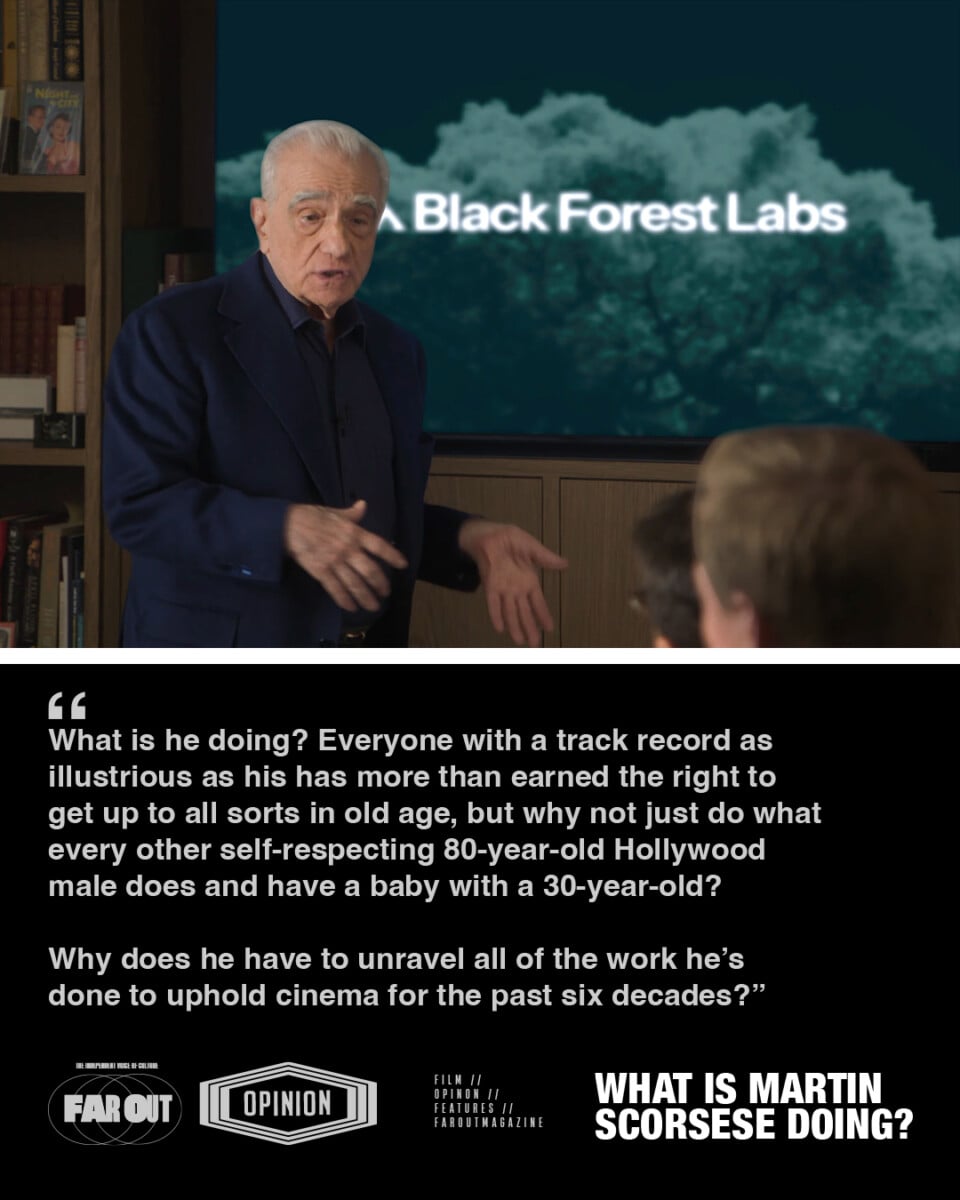
Earlier this month, an AI startup called Black Forest Labs released a video in which Martin Scorsese, that paragon of cinematic artistry and one of Hollywood’s most cine-literate auteurs, touts the benefits of AI image generation.
“No one on the set over the last 45 years knows what the picture in your head is,” he said, insisting that AI storyboarding gives the director greater control of their work. “This conveys a cinematic intelligence,” he said, adding, “That’s the great thing about this tool.”
We’ll get to the concerning levels of cognitive dissonance in this argument later, but what really stands out in the video is his attitude. He’s holding court, like a university lecturer, telling a group of corporate man-children how he got the legendary tracking shot in Goodfellas and what type of village in the Caucasus he’s dreaming up for his next movie. This isn’t a director wrestling with the staggering implications of AI in the film industry; it’s a sales pitch. Did I mention he’s a partner in the company, too?
Not surprisingly, this legacy-torching display of cognitive decline was met with significant backlash. “Et tu Mart-ay?” was the general sentiment. When the New York Times approached the director for comment, he responded with an argument that sounded like it was probably also generated by AI. “I’m interested in the intersection of technology and storytelling,” he said, adding, “Remember, cinema is a young medium, only around 125 years old, so we have to be open to how it can evolve.”
This was an interesting perspective coming from a man who, in 2019, wrote an op-ed in the very same publication about how superhero movies were ruining cinema. “The pictures are made to satisfy a specific set of demands, and they are designed as variations on a finite number of themes,” he said, inadvertently describing the exact problem with AI. Sure, it’s fabricating a visual representation of a human idea, but it’s hard to understand how an algorithm trained on pre-existing work and generating images out of ones and zeroes could avoid replicating that “finite number of themes”.
For Scorsese, apparently, image-generating tools can help bring a director’s vision to life more faithfully than a storyboard artist or production designer because the AI bypasses the limitations of language. When describing his creation of the famous nightclub tracking shot in Goodfellas, he said, “That’s something you can’t really describe, you gotta see it,” and then vehemently agreed when one of the Black Forest Labs representatives wished that their technology had been around when he was devising that scene.
Either he doesn’t understand the technology, or he’s bullshitting, because the way text-to-image generation works is by describing what’s in your head with words and then letting the platform interpret your words into an image. To put a finer point on it, it’s exactly the same process as working with a storyboard artist, except that you’re not getting the benefit of the artist’s own imagination. Cinema is a collaborative art form, and it’s the combination of the director’s vision and the individual, irreplicable artistry of everyone from the storyboard artist to the production designer to the editor who creates the final product. AI is an artistic dead-end, stunting imagination before it has time to morph into something unexpected, delightful, and completely new.
You could argue that (for now) Scorsese is only advocating the use of AI in the relatively limited arena of pre-production, but even if that were the case, why make such a song and dance about it? He’s one of the most famous directors of all time and easily one of Hollywood’s most respected elders. When he puts his voice behind something – be it the virtuosity of Powell and Pressburger or the importance of the theatrical window – it matters, and he knows it. If he wanted to use AI for storyboarding, he could easily just do it quietly. The fact that he’s being so loud about it suggests that he wants the technology to be broadly adopted in Hollywood, going against the appeals of auteurs like Guillermo del Toro.
As if shilling for the corporate overlords and the downfall of human expression weren’t enough, the Taxi Driver director has been finding other ways to become an unprovoked villain lately. Why, for example, is he appearing as an actor in three of the worst movies of the year? He’s Martin Scorsese. If he wants to act, he could do anything. Put him on a gurney in The Pitt. Make him an alien in Disclosure Day. Everyone else in Hollywood is in The Odyssey, why not make him Zeus or something?
Instead, he’s propping up the franchise bloat of Star Wars (someone please explain how this lifeless IP is any better than Marvel) in the box office disappointment The Mandalorian and Grogu and turning in an admittedly excellent performance as Jonah Hill’s mentor in the sanctimonious trash heap, Outcome. Then, there’s the upcoming Da Vinci Code-adjacent epic, In the Hand of Dante, in which he cosplays as Dumbledore opposite a hair styling disaster called Gerard Butler and Jason Momoa’s I-a-learned-a-this-from-a-Jared-Leto Italian accent.
What is he doing? Everyone with a track record as illustrious as his has more than earned the right to get up to all sorts in old age, but why not just do what every other self-respecting 80-year-old Hollywood male does and have a baby with a 30-year-old?
Why does he have to unravel all of the work he’s done to uphold cinema for the past six decades? In that 2019 New York Times article, he wrote that for those who want to make movies, “The situation at this moment is brutal and inhospitable to art”.
Who would have thought, six years later, he’d be responsible for making it even worse?
