


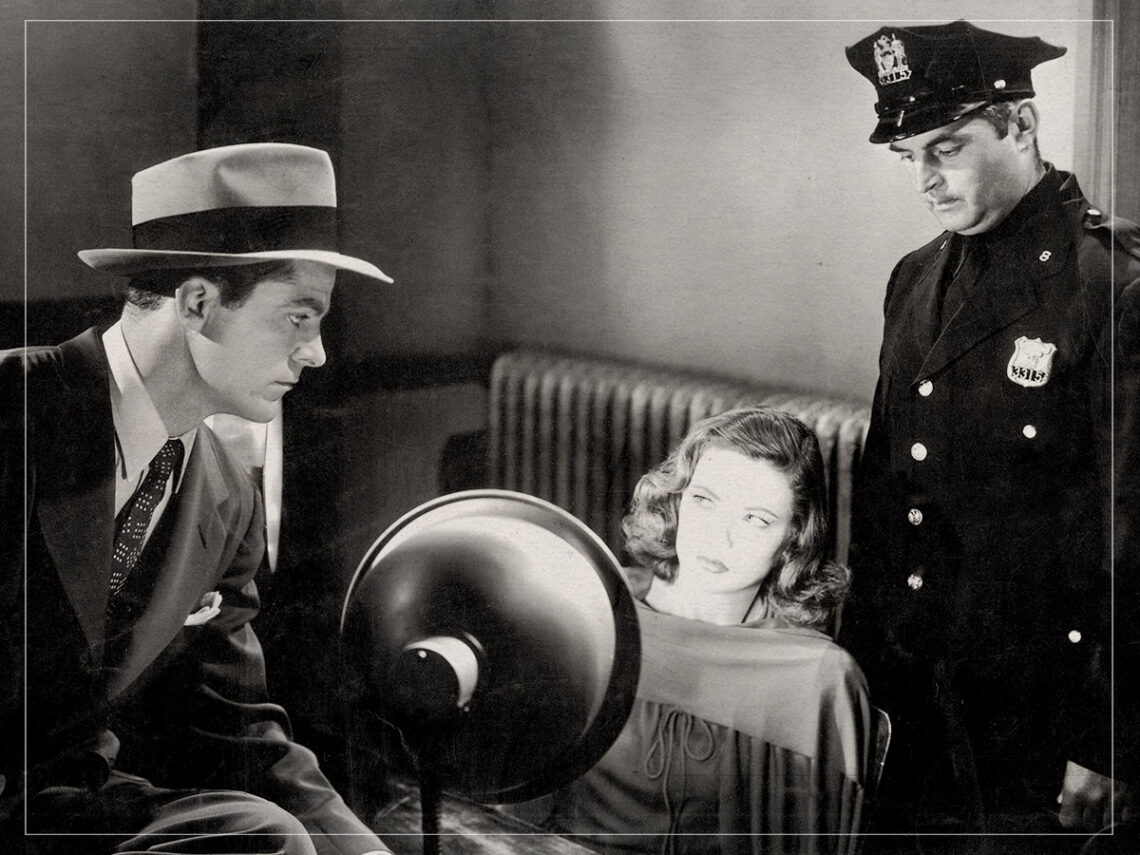
What is film noir?

Movies have always reflected the broader cultural contexts in which they were created. During the Great Depression, screwball comedy emerged as a sparkly catharsis to soothe the anxieties and desperation of the real world.
Throughout the mid-20th century, westerns provided a safe space to explore the American identity, whether it was to reinforce the mythology of Manifest Destiny and rugged individualism in The Big Trail and Stagecoach or to critique the McCarthy era with High Noon. One of the clearest examples of a cinematic movement reflecting broader societal sentiments was film noir, a genre that emerged during the latter half of World War II and ended in the mid to late-1950s.
Marked by a tone of pessimism, futility, and unease, it mimicked the feeling of weary dread that a world engulfed in years of horror had grown accustomed to. The tone was usually created and reinforced by impressionistic black and white cinematography that leant into starkly contrasting light and shadow, as well as cynical heroes and dangerous women (who became known as femme fatales).
The film that is now considered to have kicked off the genre is John Huston’s 1941 detective procedural, The Maltese Falcon. Based on Dashiell Hammett’s novel of the same name, it features Humphrey Bogart as a hard-boiled detective in a fedora, a characterisation that became the template for countless film noir characters from that point on.
However, the roots of the genre date back much further to the German Expressionists of the 1920s and ‘30s, such as FW Murnau and Fritz Lang, who used exaggerated lighting and camera angles to create a sense of darkness and mystery. Many of these filmmakers fled Nazi Germany for Hollywood in the 1930s, and it’s grimly fitting that their techniques were repurposed two decades later after Hitler’s atrocities had extended far beyond their native country.
But why is it called film noir?
The phrase “film noir” literally translates from French as “black film”, though “dark film” is more accurate. It was coined in 1946 by French critic Nino Frank in reference to the films that were emerging from Hollywood at the time, but it would take more than two decades for the phrase to be widely applied to the genre.
At the time the films were being released, most critics referred to them as gritty melodramas, detective mysteries, and crime dramas, but the throughlines of pessimism, moral ambiguity, and recurring styles of cinematography caused critics to retrospectively categorise them all as being of a piece. By the 1970s, film noir had become a broadly accepted term.

What is neo-noir?
Film noir only spans less than two decades, between the early 1940s and, depending on who you ask, the mid or late-1950s. But just as soon as the term became part of the common cinematic parlance in the 1970s, a new term emerged – neo-noir. Young filmmakers were starting to look backwards to mine the techniques and aesthetics of their cinematic forebears, and few genres were as perfectly suited to the upheaval and cynicism of the ‘70s as film noir.
As early as the 1960s, filmmakers in France were lovingly referencing the genre, most notably Jean-Luc Godard in Alphaville and Breathless and Fraçois Truffaut in Shoot the Piano Pianist. In the UK, William Friedkin made his own stab at noir with The Birthday Party, a film that would have been groundbreaking if anyone had watched it. But the ‘70s saw Hollywood embrace the genre, and it’s never really let go. Terrence Mallick’s Badlands, Roman Polanski’s Chinatown, and Francis Ford Coppola’s The Conversation were all examples of the emerging movement, reflecting yet again a society rife with cynicism and unease.
Brian De Palma has based his career on neo-noir with films like Body Double, Blow Out, and Dressed to Kill, while the 1980s and ‘90s saw a spate of erotic thrillers and science fiction films that bore many thematic hallmarks of film noir, including Blade Runner, Blue Velvet, Fatal Attraction, and Basic Instinct.
More recently, the influence of film noir has been prominently on display in films like Rian Johnson’s Brick and Looper, Dan Gilroy’s Nightcrawler, and David Fincher’s Gone Girl.
The best film noir movies of all time:
- The Maltese Falcon (John Huston, 1941)
- Double Indemnity (Billy Wilder, 1944)
- Laura (Otto Preminger, 1944)
- The Woman in the Window (Fritz Lang, 1944)
- Detour (Edgar G Ulmer, 1945)
- Leave Her to Heaven (John M. Stahl, 1945)
- Gilda (Charles Vidor, 1946)
- Dark Passage (Delmer Daves, 1947)
- Out of the Past (Jacques Tourneur, 1947)
- The Lady from Shanghai (Orson Welles, 1947)
- The Third Man (Carol Reed, 1949)
- In a Lonely Place (Nicholas Ray, 1950)
- Sunset Boulevard (Billy Wilder, 1950)
- Strangers on a Train (Alfred Hitchcock, 1951)
- The Hitch-hiker (Ida Lupino, 1953)
