


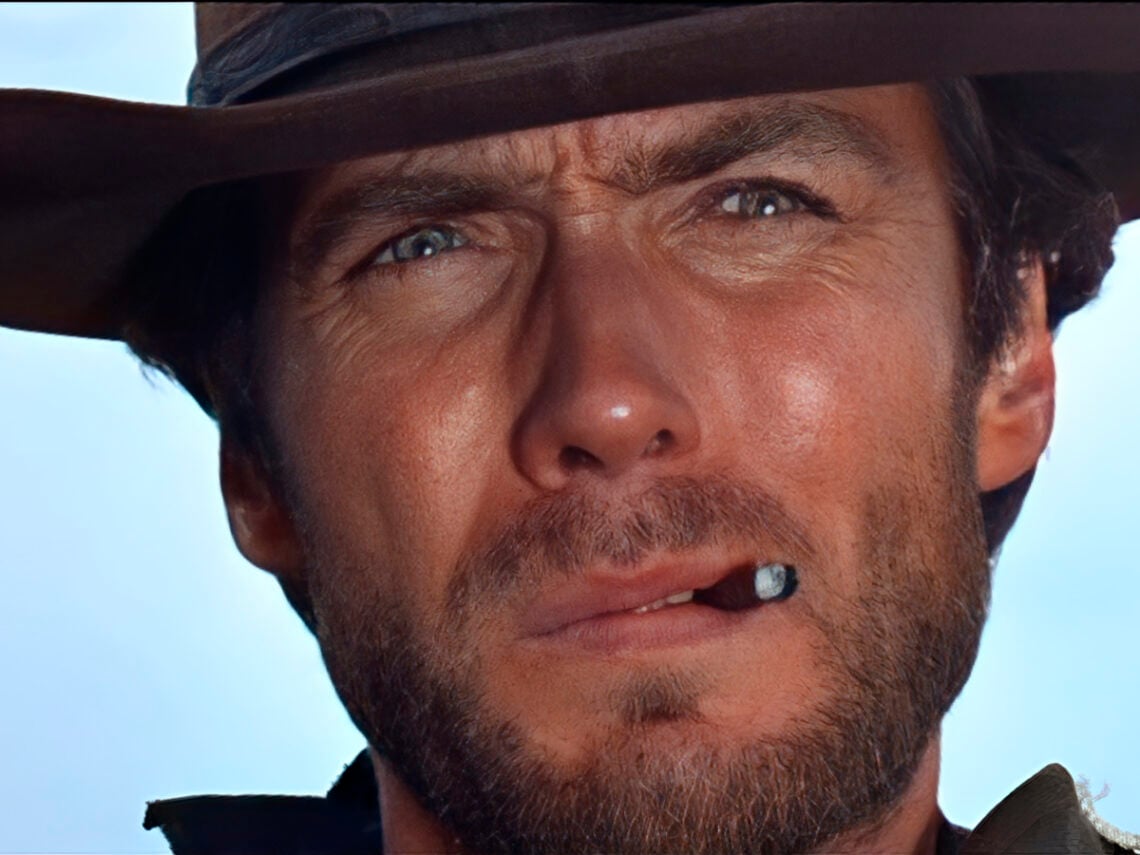
What film stock was ‘A Fistful of Dollars’ shot on?

In 1967, a film was released that catapulted Clint Eastwood to superstardom and started the spaghetti western craze in one fell swoop. The movie was, of course, A Fistful of Dollars, Eastwood’s first go-around as ‘The Man with No Name’, and it was quickly followed up that same year by the second and third instalments of what would later become known as the Dollars Trilogy.
You see, Fistful had originally been released in Italy in 1964, so the following two films – A Few Dollars More and The Good, the Bad, and the Ugly – were already in the can when the US release of Fistful rolled around. Fistful firmly established the trilogy’s distinctive visual style, though, and it owed a lot to the particular film stock director Sergio Leone chose to shoot with.
The origins of Fistful date back to 1963, when Akira Kurosawa’s Yojimbo was released in Italy. That seminal samurai film ignited the imaginations of Italian western directors Sergio Corbucci, Tonino Valerii, and Stelvio Massi. There are different accounts concerning which of these men suggested to their buddy Sergio Leone that Yojimbo’s basic plot structure and characters could make a good western, but whatever the case, he was the one who wound up making the film. Interestingly, though, pilfering so much from Kurosawa would later lead to the Japanese director receiving 15% of Fistful’s profits.
Ultimately, Fistful’s financing came from Italian, Spanish, and West German sources and was shot in Hoyo de Manzanares, Madrid. Given that it wasn’t a major Hollywood production and the budget was reportedly a scant $200,000, big American stars were out of the question. Charles Bronson and Henry Fonda both said no to playing ‘The Man with No Name’, and the part wound up going to little-known Rawhide star Eastwood. Ironically, when they saw the fruits of Leone’s labour in the Dollars Trilogy, both Bronson and Fonda agreed to star in his 1968 western Once Upon a Time in the West.
In the 1960s, 35mm film was the most common film stock used in the western genre, as it could withstand the rigours of outdoor location shooting and retain its cinematic look. Most directors wanted to portray the vastness of the American West in their films and would use expensive anamorphic lenses in their cameras to achieve this. Leone didn’t have access to these lenses, though, and 35mm film was too rich for the production’s blood.
Luckily, Technicolor Italia pioneered a new film stock in 1960 known as Techniscope. To get technical, it used a two-film-perforation negative pulldown per frame instead of 35mm’s standard four-perforation. In layman’s terms, though, the result was a widescreen cinematic image for a much lower cost. The image had a natural grain to it, though, which some filmmakers may have viewed as a negative. Leone felt the opposite, though. To him, Techniscope looked gritty, dirty, and raw – and that was exactly how he wanted Fistful to feel.
Indeed, this film stock was so integral to Leone’s vision for Fistful that he used it again in the sequels. In the book Once Upon a Time in the West: Shooting a Masterpiece, cinematographer Tonino Delli Colli said, “The sharpness of the image was fantastic. Even now, when they have been reformatted for television, they have a sharpness about them.”
Why was the movie ‘A Fistful of Dollars’ short on film stock?
Given its status as a low-budget production, Fistful didn’t have access to endless amounts of Techniscope film. In addition, many bigger-budget productions in the early ’60s were in the market for the same materials, so Leone had to be extremely careful with his limited supply. Delli Colli confirmed that this made Leone an extremely precise, economical filmmaker—there was no wasting film on a Leone set. This attention to detail undoubtedly helped Leone capture images that directors with much higher budgets would struggle to emulate.
The cinematographer explained: “His films were very carefully shot, and it paid off with audiences. He was very precise. He would rarely improvise because he had it all in his head. He knew in advance what each set-up would be like and how each set-up would be composed.”
Indeed, there is a theory that Leone employed so many close-ups and tightly framed shots because he wanted to instantly convey the emotions his characters were feeling. If he were able to do this in one close shot instead of several ones from further away or from different angles, then he’d be saving film and creating a unique visual style in the process. However, Leone also knew that these close-ups would lend an operatic feel to the film, as he often lit them like Renaissance paintings. In the end, these shots were the perfect marriage of form and function.

Never Miss A Tale
The Far Out Clint Eastwood Newsletter
All the latest stories about Clint Eastwood from the independent voice of culture.
Straight to your inbox.