


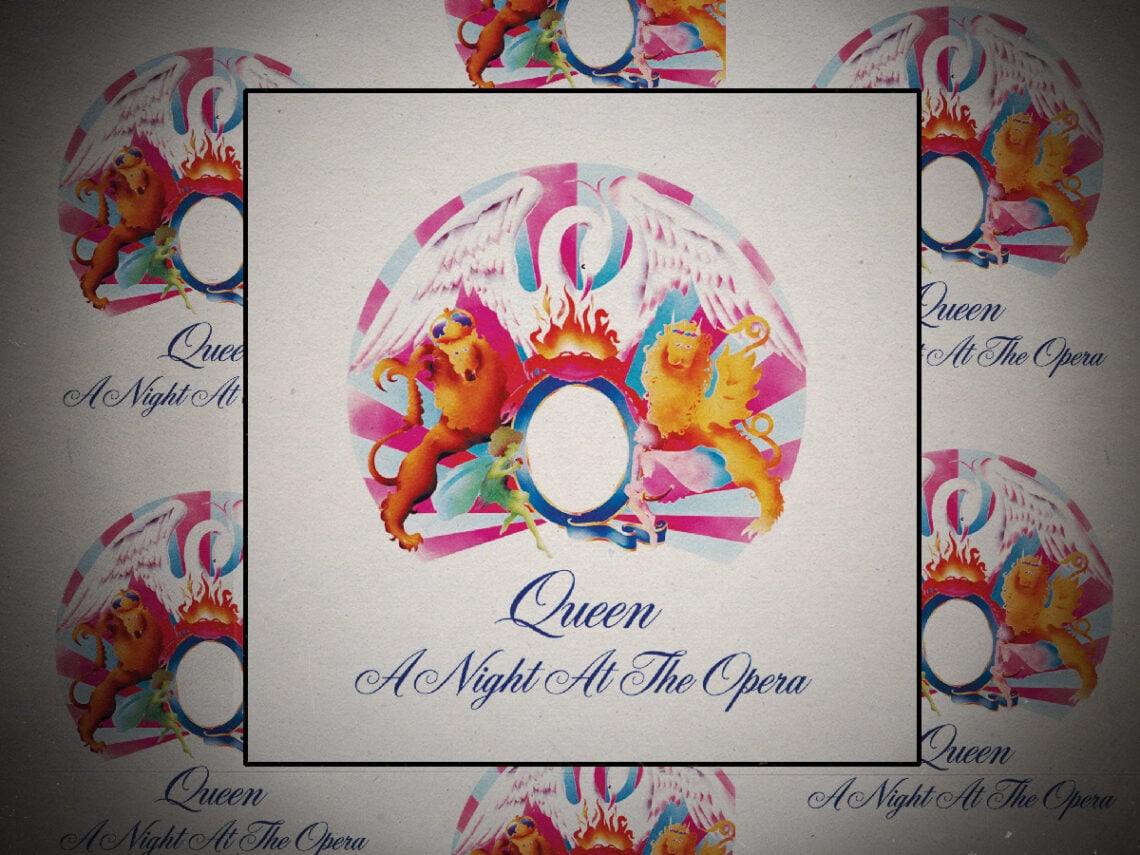
We’re still at the opera: Revisiting Queen’s spellbinding album 50 years later

Things weren’t so smooth-sailing for the members of Queen in the mid-1970s.
The material on their first three records would later be celebrated by all of them as some of their best, but commercially, and perhaps crucially, they’d all felt far too close to diminishing returns for them to feel even remotely comfortable. With funds low and pressure high, it could have been a major make-or-break moment – and in many ways, it was.
Instead, tucked beneath the veil of brewing concerns was a bigger and more important beast: an explosive resistance to failure that pushed them to the pinnacle of greatness, saving them from their downward spiral and ensuring their rise as one of the greatest rock acts in all of history. A Night at the Opera wasn’t just their saving grace; it was a reckoning.
Resilience on that scale takes confidence, but it also takes charm and talent, of which each member had in spades. Most of the record’s success can be attributed to the storm that was ‘Bohemian Rhapsody’, and how they effectively fought against advice from rules both spoken and unspoken to get it heard and out there.
Things felt a little slow here and there, but even downtime to process and digest proved fruitful – like when they paused to watch the Marx brothers’ 1935 film A Night at the Opera, and Freddie Mercury and Roger Taylor quipped about it being a good potential album title. Three albums in, there was a strange feeling in the air, partially due to their unavoidable financial issues and the overarching drive to make their fourth record the one that brought them back from the brink.
Which means that A Night at the Opera was Queen’s most significant album before it even had a name. They’d enjoyed the fruits of their labour in many ways with previous releases Queen, Queen II and Sheer Heart Attack, but debts from all corners made Mercury in particular feel stagnant. Frustrations gave Mercury a sense of focus, however, leading to what would become the vehement opening track, ‘Death on Two Legs’.

That didn’t set the tone for the rest of the record, however, as proven by the operatic central anthem that they were warned against because of the unspoken rules of radio play, as well as the more sensitive and considered parts of the piece, like ‘You’re My Best Friend’ and ‘Love of My Life’. Most songs were personal to each writer or, at least, an intensive labour of love, as was the case with Brian May’s complicated guitar section on ‘Good Company’, which took “ages and ages” because he was intent on recreating a traditional jazz atmosphere.
May also contributed the astrophysics-inspired ‘39’ about a group of astronauts who go on a voyage not realising that years and years have passed, meaning that, upon returning to earth, all their loved ones have passed away. “I had this thought in my head that if you go close to the speed of light in a circle, Einstein’s theory of general relativity tells you that your clock goes at a different speed,” May recently told Louder.
“It could be that you come back after what you think is a year as an astronaut, but it’s a hundred years later back on Earth,” he went on. “You would come back to find your children or even grandchildren grown up. It’s not the physics that got me, it’s the emotional content. It still sends shivers up my spine.”
May also discussed how completely and utterly normal it was for them to have Mercury come up with something like ‘Bohemian Rhapsody’, when it seemed that those around them hadn’t the slightest idea what it was that he was actually trying to achieve with it. “People have a hard time understanding how unsurprising ‘Bohemian Rhapsody’ was to us,” said May.
He referred to previous songs like ‘My Fairy Kind’, “a very complex” song that “goes all over the place”, as well as ‘March Of The Black Queen’ on Queen II, which is also “enormously complicated”. In his view, the latter is “more complicated” than their magnum opus on A Night at the Opera, which meant that when Mercury came up with the idea, it wasn’t anything close to a surprise – it was simply a natural progression of the things that they’d already done.
It could have been another major risk – running with something that people might not have taken to – but it ultimately paid off, becoming Queen’s most iconic song and one of the best examples of songs that have taken on a complete legacy of their own. The best part, according to the band, is that its complexity also feeds into its simplicity – it might not be immediately obvious what it’s about, but it feels personal and intimate all the same, like it was carefully curated specifically for the listener, whoever they may be.
Another lightning in a bottle was ‘The Prophet’s Song’, which was initially considered as a single before the band decided on ‘Bohemian Rhapsody’. May had been working on the monster track at the same time that Mercury was crafting specific parts of ‘Bohemian Rhapsody’, and while both aspired for a high level of artistic expression, they ended up drumming up a significant impact in completely different ways.
The same could be said for the record as a whole – it’s not everybody’s immediate favourite when presented with the question. It’s not even the band members’ own favourites, but it was the fighter project that ensured their survival during one of their most pivotal moments, packed with an extensively risqué and ambitious tracklist that could have gone any which way when released to the public.
It was also costly to make, but with a consistent grip on doing the right thing, Queen had no choice but to succeed. And they did. Five decades on, it remains one of the most timeless and important rock records of all time, proving the value of innovative artistic choices in the 11th hour, when, in the face of admitting defeat and drowning in the lake, they broke their own curse by inventing their own rules.
