


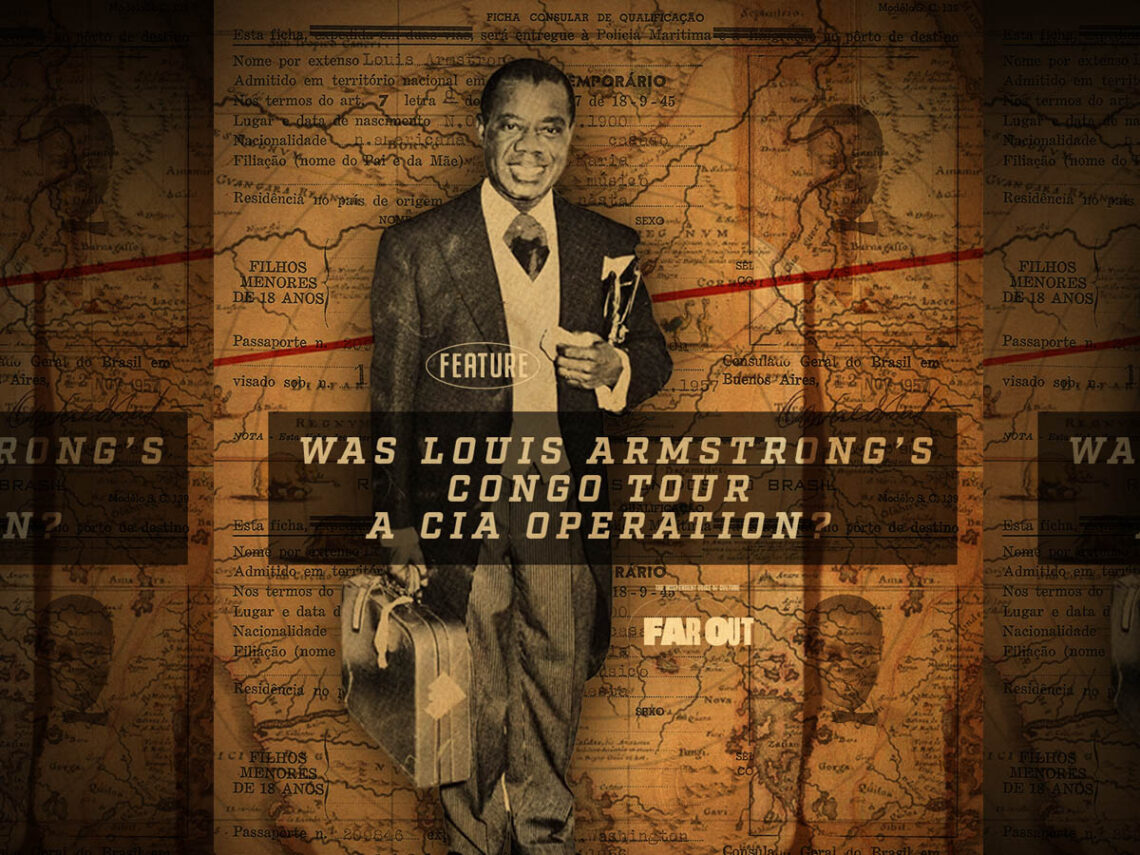
Was Louis Armstrong’s Congo tour a CIA operation?

There were many fronts in the Cold War’s international machinations. Alongside espionage, arms racing, and proxy conflicts, popular culture served as an effective weapon in the USA’s propaganda arsenal against the Soviet Union’s global challenge.
As tensions were heating up in the 1950s, the US State Department conceived the novel idea of funding selected ‘jazz ambassadors’ to serve as cultural diplomats in regions lacking American influence. Following condemnation from the East toward the US’ racial injustice and the West’s continued colonial plunder of the Global South, the Congress-approved President’s Special International Programme for Participation in International Affairs in 1956 sought to counter Soviet critique and present to the world a glowing capitalist state of racial harmony and liberal freedoms.
In March, jazz trumpeter Dizzy Gillespie led an 18-piece interracial band, featuring Quincy Jones as music director, across countries as far-flung as Pakistan, Iran, and Yugoslavia. Before long, Benny Goodman, Dave Brubeck, and Duke Ellington were all whisked away to foreign locations on tours organised by the state, indirectly softening up the local audiences towards a favourable impression of American culture.
The State Department thought they’d struck gold with a provisional tour of the USSR from jazz heavyweight Louis Armstrong, only to pull out at the last minute due to objections to the infamous Little Rock Crisis—the outrageous intervention from Arkansas Governor Orval Faubus blocking nine Black students from entering the Little Rock Central High School they were enrolled in.
Three years later, the American South was still mired in the stain of Jim Crow segregation, but Armstrong agreed to a jazz ambassador tour, sent to Cameroon, Egypt, and Nigeria, among many other African countries, with the help of the US state and Pepsi-Cola’s sponsorship. Fast becoming a key battleground in the Cold War, the musician found himself playing a show in the newly independent Republic of the Congo.
Also known as Congo-Léopoldville and officially named the Democratic Republic of the Congo today, the Central African state had only just rid itself of nearly a century of brutal Belgian colonial rule. On June 23rd, 1960, Pan-Africanist and Mouvement National Congolais President Patrice Lumumba found himself the first democratically elected prime minister of the new state scheduled for official independence a week later.

Winning 33 seats in the Chamber of Deputies and heading the coalition government, the popular Lumumba’s fierce excoriation of Belgium’s cruel and ruthlessly extractive legacy in the face of King Badouin, an ambiguous stance on Cold War allegiance, and rumours of nationalising the country’s lucrative mining industries, affixed a target on his head.
Not only was Belgium’s imperial pride attacked, but US President Dwight D Eisenhower’s administration was also anxious that it would lose easy access to Congo’s vast uranium reserves needed for its atomic bomb developments. In July, the Katanga Province, the country’s southeastern region that held the majority of the mining resources, unilaterally seceded with the backing of Belgium and sent over troops to assist the rebellion under the guise of peacekeeping. After UN forces refused direct intervention in the Katanga crisis, attempts to correspond with the Soviets for aid triggered a Red Scare panic among the West, Congo’s President Joseph Kasa-Vubu, and the nation’s military top brass.
Against this backdrop of political turmoil, Armstrong and his All-Star band unwittingly performed. Arriving in the country in late October, the trumpeter was greeted like a head of state, held aloft in a chair by fellow Black men in traditional garb as a gesture of respect and enthusiastic welcome. Playing a show in Congo’s capital Léopoldville, now Kinshasa, to reported crowds as high as 100,000, Armstrong and his entourage travelled to the troubled Katanga area soon after, along with supposed US diplomat Larry Devlin, reportedly inspiring the opposing forces in the area to put down their arms for the day’s visit. As Armstrong dined that evening with Devlin, Lumumba was held prisoner in his official residence, little over a mile away.
Devlin was no mere political attaché. Sent to Congo ten days after independence, he was in fact the country’s chief of station on behalf of the CIA, using Armstrong’s cultural visit to distract from the scheming coup underway behind the scenes, as well as gathering intelligence and managing covert operations.
According to his 2007 Chief of Station, Congo: Fighting the Cold War in a Hot Zone autobiography, Devlin had received coded orders from CIA boss and MKUltra mastermind Sidney Gottlieb to work towards Lumumba’s assassination. Deeming the task to be “morally wrong” and strategically counterintuitive, Devlin neglected to act on the objective, allowing Congo’s security forces to carry out the US’ dirty work.
Eventually leaving in a convoy of nine cars in late November, increasingly undeterred by his captors and doggedly pursuing the prime ministerial duties he’d been elected for, Lumumba delayed the urgent need to cross the Orientale Province border to make conversation with various village folk en route. Having made it to the safe side of the Sankuru River, he learned that opposing forces had caught up with his family on the other side.
Fearing for their safety, Lumumba travelled back by ferry before being arrested on spurious charges of inciting rebellion. Shepherded around various barracks across December and into early January 1961 in miserable conditions, Lumumba and his two political allies, Maurice Mpolo and Joseph Okito, were taken to a secluded spot in Élisabethville, now Lubumbashi, coordinated by Belgian officers and with quiet support from both the CIA and MI6, shot one by one by a firing squad. Their bodies were dismembered and dissolved in acid the following day.
Assuming leadership of the country before further consolidation of power in 1965, the Congolese Army’s Chief of Staff, Mobutu Sese Seko, maintained a loyal US puppet regime, presiding over a murderous and despotic kleptocracy for decades until his forced flight in 1997 during the First Congo War.
Armstrong’s tour of Africa in cahoots with the US State Department has cast a key but complicated shadow over his titanic legacy. The extent of the CIA’s involvement was never known during his time in Congo, but reportedly, the ironies of his international laundering for a country that was still oppressing his people back home were never lost on him, despite the frequent humorous quips of having “stopped the war”.
His troubled feelings surrounding the jazz ambassadorship were poured into 1962’s The Real Ambassadors with Dave and Iola Brubeck, a satirical examination of their cynical pawn manoeuvring in the oblivious aid of America’s continued imperial gameplaying set against the day’s Civil Rights struggle.
A murky affair amid an even murkier chapter of US foreign policy, America’s gloves-off dirty tricks throughout the Cold War stopped at nothing to thwart the communist spread, incredibly pulling in some of the 20th century’s jazz heavyweights into the crossfire. While arguably naive, Armstrong and his peers’ cultural deployment to the world’s corners, yet to be subsumed by Uncle Sam, stings with deep cynicism, sullying the admirable efforts of the day’s jazz entertainers to spread musical goodwill around the globe while serving as a CIA Trojan Horse the entire time.
