


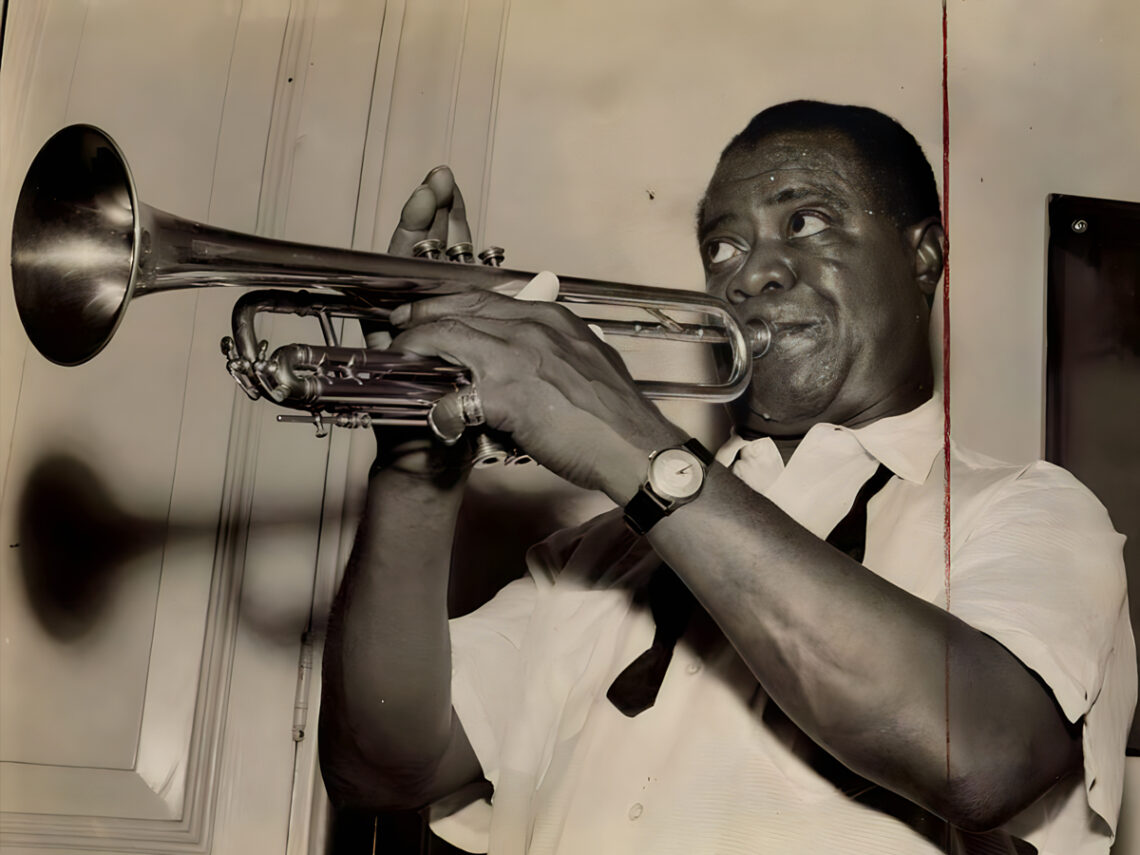
“Go to hell”: Why Louis Armstrong refused to visit the Soviet Union

Jazz has always played an important role in the history of the United States. Emerging from the clubs of New Orleans around the turn of the 20th century, jazz music regularly allowed Black artists to express themselves and their artistry during time periods in which the wider American society rejected them. While not all jazz music or musicians are overtly political, the defiance and individualism shown by artists like Louis Armstrong were vital in providing a cultural identity for America’s oppressed Black population.
First entering the world of jazz back in 1918, playing on riverboat bands in his native New Orleans, Armstrong boasted one of the most enduring and successful careers of any jazz artist. He was there to witness the style’s development over the years, moving from the big band area all the way to the spiritual jazz revolution of the 1970s, led by figures such as Alice Coltrane and Pharaoh Sanders. He was also around to witness the emergence of the civil rights movement in America and the key role that music played in that fight for liberation.
Unlike many jazz artists during the period of civil rights, Armstrong preferred to stay away from issues of politics. So, while contemporaries like Nina Simone or John Coltrane were lending their talents to the fight, Armstrong was often criticised for his lack of direct action. The trumpeter was even accused of selling out – a cardinal sin for any self-respecting jazz musician – when he started working with the US State Department during the 1960s.
From 1956 onwards, the United States government funded jazz stars like Dizzy Gillespie, Duke Ellington, and Louis Armstrong to tour their music in specific areas of the globe. So, with the backdrop of the Cold War raging on, musicians travelled to places like Yugoslavia, Lebanon, Iran, and Pakistan with the aim of sharing American culture in the form of jazz. Dizzy Gillespie was the first to head out on one of these missions of jazz diplomacy, but Louis Armstrong wasn’t quite so easily convinced.
Initially, Armstrong was asked to travel into the belly of the beast: the Soviet Union. The US’ arch enemies during the period of the Cold War, the Soviet Union, represented the antithesis of America’s capitalist society, and it was thought that Armstrong could open the eyes of Soviet citizens to the music and culture that can be fostered in a democratic, free-market regime – “US values,” as it was often described. In the end, though, the often apolitical Armstrong outright refused to take part in this jazz ambassador scheme in protest of the US government’s position on civil rights.
Crucially, Armstrong was set to travel to the USSR in 1957. However, not too long before his trip was scheduled to take place, Armstrong watched in horror as the presidency of Dwight D. Eisenhower refused to send in troops to enforce desegregation at a high school in Little Rock, Arkansas. The school had been desegregated following the decision of the Supreme Court during the case Brown v. Board of Education, but nine Black students were prevented from entering the school in 1957 and were met with extreme violence and racism.
The incident, often named the Little Rock Nine, was a key event in America’s fight for civil rights. For Armstrong, the government’s refusal to step in to protect those Black students showed that Black people, on the whole, were not being supported by the US government. As such, when asked to travel to the USSR to represent the government that failed to support those nine students in Arkansas, Armstrong famously declared, “The way they are treating my people in the South, the government can go to hell!”
Armstrong was certainly not the first jazz musician to highlight the hypocrisy and racism at the heart of the US government during this time. However, the fact that Armstrong so often refused to get involved in politics signified that these racist attitudes and issues of segregation were too colossal to ignore. His refusal to travel to the Soviet Union was not only a rallying cry of support for the civil rights movement, it also represented an ability for artists of all genres to stand up against their governmental oppressors.
The trumpeter eventually performed behind the iron curtain, travelling to East Germany in 1965 and, eventually, to the Soviet Union in 1970. This time, though, Armstrong’s visit was not on behalf of the US State Department but came because of an invitation by the USSR Academy of Sciences. Satchmo performed multiple shows during his stay in the Soviet Union, spreading jazz excellence rather than phoney “US values”, as the government of Eisenhower had asked him to do decades prior.
