


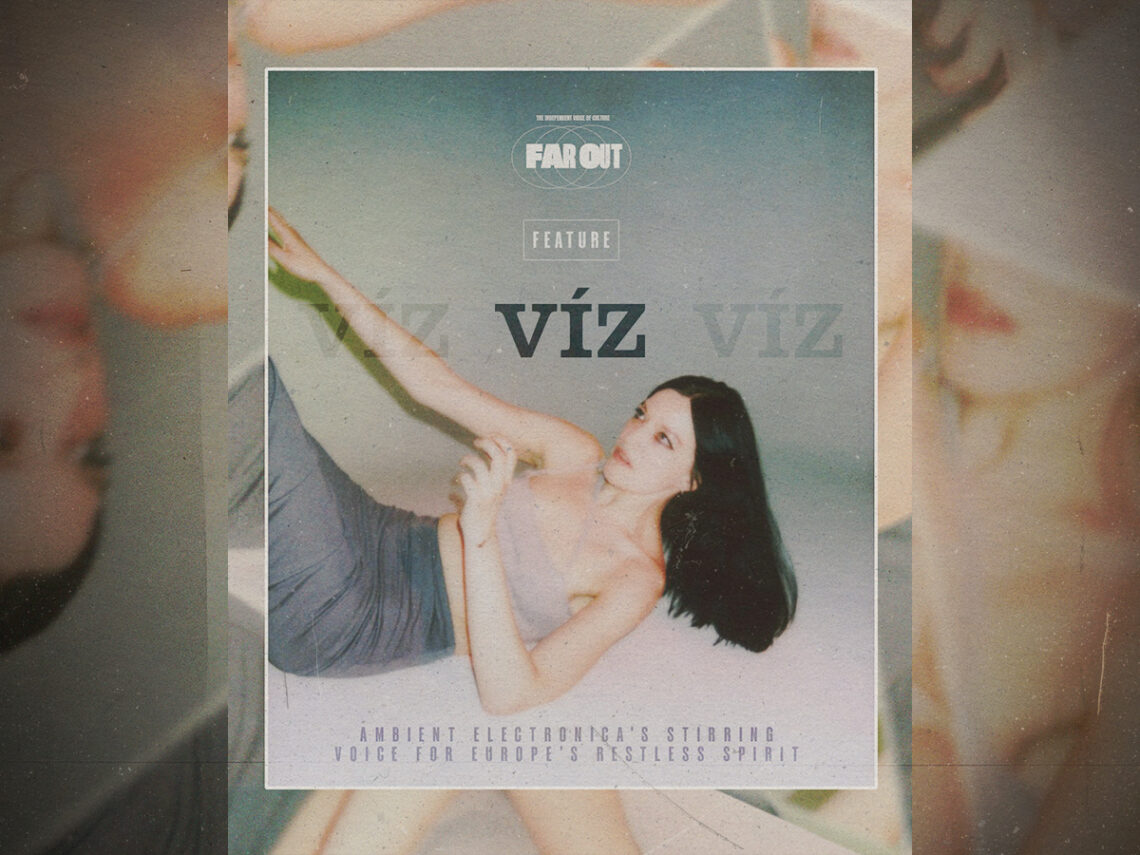
VÍZ: ambient electronica’s stirring voice for Europe’s restless spirit

Listening to any of VÍZ’s dark ambient work is to experience fraught waverings on trepidatious edges of thematic clashes, sonic tensions, and the spectral frissons between the material and metaphysical. Swirling together an aural brew of industrial clangour, arcane folk and vintage horror scores, Hungarian Transylvanian performer and artist Réka Csiszér charges her Giallo electronics with a nebulous shroud where beauty and horror are forever in disconcerting proximity. VÍZ, Hungarian for “water”, Csiszér illustrates its apt amorphousness in life and her music: “Water reminds me of where I come from, what I am made of and the teachings that come with these origins. Water is formless and shapeless. Quiet, violent, mysterious, and dangerous at the same time. You can float on it, but also drown”.
Out on Athens’ experimental Heat Crimes label, VÍZ’s sophomore Danse des Larmes showcases another leap forward in stirring, darkwave etherea. Deeply imbued with a personally poetic mine of blurred identity and a confused nationhood, Csiszér’s soundscapes are anchored in an unmistakable sense of Eastern Europe’s psychogeography. With familial roots in Romania’s Hungarian Székely minority and born in the former East Germany, displaced heritage and transient culture spark Csiszér’s melancholic wandering with a troubled energy, restlessly seeking other nomads similarly navigating a spiritual homesickness for a land that may no longer, or never have, existed.
“Since I can remember, I have been trying to figure out the meaning of the word ‘home’, the essence of my Hungarian roots and the constant sensation of living in an in-between state,” Csiszér confesses. “VÍZ became a portal for the exploration of these themes, and I try to cultivate that missing place within myself, creating a bridge that not only helps me connect inwardly but also reaches outward to others”.
“But it’s not just sadness,” Csiszér clarifies. “It’s a way of making sense of things, I guess—identity, time, memory, transformation”. Candid about her love of Hungarian filmmaker Béla Tarr‘s sombre studies of Central Europe, the political struggles and precarious national boundaries all feature in VÍZ’s evocative ambience when one is truly listening. “There’s a stillness to it. A kind of beauty in the weight. Béla Tarr’s films sit in that space between beauty and bleakness. They often read like quiet allegories—about the slow collapse of civilisation, the indifference of nature, and the futility of control”.
Contemporary electronic music and a fascination with the ‘old world’ have enjoyed a potent resurface in the music underground of late. From the myriad of synth-soaked archaeologists that dwell on Bristol’s Avon Terror Corps or Index For Working Musik’s post-punk echoes of faded history, a collective yearn for meaning in a world ever-governed by atomised, corporate banality seems to be earnestly rearing its head across disparate corners of the musical map. While operating outside of any ‘scenes’ or established communities, Csiszér has an intuitive understanding of where this fascination with the arcane is rooted. “Folklore ties us to something older, something ancestral—while electronic sounds bring us into the present,” she says. “Together, they open up a space where past and present meet. There’s something in that contrast—the synthetic and the ancient—that taps into a deeper search for identity. It’s a way of connecting timelines. Remembering. Reimagining”.

Recorded in Belgium’s Gam Studios and Canada’s Hotel2Tango with mixing help from Jerusalem in My Heart’s Radwan Ghazi Moumneh, Danse des Larmes began life as sketches for a theatre production examining youth and the passage of time’s weathering effect as one enters adulthood. Boasting novel use of classic synthesizers such as the Moog and Yamaha DX7, coupled with the textured choirs of the mysterious Mellotron, helped score the sessions’ mournful document. Fleshed out while several close friends’ parents had died, the surrounding tragedy inexorably found its way into informing her practice and approach for Danse des Larmes‘ haunting presentation.
“The album also has a strong video game soundtrack quality to me,” Csiszér revealed. “I can picture the tracks not just as scenes in a movie, but as moments where characters face challenges, overcome obstacles, and level up—kind of like how life feels sometimes”.
Csiszér gave further insight into some of the record’s key tracks: “While I was working on ‘Tűz Tó’, I had this apocalyptic vision of a character standing in front of the lake of fire, waiting for the phoenix to rise in a world that’s already fallen apart. The half-hour track ‘Eternia Now’, included as a bonus on the digital release, was created with the concept of crafting an endless space to drift through—somewhere in that in-between”.
Danse des Larmes marks a transitional moment for VÍZ, as she emerges from the painful meditation of her father’s passing for 2021’s Veils. A step away from grieving introspection toward a broader vantage of Central Europe’s messy and phantasmic landscape marks VÍZ’s next chapter, as well as hints to further sonic and thematic trajectories. With no lacking in psychic plunder lying buried in Europe’s soil as history is sedimented and the contemporary shadow of war and political turmoil spread across the continent with danger and uncertainty, Csiszér’s haunting electro-acoustic soundtracks look set to never feel too far away from Europe’s spiritual chaos, offering clarity and solidarity amid its sonic unease: “If Veils was about the ashes of the past, then Danse des Larmes is the phoenix rising from them. It marks a new beginning”.
