


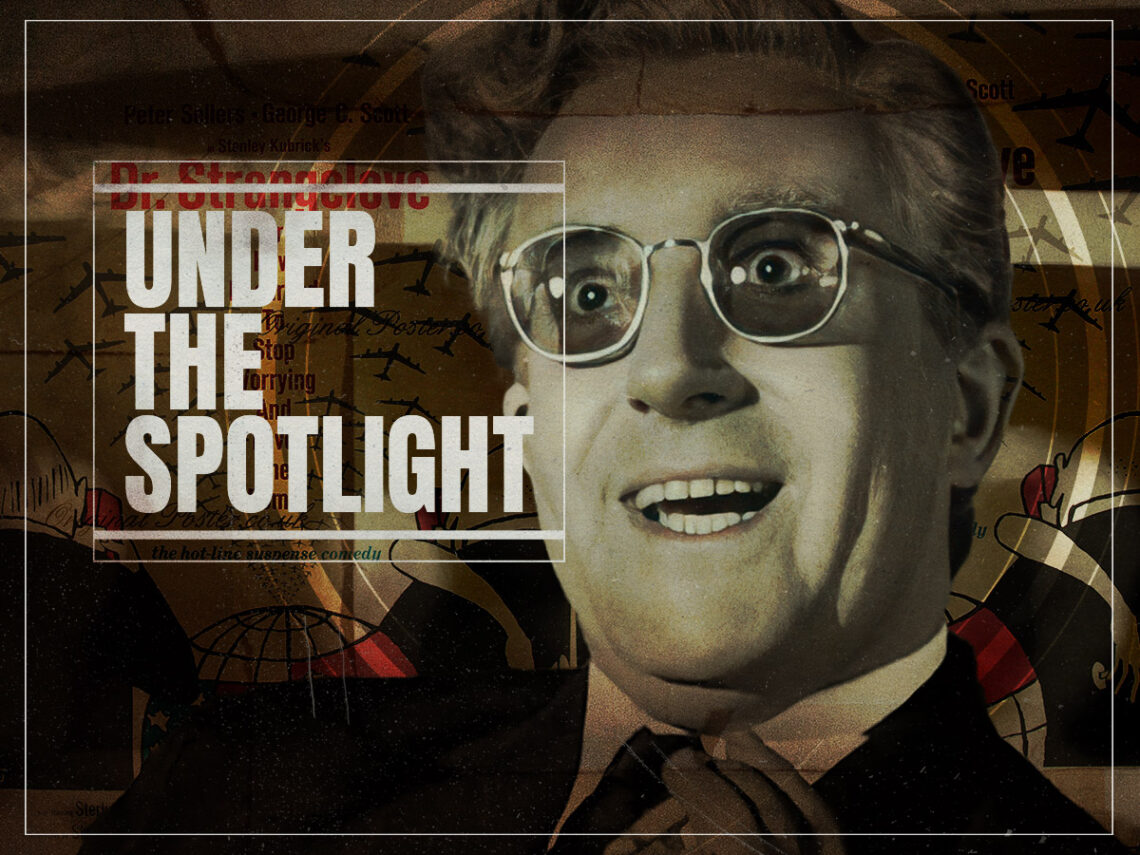
Under the Spotlight: Peter Sellers explosive turn in ‘Dr. Strangelove’

Any comedy actor who plays multiple roles in the same movie – with Mike Myers and Eddie Murphy two notable stars who made it a habit – is always going to exist under the looming shadow cast by Peter Sellers, who shot to fame on the back of disguising himself as a number of different characters.
It was his signature shtick that served him very well in Lolita, The Mouse That Roared, Soft Beds, Hard Battles, The Prisoner of Zenda, and The Fiendish Plot of Dr. Fu Manchu, and more on the big and small screen, but he was never better than he was in Stanley Kubrick’s Dr. Strangelove or: How I Learned to Stop Worrying and Love the Bomb.
There’s something almost serendipitous about a comedic powerhouse like Sellers working so well with the cold, calculating, and meticulous Kubrick, given their vastly different approaches and personas, especially when Dr. Strangelove didn’t originate as a satire. It was supposed to be a serious rumination on the nuclear age at first. However, the filmmaker discovered it was so inherently ridiculous that the best way to maximise the material’s potential was to play it for laughs.
On paper, it’s not too difficult for an actor to play numerous characters in the same film. All they have to do is get buried under prosthetics, adopt several different accents and affectations, and play to the gallery. However, it’s exponentially harder to make each individual feel like a distinct character in their own right, something Sellers managed to such an extent that he earned an Academy Award nomination for ‘Best Actor’.
The studio wanted Sellers to play at least four roles, but three proved to be more than enough. The only suggested part he didn’t play was that of Major T.J. ‘King Kong’, which ended up becoming iconic in its own right when Slim Pickens was the focal point of one of the most indelible images from Dr. Strangelove.
Again, despite their disparate approaches to the art of filmmaking, Kubrick and Sellers were a match made in heaven. One of them was renowned for their painstakingly exhaustive research, while the other revelled in going off-script to improvise. Put them together and it could have been disaster, but instead the end result was pure magic.
Lionel Mandrake is the most studious and straight-faced of the Sellers’ trio, and was treated as such. He’s the only one of the three that isn’t obviously off their rocker to some extent, with the actor picking up tics and foibles from the superiors he’d served under as part of the Royal Air Force during World War II. He’s not the most memorable figure in Dr. Strangelove, but that’s the point.

Sellers uses the role to act as the solemn foil to the insanity that unfolds around him, rooting Mandrake in the drama of the situation. That’s key to Dr. Strangelove as a whole, because no matter how far-fetched or silly it may get at a number of points, the overarching narrative thrust was that of one entrenched entirely within the realms of plausibility.
The presidential Merkin Muffley had to convey the gravitas of being the free world’s most powerful leader while gradually leaning harder into the absurdity. Sellers initially wanted to make the politician more overtly comedic, but after ruining a few too many takes for Kubrick’s liking, he was convinced to rein it in. That’s not to say he isn’t funny, though, with the bulk of the humour coming from Muffley’s reactive nature.
That’s one straight man, and one semi-straight man who becomes funny by way of the scenarios they find themselves in, with the title character rounding out the pitch-perfect Sellers tour-de-force by allowing him to go for broke, ham it up, and overact to high heaven as Dr Strangelove.
Whether it’s the mannerisms, the unusual accent, or the bursts of uncontrollable physicality, the wheelchair-bound scientist is the broadest and most blatantly comedic of the three by far. And yet, despite being so starkly different to the aforementioned pair, it’s to Sellers and Kubrick’s credit that even though they’re three wildly different folks being played by the same actor, it’s entirely believable to have them operating within the confines of the same story.
The finest example of an actor becoming one with a character is when it’s impossible to imagine them being played by anybody else. The fact Sellers accomplishes that feat three times over in the space of a little over 90 minutes is a testament to not only Dr. Strangelove‘s status as perhaps cinema’s greatest-ever satire, but also the vessel for what might just be its greatest-ever comedy performance.
