


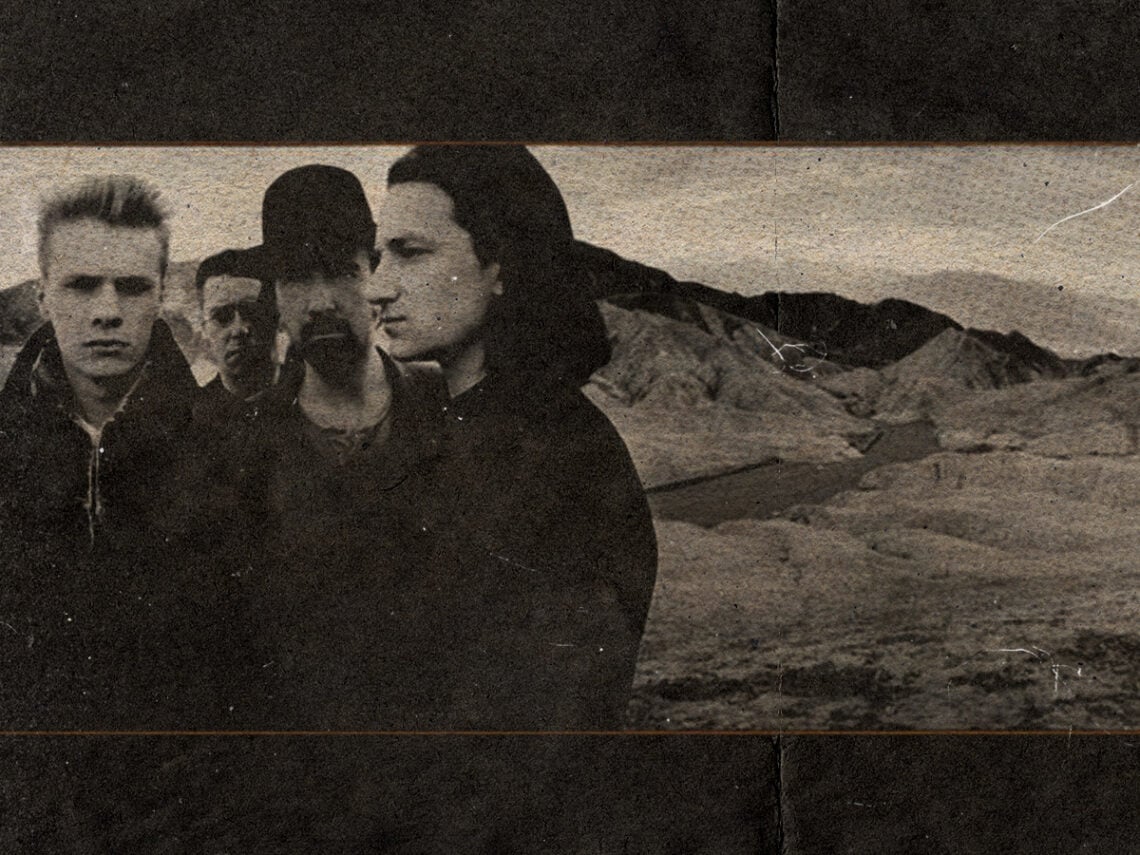
U2 – ‘The Joshua Tree’

When Brian Eno took the producing reigns on U2’s fourth studio album, The Unforgettable Fire, something magical happened. Gone was the punk influence of Steve Lilywhite, as expressed on the previous effort War. This was replaced by what we would come to know and love as alternative stadium rock.
Eno’s emphasis on ambient layers lay in perfect marriage to the delicious sonic guitar textures of The Edge and gave U2 a truly unique sound that many have subsequently tried to imitate but none have truly captured. This formula was perhaps best exemplified on The Unforgettable Fire’s follow-up record, The Joshua Tree, which saw the band further reiterate the American political themes they had touched on in 1984’s studio effort.
The Joshua Tree is certainly U2’s ‘America’ album and equally their most popular by some stretch. The band had conquered the United States during the War tour, although the ensuing The Unforgettable Fire is undoubtedly an Irish record at heart, with it being recorded at the iconic Slane Castle in County Meath, and ‘A Sort of Homecoming’ being a perfect example of this longing for Ireland after many months spent abroad on promotional tours.
While The Joshua Tree was also produced on U2’s home turf, its lyrical and musical content make it a genuinely American album, although perhaps this is not wholly evident during its first three songs. On that opening 15 minutes or so, we are treated to one of the greatest three-song runs ever committed to record, with each of ‘Where the Streets Have No Name’, ‘I Still Haven’t Found What I’m Looking For’ and ‘With or Without You’ staking their rightful claim to be uttered in whispers of the band’s best ever songs.
Eno’s work with The Edge is evident on each of the album’s three worldwide-released singles, as are his own instrumental contributions, none more so than in the typically Eno-esque first 40 seconds of the record before Edge’s shimmering delayed guitar tone builds us up in anticipation for Adam Clayton and Larry Mullen Jr. to eventually join proceedings.
Bono’s voice is on absolute fire, picking up right where he had left off. Those opening three tracks are primarily personal, almost quasi-religious songs where Bono explores his deepest inner yearnings: love, passion, faith, a sense of belonging and desire. But from there onwards, as soon as ‘Bullet the Blue Sky’ kicks into action, we realise that The Joshua Tree is one of the finest albums ever recorded.
The album’s fourth track moves away from those personal yearnings of Bono’s to something much more immediate and vital. Suddenly, The Joshua Tree turns dark. Bono had once explained that much of the album explored the juxtaposition between the “mythical America” that exists in much of our consciousness as informed by movies, songs and television and the “real America”, the one we are greeted by upon our arrival to the fabled country: an America of extreme poverty, particularly amongst those from immigrant communities. And Bono was sure to let this be known throughout U2’s fifth studio album.
And yet, there are still those links to the home island; ‘Running to Stand Still’, explores the influx of drugs in poor communities in Dublin and their disastrous consequences, a similar fate that had been suffered in most of the major cities across America’s vast landscape. There are also shades of the late Irish poet laureate Seamus Heaney on the likes of ‘Red Hill Mining Town’, and yet, the song could just have easily been influenced by a punchy American author like Raymond Carver or Flannery O’Connor, who Bono had been reading in the run-up to production.
That “mythical” notion of America comes to the fore in ‘In God’s Country’ and ‘Trip Through Your Wires’, where the romantic ideal of the great expanse of the American desert is in full swing. In songs such as these, the great American song traditions are toyed with, particularly on the latter, which exemplifies the blues, R&B and folk influences that had certainly informed Bono and The Edge’s songwriting process.
The darkness and ferocity of ‘Bullet The Blue Sky’ is matched only by ‘Exit’, which had been borne out of a jam session, showing that producers Brian Eno and Daniel Lanois understood that U2 were really at their best in a live setting. However, the tender moments that would define the band’s future output were still to be found on ‘One Tree Hill’ and ‘Mothers of the Disappeared’.
Throughout The Joshua Tree, you get the impression that nothing is out of place; every instrument is required and is played as it should be, with no superfluous embellishments. Bono’s vocals truly mean something in every breath (and there is certainly a lot of breathing), The Edge’s guitar tone never sounded better, and Mullen Jr. and Clayton’s rhythm section is just about as dependable as one could wish for.
The Joshua Tree is always the first LP that fans and foes think of when it comes to U2, which is understandable given the far-reaching singles that open it. However, when you look beyond those first 15 minutes, you will find a rock band playing with complete confidence, at the height of their powers, and a record that marries the twin mythologies of America and Ireland together in the process.
