


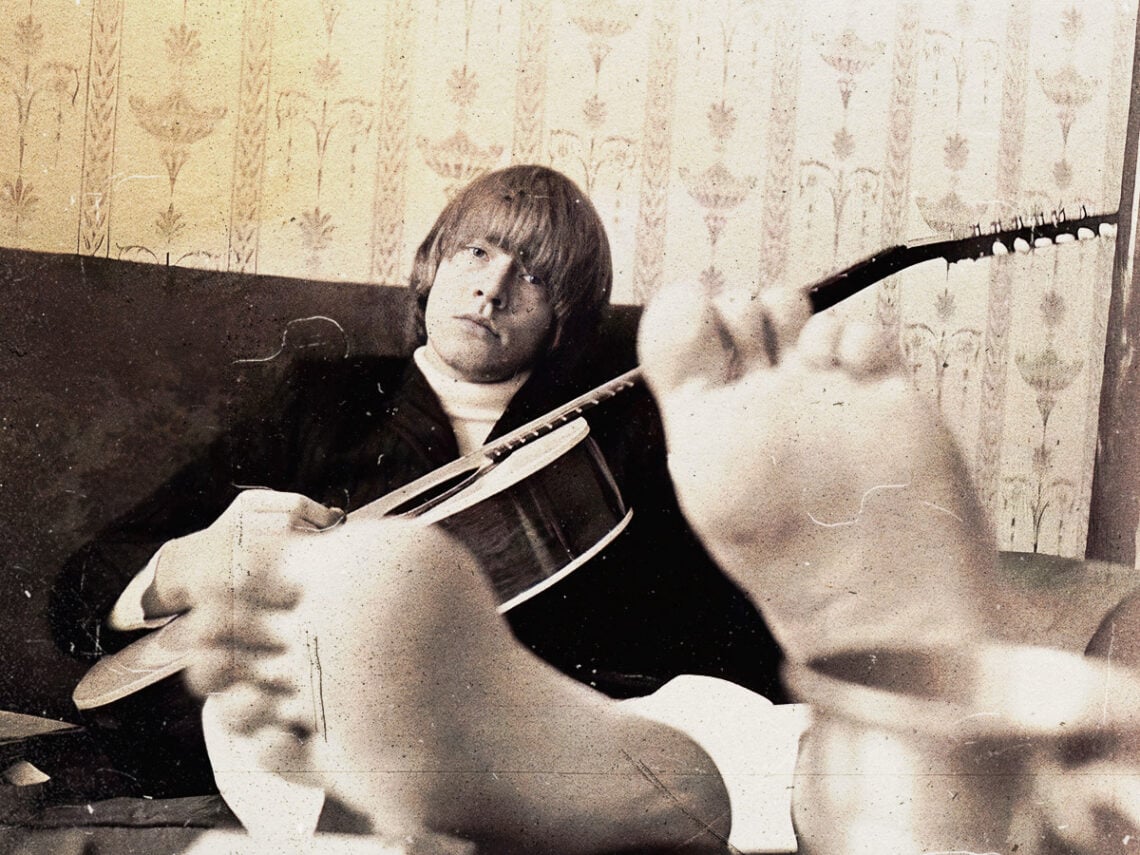
The two unreleased songs Brian Jones wrote for The Rolling Stones

When The Rolling Stones settled into the bustling blues scene in early-1960s London, Brian Jones led the five-piece to prominence with a discerning rotation of traditional covers and adaptations. This approach was crucial in attaining an early fanbase, but if the band was to prosper and compete with contemporary pop artists like The Beatles, they would have to rely increasingly on the songwriting talent of Mick Jagger and Keith Richards.
Richards, the spiritual hub of The Rolling Stones and Mick Jagger’s songwriting partner, is the band’s longest-serving guitarist. Throughout much of the band’s history, they have profited handsomely from two guitarists trading licks and chord progressions. While many rock bands delegate rhythm duties to one and lead to the other, Richards and his partner, be that Brian Jones, Mick Taylor or Ronnie Wood, often traded duties to great effect.
As far as Jones was concerned, The Rolling Stones accomplished their mission at the end of 1964, when their cover of Willie Dixon’s effort ‘Little Red Rooster’ reached number one on the UK Singles Chart. The song remains the only blues song to achieve such a feat to this day and was undoubtedly a career high point for the Cheltenham-born multi-instrumentalist.
Throughout the mid-1960s, the Jagger-Richards partnership grew increasingly competent, eventually derailing Jones’ blues-centric vision in the name of popular acclaim and artistic independence. As a chasm formed between Jones and his bandmates, he became increasingly withdrawn but jumped on the psychedelic bandwagon to exhibit his broad instrumental vocabulary, famously contributing alto recorder tracks to ‘Ruby Tuesday’, using a sitar in ‘Paint it Black’ and playing the mellotron in ‘She’s a Rainbow’.
Jones finally bowed out after Beggars Banquet, the 1968 album that heard the Stones return to their associated blues rock sound following the psychedelic tangent. Jones’ contributions were limited but highlighted by the brilliant slide guitar work on ‘No Expectations’. While his departure was mostly amicable, amid a spiralling relationship with drugs and alcohol, the split wasn’t without bitterness.

When Jones died, less than a month after leaving the Stones, Richards and Jagger were notably absent from his funeral. “Because he’s dead, I can say, ‘Oh, Brian was a fantastic musician’, but it wasn’t true. Brian wasn’t a great musician,” Richards said in a 1974 conversation with the NME. “He did have a certain feel for certain things, but then everybody in the band has that for certain things, too. And there was a nice bit of chemistry there for a while, which unfortunately didn’t stay.”
Jones was famously difficult to work with, especially later in the 1960s, and it is apparent that resentment lingered. However, Richards detailed that Jones’ weakness was in songwriting and composition. “Brian, as far as I know, never wrote a single finished song in ‘is life,” he added. “He wrote bits and pieces, but he never presented them to us. No doubt he spent hours, weeks, working on things – but his paranoia was so great that he could never bring himself to present it to us.”
The Rolling Stones’ fanbase is split into two major groups: those who maintain the band was greatest with Jones and those who favour Mick Taylor’s heavier rock era. As the band’s co-founding leader, Jones was undoubtedly a huge part of the band’s DNA, but it is also difficult to deny Taylor’s brilliance. Frankly, these two eras are better left unparalleled.
Still, Richards’ position that Jones couldn’t write could well be an exaggeration spurred by the bitterness that surrounded the latter’s departure. Lyrics certainly weren’t Jones’ forte, but he proved on many occasions that he could conjure and innovate instrumental passages and bring fresh, invigorating ideas to the table.
With Jagger and Richards’ songwriting contributions taking the driver’s seat, Jones seemed unable or unwilling to present his own fully-fledged ideas. Yet, as Richards suggested, such ideas did exist. In 1963, The Rolling Stones recorded ‘Sure I Do’, a song credited to Jones as a songwriter, for an early acetate that was in scarce circulation. Later that year, Jones contributed his song ‘I Want You To Know’ to an early session. Despite recording a clean version of the track, this one was never released.
Though Jones’ lyrical contributions were thin on the ground, many claim that his musical songwriting contributions are much more prolific than the record label credits might suggest. For instance, several sources claim he wrote the music for ‘Ruby Tuesday’ and deserves a co-songwriting credit alongside Jagger and Richards. Additionally, Jones proved his mostly nascent lyrical talents when writing his poem ‘Thank You For Being There’, which has since been recorded as a song by several artists.
