


Trophy Wife talk sex, blame, and power play: “You end up on the floor regardless”

The first time I met McKenzie Iazzetta of Trophy Wife, we sat underneath dozens of synthetic breasts. I was in New York for a couple of days, and Iazzetta lived in a cute flat down the street.
We chose a gimmicky bar to match our mood, for there was very little at stake: The summer was blazing gloriously by, the day was lit by a slow-fading blushy pink. We swapped stupid stories of sex and shame, as if they had no end.
Almost a year later, and our epic narratives have bloomed, burned out, or burst dramatically. Each consequence has been thick with sluggish mid-20s insight. This time, we are separated by an ocean, but our experiences are no less tied together.
We’re both thinking the same thing: How many bad things can happen to someone before they become the main suspect? How many times can a woman be hurt before she realises the hand behind the right hook belongs to her? This is exactly what Trophy Wife’s second album, Pathetic, is all about: “Pathetic is a very introspective album. It puts the blame back on me, on us,” Iazzetta confesses.
I have been a fan of the alt-rock band for some time, having just sorely missed out on their 2021 debut EP, Bruiser, which was expertly followed by 2022’s Voyeur, and, eventually, 2024’s full-length Get Ugly. I recommend the album to anybody who listens, with a quiet, unspoken fear over the state of their sophomore album. What else is at stake when the door has been opened and the coat slipped onto the rack?
Everything, really. Pathetic is a dizzying triumph, a rupture in the way we think about female desire, a testament to the importance of grunge just as our shrinking attention spans seek out climaxes that come and go quicker than grunge’s usual kind of foreplay, its bolshy, flirtatious fuzz. Far Out gave the release a radiant five stars. Without an array of breasts surrounding us this time, Iazzetta walks me through the making of the masterpiece.
Playing the blame game
We look back, first, to look forward. Get Ugly, Iazzetta reminisces, was “a very cathartic record. It spewed everything outward: All the hurt I was feeling was very much shot out of me in all directions. With Pathetic, I spend more time looking back on myself and wondering: How did I end up here? How could I be in all of these situations I don’t even like? On Pathetic, I’m trying to siphon as much control out of these situations as I can and reframe them so that I’m in charge and I’m in control. It figures that still, you end up on the floor regardless.”
On Get Ugly, Trophy Wife waves a huge middle finger to the gruff hands of the patriarchy, which thrives on women feeling awful about themselves, their ambitions, and their desires. One must wear this ugliness to feel better about it, the alt-rock group posited. With Pathetic, Iazetta still embodies shame as a form of reclamation, but now, the blame has shifted. All along, it appears she accidentally concocted the recipe for her own misery.
It’s inevitable, I suggest: A woman will only shirk responsibility for her pain for so long before she decides the problem stems from inside. We are taught to carry this burden, we run from the package in which it is delivered, a sort of scapegoat mentality for misogynist violence towards women, but being able to admit to fault isn’t the trap third-wave feminism might make it out to be.
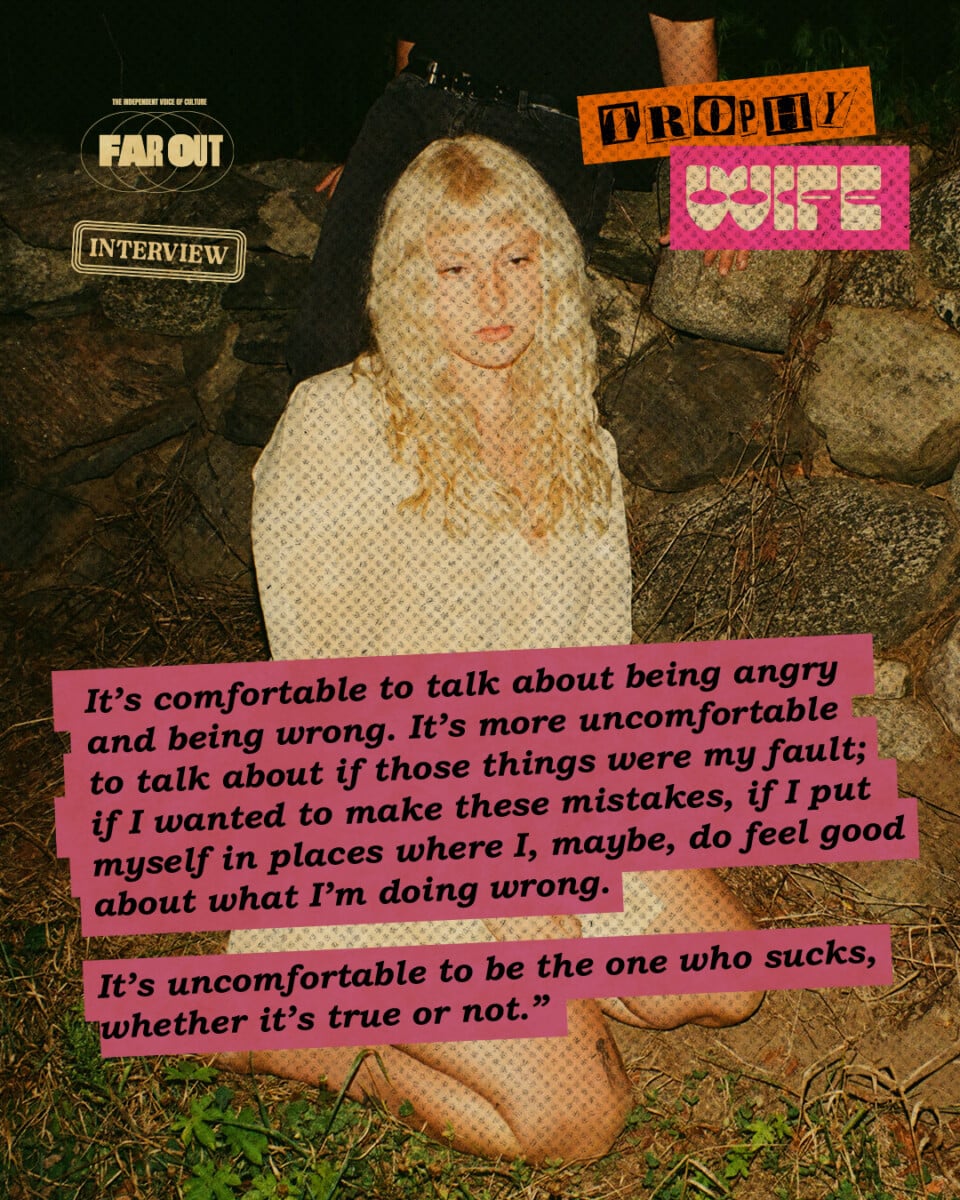
“It’s more comfortable to talk about being angry and being wrong. It’s more uncomfortable to talk about if those things were my fault; if I wanted to make these mistakes, if I put myself in places where I, maybe, do feel good about what I’m doing wrong.” She adds, with a knowing, self-deprecating laugh, “It’s uncomfortable to be the one who sucks, whether it’s true or not.”
Iazzetta places herself in the current female canon, in which more music seems to be embracing this searing self-excavation, or, in her words, is “crawling out of the girl boss mentality”.
We can place these thoughts in conversation with British indie group Lime Garden’s latest album, full of admissions of bitchy inner monologues, or even Charli XCX’s latest single, ‘Wink Wink’, where she plays up the cruel depictions of her shadowy morality as she sings, “Maybe I fucked your dad, just kidding, I’m only saying that for effect”.
Iazzetta has risen from the ashes of deflection into radical self-immolation: “I kept coming back to these painful situations. It made me so upset, and I kept trying to twist them in a new direction that made me the one on top… But I don’t know. You either throw it out or you throw it in when you’re feeling bad.”
No more obvious is this than on album opener, ‘Pervert Workaholic’, which sees Iazzetta chart the characteristics she desires in a partner. Predictably, it turned out to be a terrible list: “I want you, making eyes with the mirror, so self-consumed”. When she showed the track to bassist Pace, he quipped, “This song’s about you, right?” The ultimate conflation of victim and perpetrator welcomes us into a nightmarish, suffocating, and sinful world of lust, lies, and sacrifice.
The Good, the bad, the other
The Trophy Wife universe doesn’t exist in a vacuum. Rather, as we both attest to, it carries the weight of the worsening political landscape in the West. There is a fascist in office in the USA, and the influence of fascism is quickly seeping into the Commons over this side of the pond.
All of this to say that “there is an absence of grey area, now more than ever”, as Iazzetta told me the first time we met, “Either you’re good or you’re bad. And I don’t know that I’m good”. It’s a notion that stays with me throughout the year, as the boxes we are pushed into become smaller and further apart. Now, Iazzetta caveats her own admission with a kind of graciousness that’s a surprising discovery for Trophy Wife: “I don’t know that I’m bad, either”.
This, in many ways, is what the album is about: shifting power lines, doing your best and sometimes failing. I point to ‘Nesbit’, which sees the band unravel the dual pull of innocence and temptation, and Iazzetta expands, “If I keep ending up in these situations, maybe I’m the one pulling them in”. The single’s character is dolled up and lays a trap for those who usually ensnare her. How far can she fall into the licentious, devilish character she reckons with? “At the climax, we want to sound like I ate them,” she explains with a laugh. Her answer, then, is “As far as possible, then further”.
Iazzetta reveals that the song’s curious title relates to the horrifying story from the early 1900s of the teenage model and showgirl Evelyn Nesbit, whose controlling husband and rich socialite Harry Thaw murdered architect Stanford White in the rooftop cabaret atop Madison Square Garden in a “crazy duel” imbued by obsessive jealousy. She was “drugged up the whole time, and had no agency at all, but when the papers came out about it, they painted her as a beautiful supermodel seductress that’d driven the men crazy,” Iazzetta explains.
Nesbit’s dismal plight captures the consequences of blaming violent male desires on inadvertent female seduction.
It’s a theme picked up in the band’s music videos, too, inspired by Iazzetta’s collection of old Playboys: “We wanted everything to seem voyeuristic, we wanted to expose fantasies that you aren’t proud of”. In the ‘Paragraph’ music video, shot in her Bushwick bedroom, she spies on friends from her window and follows her bandmates with a camera. In the music video for ‘So Hard’, she looks on while men wrestle and tumble in the dirt for her affection.
In the slithering, murky basslines and the ripping, shivering guitars, the band sonically contends with the question of being good, bad, or a third, more complex thing. But, in all the mix-up, Iazzetta doesn’t quite leave room to trust herself: “I wonder if I am being vulnerable, or if I’ll notice down the line that I was spinning something.” What other way is there than to honour the dizzying complication and endlessly iterative human subject?
Throwing tantrums, breaking rules
It’s a wild time to be an artist in New York, what with the boom of punk-disco like The Dare and Fcukers, the rise in raggedy alt-rock like Geese. Still, no untoward influence has touched the independent band. They make their own music, they play their own songs, and any purposeful emulation comes from the past or from a sprawling palette of influences, including Tori Amos, Xiu Xiu, and Mitski.
“It’s about finding your own rules, so you can break them,” she explains, citing Nirvana’s In Utero as a core pillar for Pathetic.
We find a similar ethos at the mid-point of the album. “I want to tear it all down, or just stick to the plan. Am I so different babe? I just want what I can’t have,” she sings in ‘Paragraph’, which is as much about writing a love song as it is an anti-love song. Or on ‘Whatever You Want’, the most jovially sonic cut on the album, which purposely “ignores” the lyrical content. It’s a purposeful manipulation and subversion of musical tropes.
At some point, then, the music must explode. Often, as is the case with Trophy Wife’s esteemed Audiotree version of their 2022 song, ‘Leech’, Iazzetta ends up being the instrument manipulated to the point of fracture. She falls to the floor with shuddering shrieks, holding onto her fretboard like it’s the top of a crucifix. It looks both liberating and exhausting, so which is it?
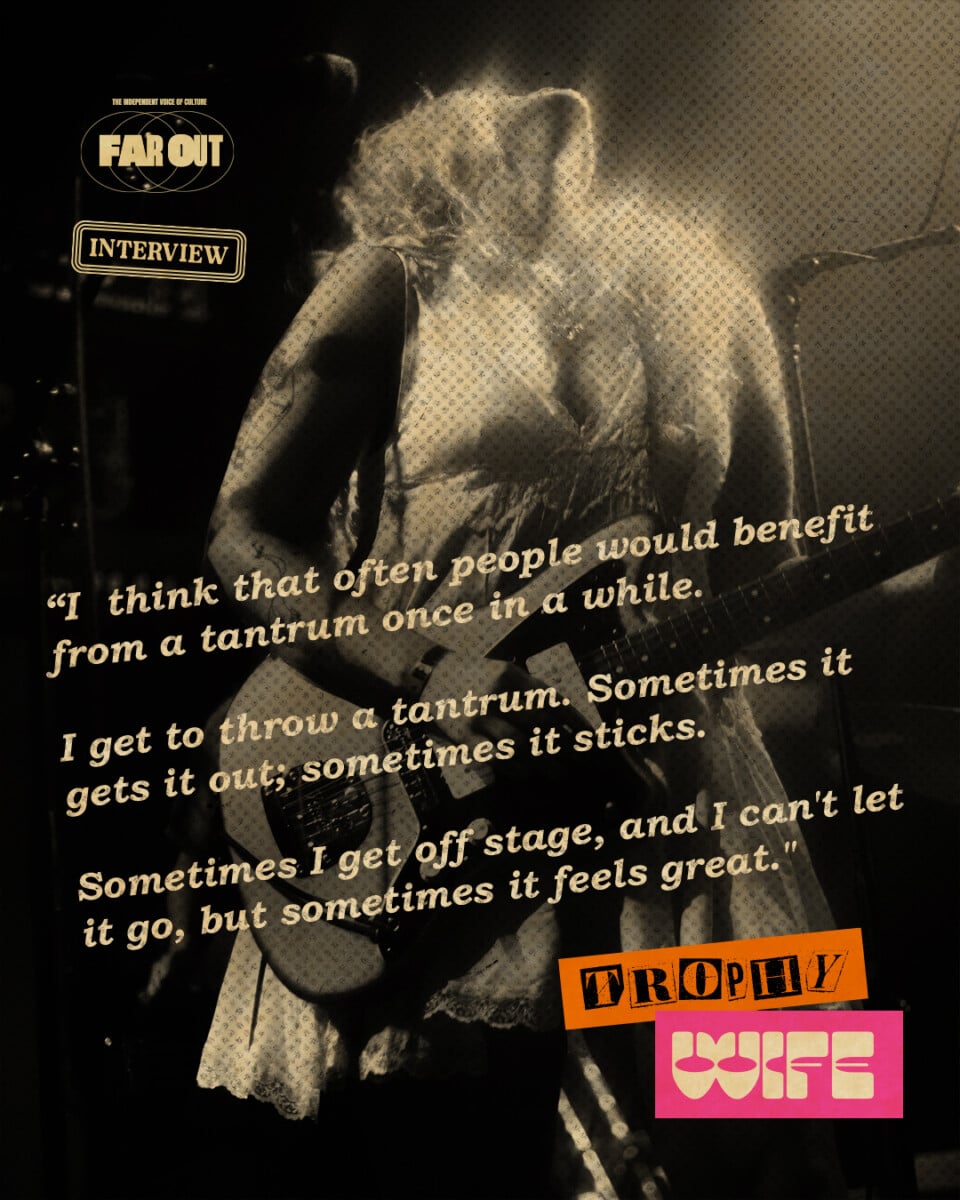
The chaos is controlled, she reassures me; the breakdown is, paradoxically, another way to siphon power. “I think that often people would benefit from a tantrum once in a while. I get to throw a tantrum,” she smiles, explaining that a sprawling array of emotions fires out in an onstage outburst, like a balloon fit to pop slowly thinned of its air.
“Sometimes it gets it out, sometimes it sticks. Sometimes I get off stage, and I can’t let it go,” but sometimes the rope snaps, and the band is soaring, blissfully unaware of the ground below. It’s a good job, because for Trophy Wife, the sky’s the limit.
