


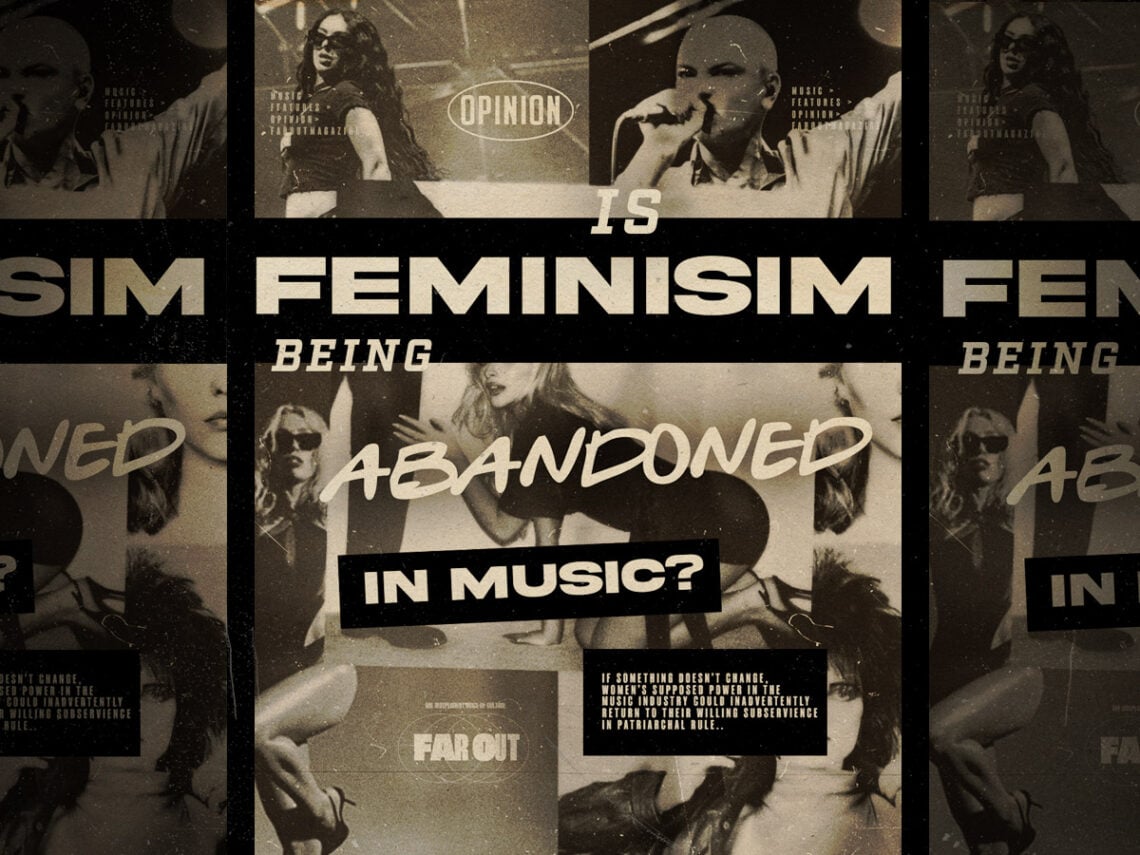
Is feminism being abandoned in music?

When Sabrina Carpenter announced the title and artwork for her forthcoming album Man’s Best Friend, it certainly hit the cultural zeitgeist—but maybe this time more with rotten apples, rather than critical acclaim. There she was, in all her blonde bombshell, sexy glory… yet on her hands and knees, being pulled up by the hair by a man’s hand, begging the question of whether this striking image is rooted in 2025 feminism or somehow back in the 1950s?
Naturally, given the firestorm social media world we live in, the provocative flames of the image were instantly fanned far and wide. Some were abhorred while others were allured, and on the whole, there was no clear consensus on whether Carpenter’s depiction of female subservience is reclaiming a sense of control or diminishing it. The album title, as well, Man’s Best Friend, you could take it as a piece of tongue-in-cheek dark humour, but the level of overt objectification seemed to be resurrecting horrific tropes of the past in the present.
This is not to vilify her or jump on a bandwagon of hatred towards the singer, because that approach doesn’t prove helpful to the discourse either. But her case does present the tip of the iceberg in what is potentially a mounting eruption of sexism that is rearing its ugly head back in the music industry. Where 30 years ago the scene was dominated by a rousing message of ‘girl power’, the path we are now facing is one of ‘girl degradation, but this change hasn’t been as sudden as you might think.
Cast your mind back to the feminist icons in music of perhaps the 1970s or 1980s. You had the likes of Debbie Harry, Siouxsie Sioux, Stevie Nicks, and the list could go on. Compare that to today, and although pop music in recent years has seen an invigoration of female artists, can you imagine any of them having as much generational sticking power as those aforementioned? Probably not.
“How can one be a woman and not be a feminist? That’s my question”.
Debbie Harry
For a scene that is seemingly at the moment being carried by women on the surface, it seems the deeper and deeper you travel down the rabbit hole, the more well-intentioned feminist principles are being skewed and left by the wayside in order to once again conform to one outdated archetypal image—a skinny blonde girl with boobs, a bum, and a pretty face, and nothing more.
The more you dig into the reasons behind this, certain juxtaposing standards become clear. We have lived through an age of around 15 years or so of women’s sexual agency taking hold of the mainstream of the music industry, and rightly so, but has this now gone so far as to being conflated or confused with objectification and degradation, as in the case of Carpenter?
Take the example of Miley Cyrus as a similar issue to this. Of course, for an artist like her, breaking out of the clean-cut Disney mould was bound to come with some collateral damage, but she, quite literally in some ways, burst out of that bubble with blazing force, as a way of well and truly leaving her Hannah Montana persona as a naïve relic of the past. The result was 2013’s ‘Wrecking Ball’, a song whose video stirred up its fair share of outrage as Cyrus sat naked swinging back and forth on a giant chained boulder.
Naturally, you would think the calls of objection would have come from parents whose young children had grown up with Cyrus as their role model, and while these still did ring loud and clear, some of the most prominent voices came from within the music industry’s own house. Sinéad O’Connor, for one, who had spent so long paving a way for other female artists, was among the first to speak out, resulting in a fiery social media spat with Cyrus.
“They will prostitute you for all you are worth, and cleverly make you think it’s what YOU wanted,” O’Connor said in an open letter to the singer, to which Cyrus responded by posting tweets O’Connor had made about her mental health struggles. It seemed like nasty business, but with the passing of time, something that the former child star came to change her mind on, as she recently said: “I responded in a way that I would never as an adult, but that was also an adult talking to a young person”.

That case proves just one example of young female artists feeling as if they have to use their bodies to form part of their brand, in a not-so-dissimilar way to what we are seeing now with the likes of Carpenter. It then falls to the veteran godmothers of the industry, like the dearly departed O’Connor, to try and illuminate these dangers before it is too late. But with a pop music scene so dominated with young women at the moment, the warning calls may be difficult to hear over all the noise.
It’s a plain fact that artists like Carpenter, as well as Chappell Roan, Charli XCX, and Taylor Swift are the current leaders of the game, but what has also emerged with them is a fanbase dominated by fellow women and young girls, which could also present problems in its own way. Don’t misconstrue this: women seeing themselves represented in music is obviously an extremely positive thing. However, when that is currently manifesting in the musicians onstage exposing themselves more and more, seemingly in the name of feminism, are we losing sight of the real point?
Feminism has never been about women being pressured to over-sexualise themselves in the name of equality. In fact, the very opposite has been the core tenet. Agency is centred on the principle of taking command of one’s own persona, and if that sometimes involves the body, then fine, but it shouldn’t make up the entire representation of it. Feminism in music has become confused with something far deeper and more sinister in women feeling that they are grappling for objective value, a notion made all the more stark when you consider the case currently dominating the courtrooms in New York.
Sean ‘Diddy’ Combs is facing trial for a range of sexual abuse offences which he denies, and although this is absolutely not to say that any of the alleged victims are in any way at fault, you can’t shake the feeling that the rise of women’s sexualisation in music runs concurrent to cases like this. Conservative values also have a role to play in both cementing and exacerbating the issue—women shouldn’t be forced to cover up, but equally, how can such tropes be avoided when you land in a case like Carpenter’s album artwork, which reeks of an uncomfortable relic of the past?
In short, there are no clear answers to the issue. For as long as female artists continue to reel in predominantly young female audiences, this state of affairs is bound to carry on, with pressure from the higher echelons of the industry pushing celebrities into presenting a certain sanctioned image that they paint as feminism and liberation. Time will only tell which of them is able to heed the warning calls, but if something doesn’t change, women’s supposed power in the music industry could inadvertently return to their willing subservience in patriarchal rule.
