


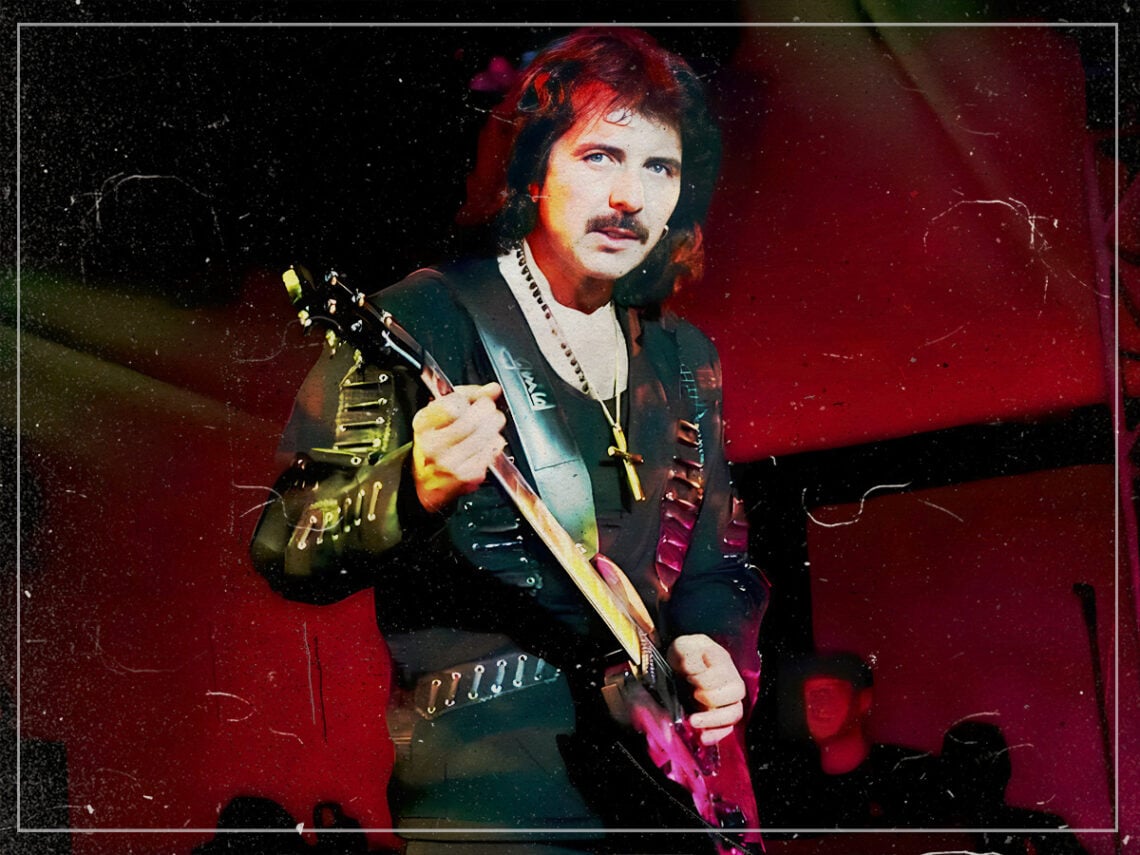
Tony Iommi on the best guitarist of all time: “Nobody can play like him”

In music history, genres often hit a sweet spot after several years of existence and refinement. In the case of heavy metal, Black Sabbath broke the mould at the very start with the perfect product. The self-titled debut pioneered a satanic corner of rock ‘n’ roll, and the Birmingham four-piece developed impressively over the ensuing three years. The follow-ups, Paranoid, Vol. 4, and Sabbath Bloody Sabbath, are all considered seminal classics of the genre. Throughout this exemplary run of albums, Tony Iommi chartered new territory for the six-string.
In Black Sabbath’s subsequent, more experimental and less critically acclaimed releases, Iommi showed development as a dextrous guitarist. Still, he will always be remembered for his simple yet effective solos that brought industrial grit and crucial structure to Sabbath’s early material. Closely rivalled by ‘Iron Man’, his most instantly recognisable riff is that from ‘Paranoid’, but it’s not one of his personal favourites.
Today, Iommi appreciates the riff as a Sabbath classic but regrets the rushed studio session and the ring modulation effect applied to the studio recording. “At first, I said, ’What the hell’s that? It sounds horrible!’ But [the label] went ahead and picked it as the solo that ended up on the record all the same,” Iommi told Classic Rock, adding, “In the great British tradition of keeping calm and carrying on, I’ve got used to it now.”
Iommi’s nuanced approach to lead guitar is influenced by an industrial accident he endured at age 17. On his final day working at a sheet metal factory in Aston, Birmingham, the guitarist accidentally cut off the tips of his right middle and ring fingers. Inspired by Django Reinhardt, the legendary jazz guitarist who lost two fingers in a fire, Iommi fashioned plastic prosthetic finger caps and detuned his guitar to reduce the pressure required to hold a fret.
Naturally, this accident hindered Iommi’s development initially, but over time, he became fully competent, tailoring his compositions to the ailment. Thus, his style was nuanced, but the simplicity of his iconic riffs wasn’t a necessity, as the virtuosic work elsewhere in the Sabbath catalogue attests.
Whether or not Iommi’s sheet metal accident was a factor or not, his virtuosity was limited, especially where speed was concerned. As the heavy metal genre evolved through the 1970s and beyond, new subgenres emerged, including speed metal and thrash metal. As these names suggest, some of the bands leading the charge boasted remarkably speedy guitarists.
One of the fastest left hands in town was that of Eddie Van Halen. The guitarist formed Van Halen with his brother Alex in 1972, taking a few leaves from Black Sabbath’s book. The band released its eponymous debut album in 1978 to a chorus of critical acclaim, reaching number 19 on the Billboard 200.
In March 1978, Van Halen embarked on their first world tour across North America, Europe and Asia. With many of their tour stops supporting Black Sabbath’s concurrent headline tour, the British stalwarts helped introduce Van Halen to a wider audience. “We took Van Halen on their first big tour,” Iommi recalled in a 2020 interview with Guitar World. “They were with us for eight months.”
Black Sabbath undoubtedly imparted much wisdom to the young Americans, but Iommi certainly didn’t need to teach Eddie any new tricks on the guitar. “Eddie was playing things I’d never seen before,” Iommi continued. “We’re still friends, and we became friends then. Of course, he set off a whole new load of players playing like that, and now I can’t believe some of them. I can’t follow it. I certainly couldn’t do it.”
Several months later, in October 2020, Eddie Van Halen passed away due to complications from throat cancer. Iommi was among the guitarist’s close friends to pay a public tribute. After lauding Van Halen’s unmatched talent and claiming that “Nobody can play like him,” Iommi reflected on their friendship of over 40 years. “I can’t stop thinking about it, to be honest,” he said mournfully. “It’s very, very sad.”
Watch Eddie Van Halen doing what he did best below.
