


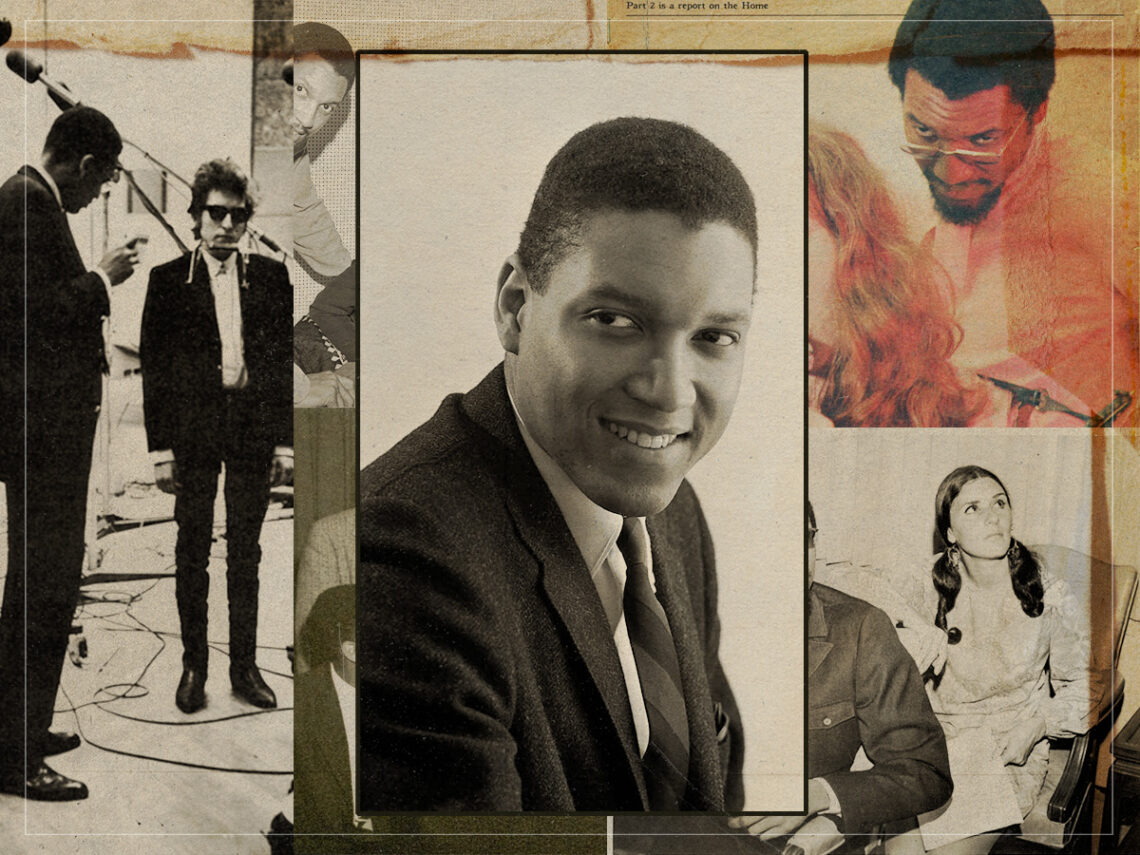
Tom Wilson: the unsung hero of the 1960s

Losing Tom Wilson to a heart attack in 1978 might just be one of the biggest tragedies in rock music, certainly one of the biggest in rock production. On a human level, there’s the fact that he went out at the tragically young age of 47, no age for anyone to leave us. On a musical note, losing a hero of 1960s rock before he could get his flowers stings intensely. This was a Black icon whose place in rock music of that time arguably stands toe-to-toe with Jimi Hendrix and Aretha Franklin and does so from behind the mixing desk rather than the mic.
To read Wilson’s production credits is to read a record of the way rock music developed from a teen fad into the dominant form of music in the late 20th century. He began as a jazz producer who assembled his own record label, Transition Records. There, he was the first to commit the music of Sun Ra to vinyl, among many other leading lights of jazz, like Cecil Taylor and Louis Smith. While never a money-spinner, the work he produced for the label got him a job as a staff producer at Columbia Records.
In 1963, he was assigned to work with up-and-coming New York folk musician Bob Dylan. After producing the two albums that catapulted him into the mainstream, The Times They Are a-Changin’ and Another Side of Bob Dylan, he worked closely with Dylan to bring his vision for the third album they made together to life. A fusion of traditional folk music with rock that turned the entire music industry upside down.
The resulting albums, Bringing It All Back Home and Highway 61 Revisited, didn’t so much succeed in making that fusion work as change the face of popular music forever. What’s more, that wouldn’t be the last time Wilson did that, as we’ll see from this list of the five greatest tracks that he produced. His character appearance in A Complete Unknown and an upcoming biopic of his own, reported by Variety to be titled after his greatest achievement, shows that the song of this unsung hero might just be about to ring out. So, let’s get in before everyone else!
The five greatest tracks produced by Tom Wilson:
Cecil Taylor – ‘Bemsha Swing’

While Wilson’s greatest discovery in jazz might be Sun Ra, he didn’t actually spend much time behind the console for the great man’s work. He worked on his debut album, Jazz By Sun Ra, but that was about it. Wilson did a lot more work for the great master of jazz piano, Cecil Taylor, and the opening track of Taylor’s debut album Jazz Advance shows just how forward-thinking their vision for his music was.
This version of the Thelonious Monk classic is raw, earthy and daring. At a time when mainstream jazz was lush and melodic, there’s something almost punkish in how stripped-back Taylor’s ‘Bemsha Swing’ is. One can almost hear the distance between Taylor’s piano and Denis Taylor’s drums, sharing the same microphone like close harmony singers. This uncompromising vision of jazz’s future wouldn’t come to fruition for another decade but, as is his wont, Wilson was far ahead of his time.
Bob Dylan – ‘Like a Rolling Stone’

Well duh. If you had a hand in one of the greatest songs in pop history, it stands to reason it would turn up on a list of your best moments. By 1965, Dylan and Wilson had been happily working together for two years. Having been assigned to work together by their record label Columbia, Wilson had always seen more than just a folk musician in the man born Robert Zimmerman.
In a 1976 interview with Melody Maker, Wilson claimed that in one of his first sessions with Dylan, he told the singer’s manager, “If you put some background to this, you might have a white Ray Charles with a message.” The seeds were sown with 1965’s Bringing It All Back Home. ‘Subterranean Homesick Blues’ and ‘Maggie’s Farm’ set up the pins that ‘Like a Rolling Stone’ knocked down in a strike that shook pop music to its core. Dylan has consistently credited Wilson as a key part of this, saying in a 1969 Rolling Stone interview that Wilson “had a sound in mind”.
Simon and Garfunkel – ‘The Sound of Silence’

While Wilson’s name was made through jazz music, his reputation was made through folk. His work with Dylan made an international hero out of the troubadour and a demigod in their adopted home of New York. Naturally, several more artists in the Greenwich Village folk scene were shunted Wilson’s way to work his magic, most notably Paul Simon and Art Garfunkel. A duo which, at the time, was regarded as a total joke by the hipsters of the scene.
As scene legend Dave Van Ronk infamously said, “For a while there, it was only necessary to start singing ‘Hello darkness, my old friend…’ and everybody would crack up.”
Despite this, Columbia thought there could be a hit in that very song, ‘The Sound of Silence’, and released the sparse folk track as a single. For a period of time, they were dead wrong. So much so that Simon and Garfunkel very nearly went their separate ways. This was until Wilson, inspired by The Byrd’s version of ‘Mr Tambourine Man’ and his own work with Dylan, re-recorded the song with electric instruments without telling the band or the label. This version of the track worked out pretty well for everyone involved, hitting number one on the Billboard Hot 100.
Frank Zappa and The Mothers of Invention – ‘Trouble Every Day’

No matter how many pop hits he made for New York folk artists, though, Wilson was an avant-garde artist at heart. Every decision he made was with one eye on pushing the mediums he was working in, and once he had the pop hits with Dylan and Simon and Garfunkel under his belt, he went searching for a new sound. Fortunately, he was looking at the exact same time psychedelia was becoming the biggest and most exciting music movement on the planet on the other side of the country.
When checking out the Los Angeles hippie scene, he happened to attend a concert by Frank Zappa and his newly christened The Mothers of Invention. Wilson was so impressed by what he heard he got them a record deal and personally produced their first album, Freak Out! Placed in prime position as the opening of the second half of the album is the song that convinced Wilson to sign the band—their blues rock protest song ‘Trouble Every Day’. Wilson’s vision of the song retaining every inch of that dark, dangerous, yet effortlessly catchy swagger that captured his imagination during their live show.
The Velvet Underground – ‘Sister Ray’

By this point, though, Wilson was a dyed-in-the-wool New Yorker, and LA couldn’t keep him too long. Once he was back in his adopted home city, he went searching for a band that was making similarly forward-thinking alternative music, and he arguably found the first true alternative rock band. At the time, The Velvet Underground had a famous patron in the form of Andy Warhol, but their brand of bleak, avant-garde proto-post-punk was so far ahead of their time that no label would touch them with a ten-foot pole. Wilson, who’d just started a new job with MGM, got it entirely, though, and signed them on for a record deal.
While Warhol was the credited producer for their debut album The Velvet Underground & Nico, the true brains behind the desk was Wilson. Upon the release of their second album, White Light/White Heat, Wilson took a deserved place as the sole producer of the record, a position he took to so well that John Cale himself would later say, “The band never again had as good a producer as Tom Wilson.”
The record’s opus is the 17-minute jazz-noise thrash ‘Sister Ray’, a piece that arguably sees Wilson connect the two disparate sides of his discography together. He managed to connect the avant-garde with rock and roll in one of the most influential and progressive songs of the 1960s.

Never Miss A Tale
The Far Out Bob Dylan Newsletter
All the latest stories about Bob Dylan from the independent voice of culture.
Straight to your inbox.