


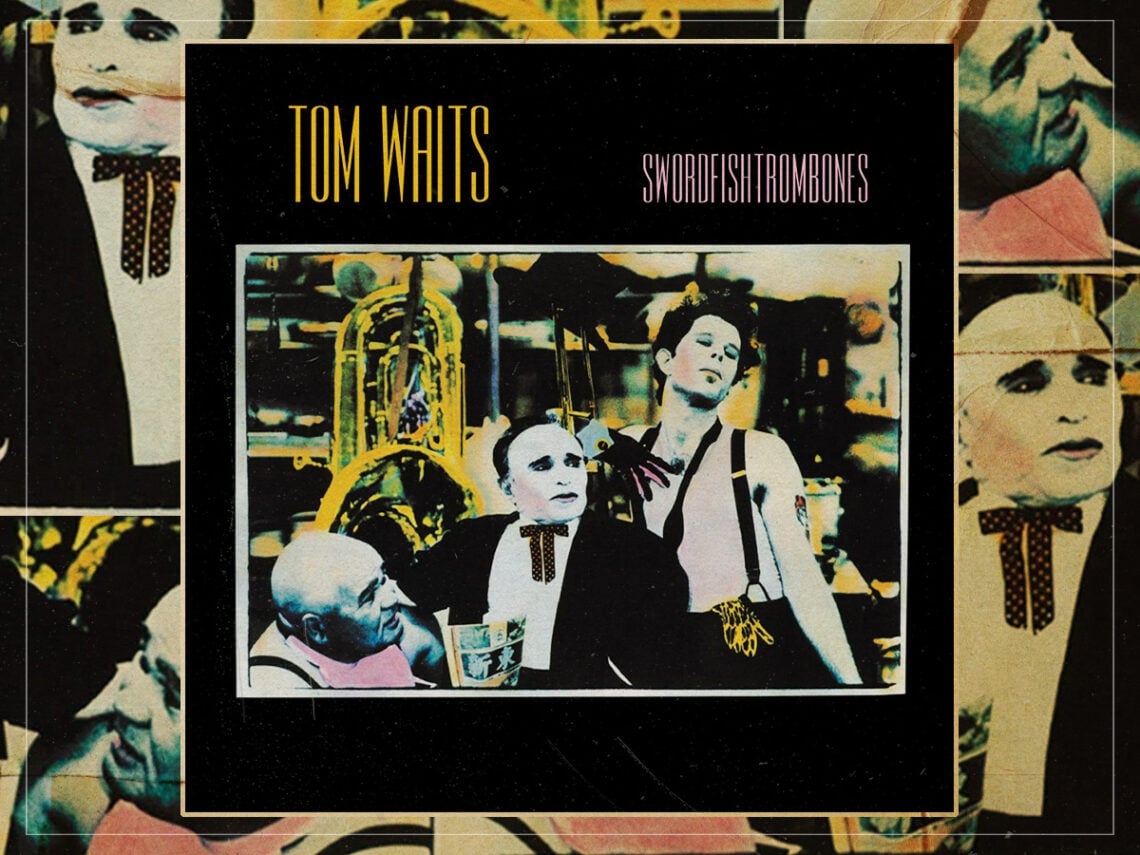
Who are the two men with Tom Waits on the cover of ‘Swordfishtrombones’?

Tom Waits had never been an artist with the primary ambition of following any sort of trend, or of blending in with any particular crowd, but even by his already weird and wonderful standards, his 1983 album Swordfishtrombones was a drastic and unexpected change of creative direction. He had come dangerously close to being pigeon-holed and pastiched by his own character as the 1970s slowly turned into the ’80s. He was the scratchy-voice jazz-bo who sang about down-and-out bums on the Bowery, greasy eggs and bacon for breakfast, and bourbon for dessert.
Intuitive fans would have noticed that he was reaching for a new sound on his 1978 album, Blue Valentine, and that he leaned further into that rockier, more guitar-oriented style with the 1980 follow-up, Heart Attack and Vine, but even they wouldn’t have guessed just how weird things would get by the time his next studio album proper came around (not counting the soundtrack album recorded with Crystal Gayle in-between).
The first clue that something was different should have been the title—just what the hell was a Swordfishtrombone anyway?—and the second was the cover.
Waits’ album covers were usually pieces of artwork in their own right, and each one told its own story, as well. They featured highly evocative shots of Waits in various moods and in various environments, like standing alone in the spotlight, under a gently lit-up clock and next to a darkened upright piano on the cover of Closing Time or else turning in his seat at a booth on the front of Nighthawks at the Diner. Is he turning away from someone he doesn’t want to be recognised by, or turning to get the attention, and maybe even the number of the waitress, or getting ready to leave and head out into the darkness?
On the front cover of Small Change, he’s scratching his head, wondering where it all went wrong, or at least, just where it went at all, while behind him, in the dressing room, mirrors are lit up and cigarettes are waiting to be had. There’s a selection of glittery dresses hanging from the doorframe behind him, languidly waiting for the topless model he’s turned away from to choose to wear. Maybe she won’t wear any of them. He doesn’t seem to care one way or the other.

Despite the different stories they told, most of Waits’ covers in his early career shared a similar muted palette. They were dark, down-low, and dirty, just like all the characters in his songs. But the cover of Swordfishtrombones jumps out at you. It bursts with vibrant colour; although, the longer you look, the less you’re sure whether the colours are even there at all, or if you’re just filling in the gaps with your mind.
In the photograph shot by Michael A Russ and treated with the cameraman’s trademark TinTone style, Waits is translucent—ghostlike and vanishing. Looking like he is disappearing before your eyes, with the only definition to him lent by the shadow lines that mark his eyes, his hair, his nose and the hair under his lip. A smudge of red blush streaks down his cheek. He looks like he’s stepped out of a cartoon carnival, or a cabaret of the underworld.
He’s joined on the cover by two more members of the carnival cast. While Waits looks like he is frozen in time, dancing to the tune of his own parade, the two men to his side are each taken with worlds of their own. Each is as ghostly as Waits, and just as haunting.
But who are the two men with Tom Waits on the album cover?
One of the men is Hilo Lee Kolima, who had worked as both a professional wrestler—variously competing under his name and others such as ‘Great Toto’, ‘Hilo Kolima’, ‘Kubla Khan’, ‘Lee Kalima’, and ‘Royal Hawaiian’, winning 28 out of his 149 bouts—and later as an actor. He made his theatrical debut in 1965 in the television series Voyage to the Bottom of the Sea, and later starred in a string of villainous roles in various spy shows, as well as in a spy-spoof episode of the musical sit-com The Monkees. His final role would come in the comedy vehicle Cannonball Run II, the year after Swordfishtrombones was unleashed upon the world.
The man in the middle of the album cover is actor Angelo Rossitto. Rossitto, who was born with dwarfism and stood at 2ft 11″, worked in silent films opposite the likes of Lon Chaney and John Barrymore, and also featured in well-known movies such as The Wizard of Oz (1939) and Samson and Delilah (1949), as well as plenty with titles that could easily have been Tom Waits songs themselves, such as While the City Sleeps (1928), The Corpse Vanishes (1942), The Spider Woman and Lady in the Dark (both 1944), Jungle Moon Men (1955), The Story of Mankind (1957), The Wild and the Innocent (1959) and ‘Town With No Cheer’. Wait, that last one actually is a Tom Waits song.
Rossitto also featured on the album art for Bob Dylan’s 1975 release The Basement Tapes, alongside The Band, Dylan and his dog, David Blue and a troupe of characters who seemed like they had stepped right out of the songs themselves.
